The Death of Previsualization?

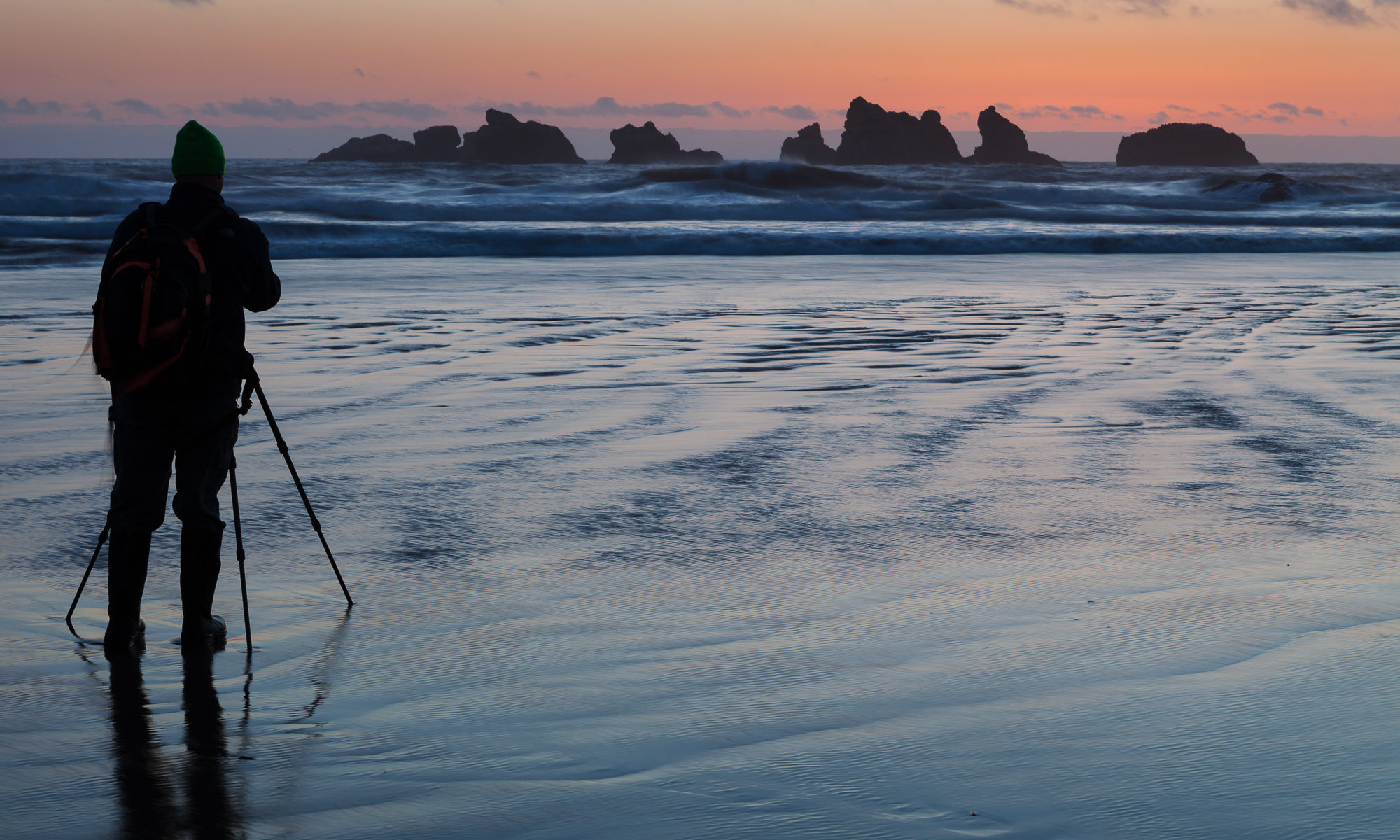
A photographer stands in shallow water filming a fleeting sunset

Last week’s post about Yosemite’s natural firefall got me thinking about the late, great adventure and landscape photographer Galen Rowell. A topic that he wrote about often was the importance of pre-visualization in photography. That is to say, as a photographer, it is important to “pre-visualize the way the image will look on film before you take the photograph, instead of merely taking a snapshot with the naïve expectation that the outcome will be like you see.”

As I was learning the craft of photography, I always took this teaching to heart. But is the idea of pre-visualation as important today as it once was? Rowell was emphasizing the importance of understanding how each specific film type captures light and is processed into the resulting photograph.  Very few of us still shoot with film, so does the same concept hold true in the digital age?

As anyone who has learned photography with a digital camera can attest, being able to see the results of your work instantly in the field greatly accelerates the learning process. In other words, if you get the settings wrong when capturing an image, in most cases you can review the image, correct for any mistakes, and shoot again. The necessity of understanding how the camera sensor will capture the subject is diminished.  Of course, this may not hold true with certain types of action or event photography, as you might miss that critical moment.  But even with wildlife, I often take a few sample shots and review them to make sure my settings are in the ballpark of correctness.

The need for this type of pre-visualization falls apart even more when moving from DSLR to mirrorless photography. Mirrorless cameras have an electronic viewfinder, allowing the photographer to see a “live” view of exactly what the camera’s sensor sees. Here the photographer knows exactly what the image will look like before ever pressing the shutter.

So maybe Rowell’s original reasons for the need to practice pre-visualization have faded over the years. However, not all digital photographic results are directly correlated to what the photographer sees on the back of the camera. If the photographer is truly thinking digitally, they may be overexposing in order to capture more digital information in their final photo (exposing to the right). Or they may be thinking about capturing certain elements of the frame to use later in digital blending. Using techniques such as exposure blending, panorama stitching, or ISO blending all require some degree of pre-visualization of the final intended outcome.

Although the need to understand how the camera settings ultimately interact with the specific film you are using may no longer be valid for most photographers, the need to understand what you are trying to create and how to control the camera in order to achieve that vision may be more important than ever. The tools may have changed (film vs final digital output), but the concept is the same. The better you understand what you’re working with, the more predictive you can be about your desired outcome, and therefore, the better you’ll be able to prepare for that desired result in the field.

Gear I used to create the photos in this post:
Yosemite’s Natural Fire Fall

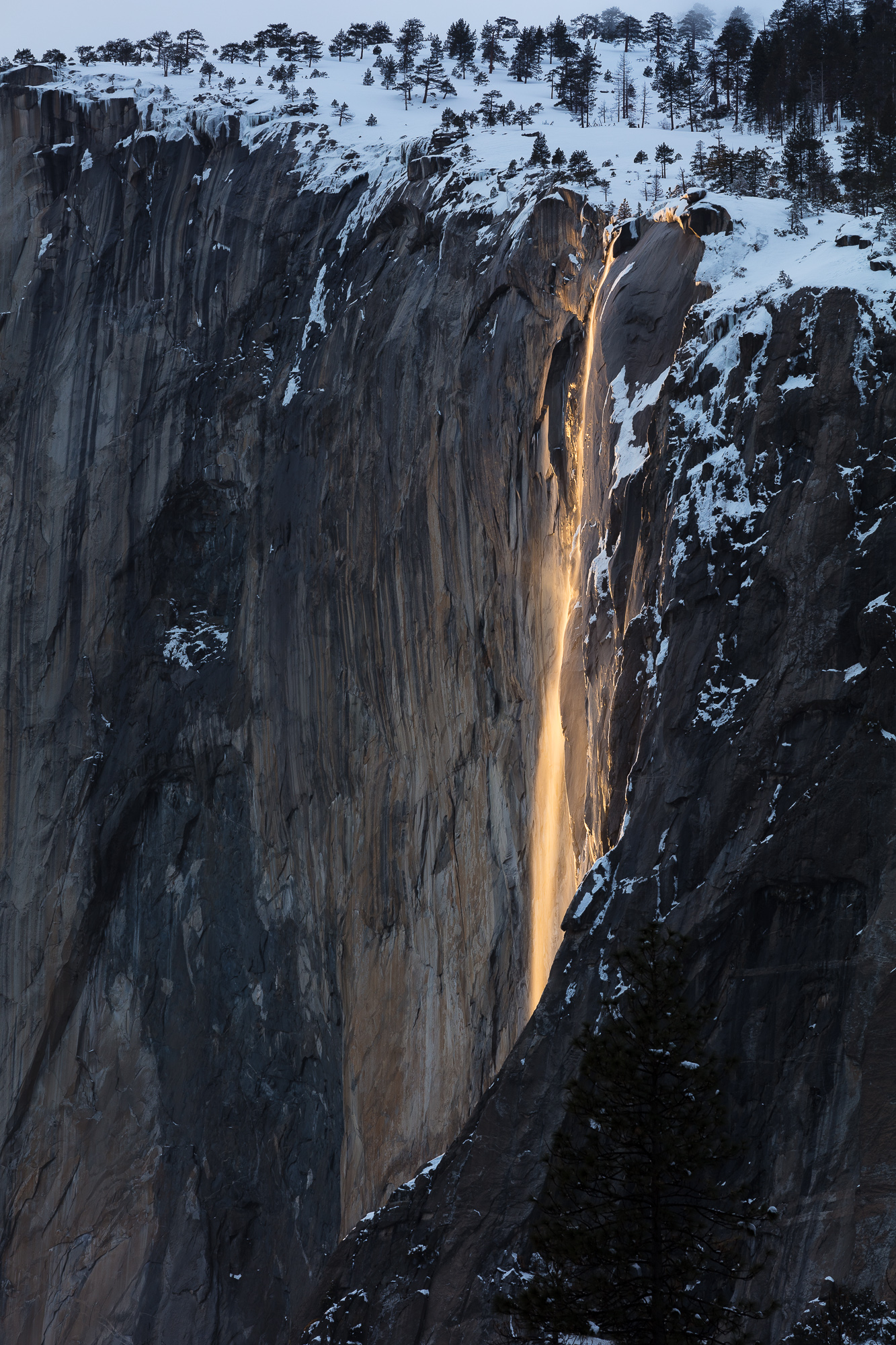
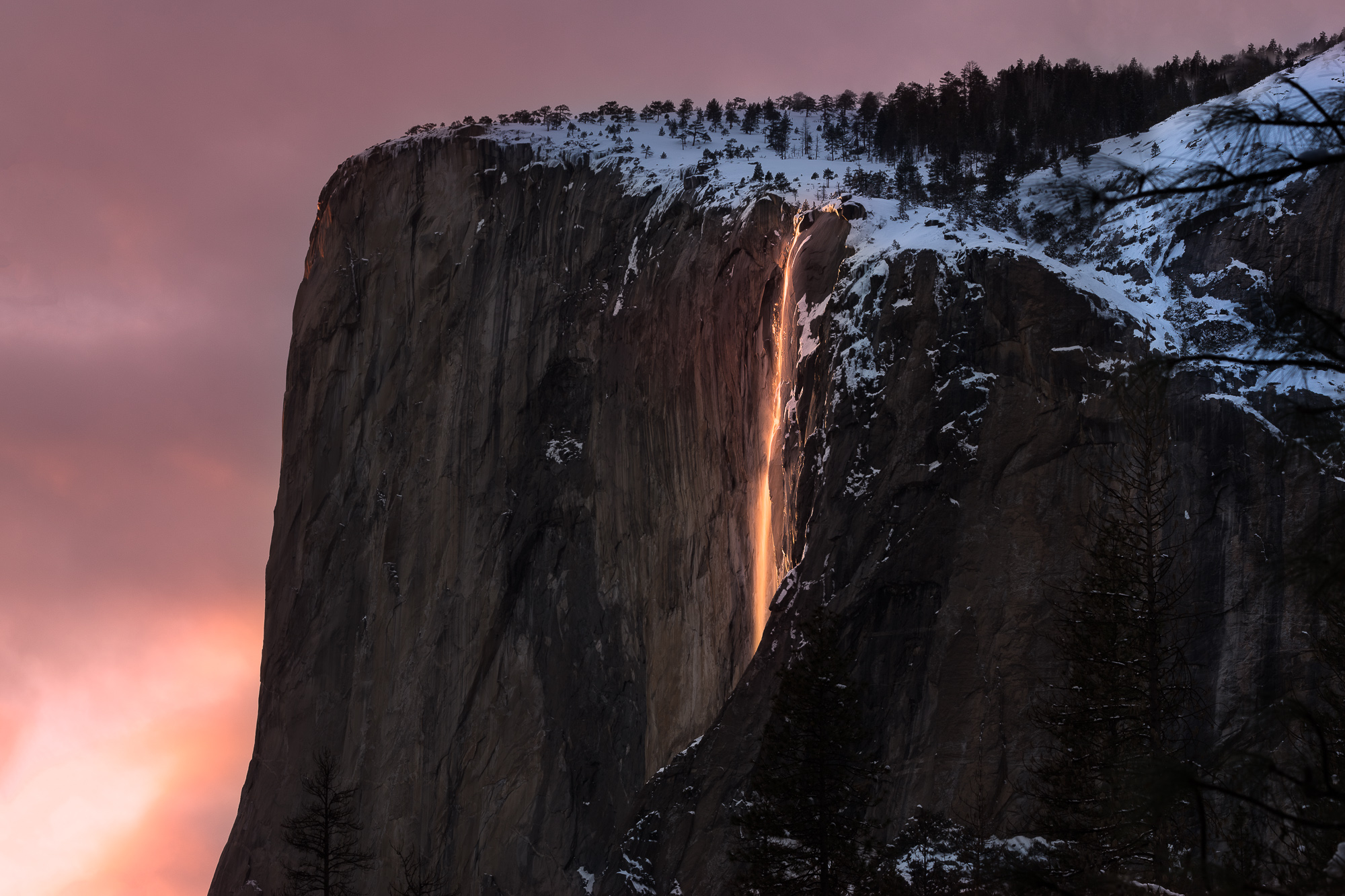
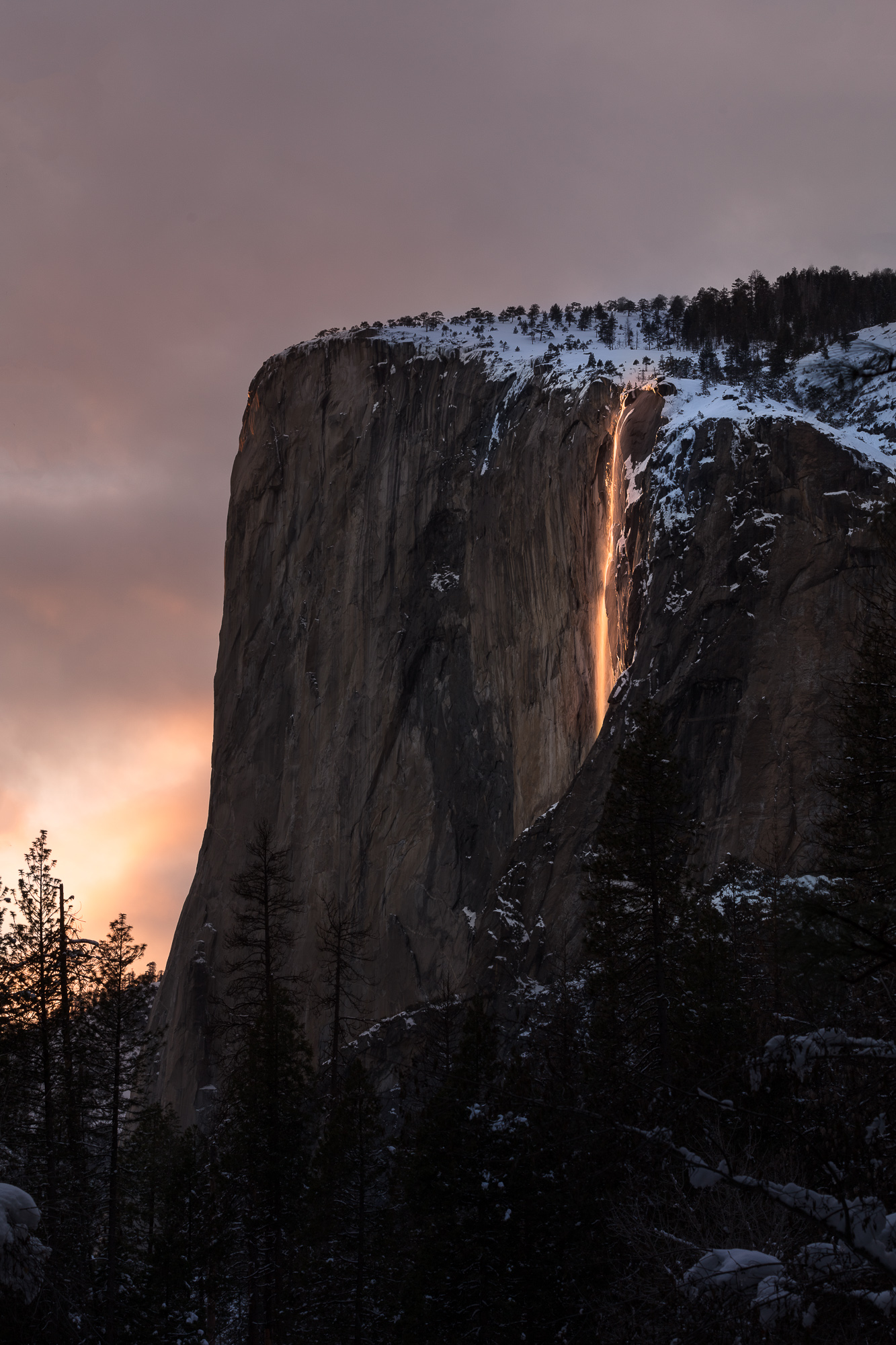
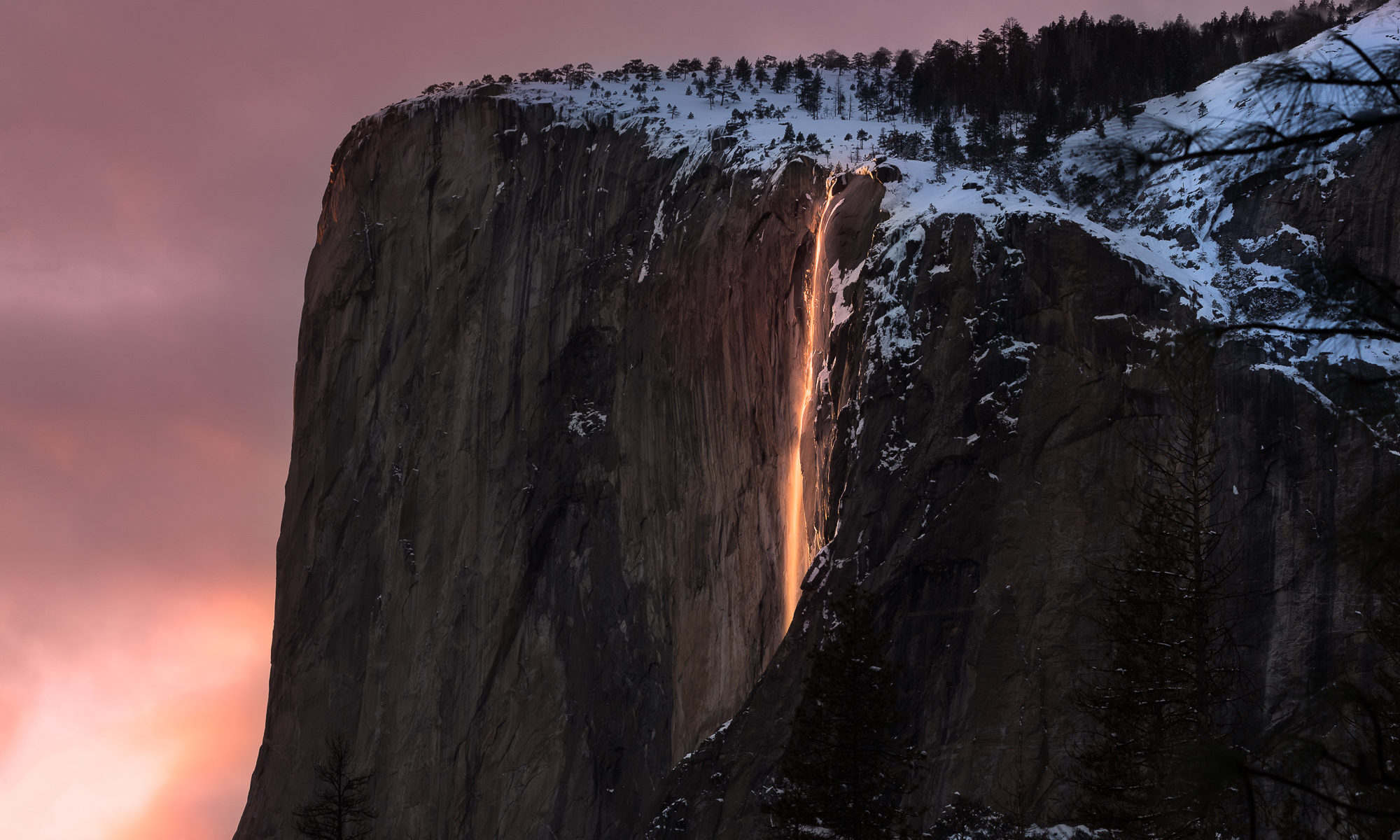
For only a few days a year, the setting sun lights up the seasonal horsetail falls, cascading down the sheer face of El Capitan in Yosemite National Park.

A couple of weekends ago, I had the opportunity to witness one of nature’s most spectacular light phenomenons. For only a few days of only some years, a seasonal waterfall in Yosemite National Park glows like lava as it catches the last rays of waning sunlight. I had long wanted to witness this event in person, but timing or weather had thus far made it impossible. Luckily, my good friend Steve was on the ball, and invited me along. He had already taken care of all the logistics (thank you Steve!) and all I had to do was pack for snow and show up.

Snow covers the floor of Yosemite Valley after a winter storm.

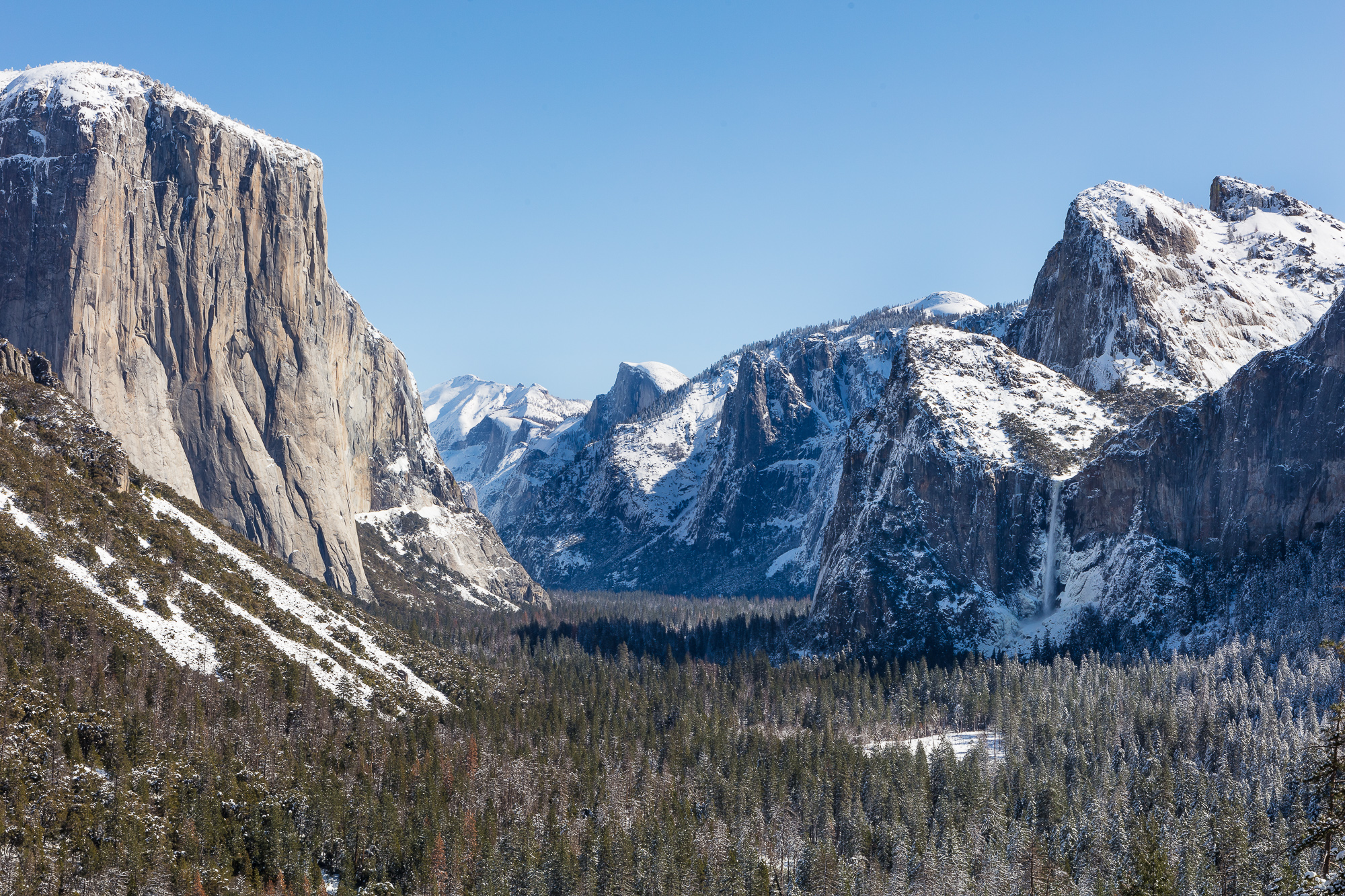
After a morning drive to Yosemite from the San Francisco Bay Area, we soon found ourselves in one of the most beautiful valleys on Earth. A recent storm had dropped several feet of snow on the ground and frosted the landscape, accentuating Yosemite Valley in all it wintry glory.

Snow covers the floor of Yosemite Valley after a winter storm.

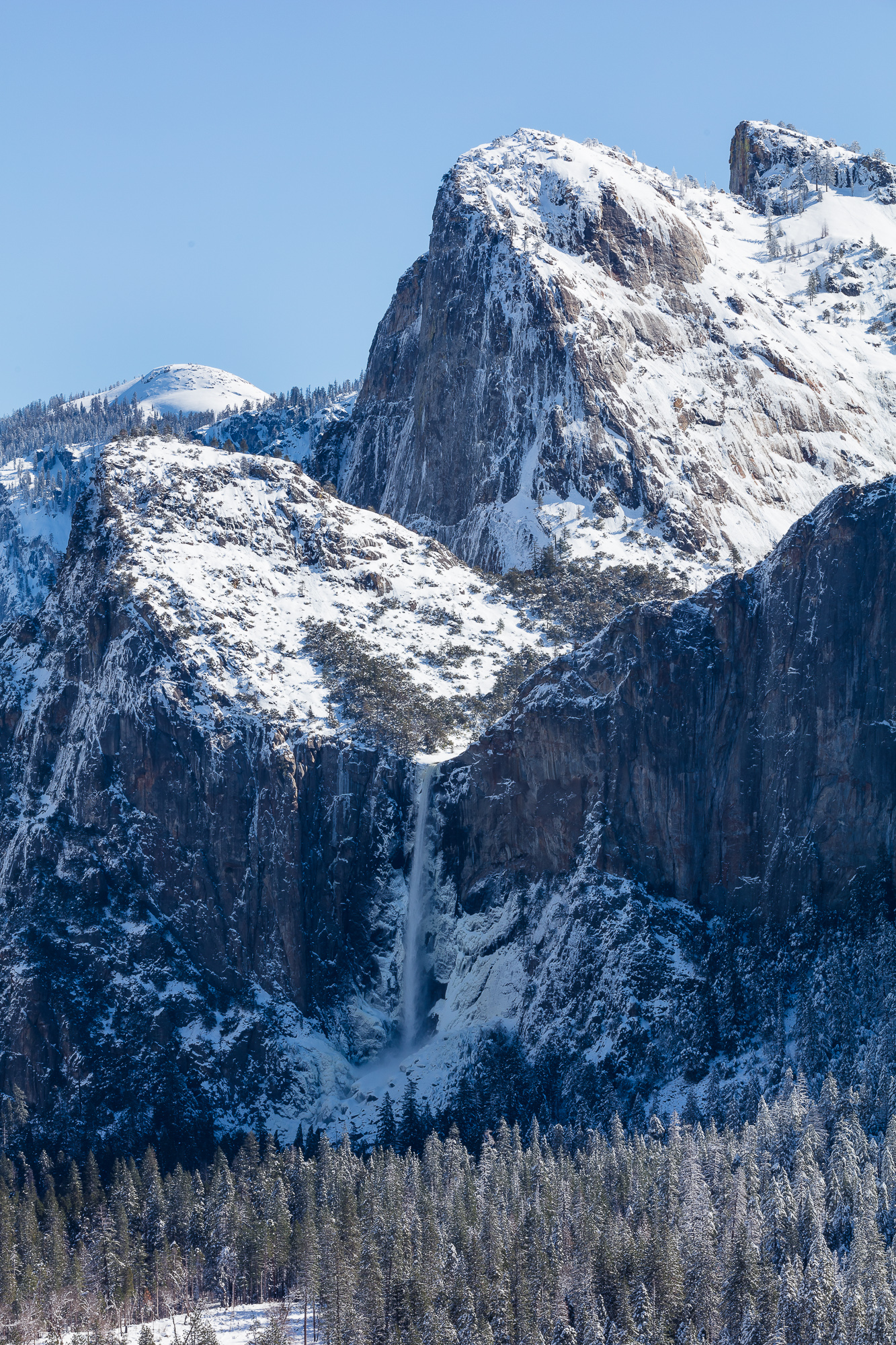
As I often do with grand vistas, I not only captured the standard landscape shots, but also used my telephoto lens to find scenes within the scene. Switching to my 70-200mm allowed me to isolate Bridalveil Falls cascading down icy cliffs.

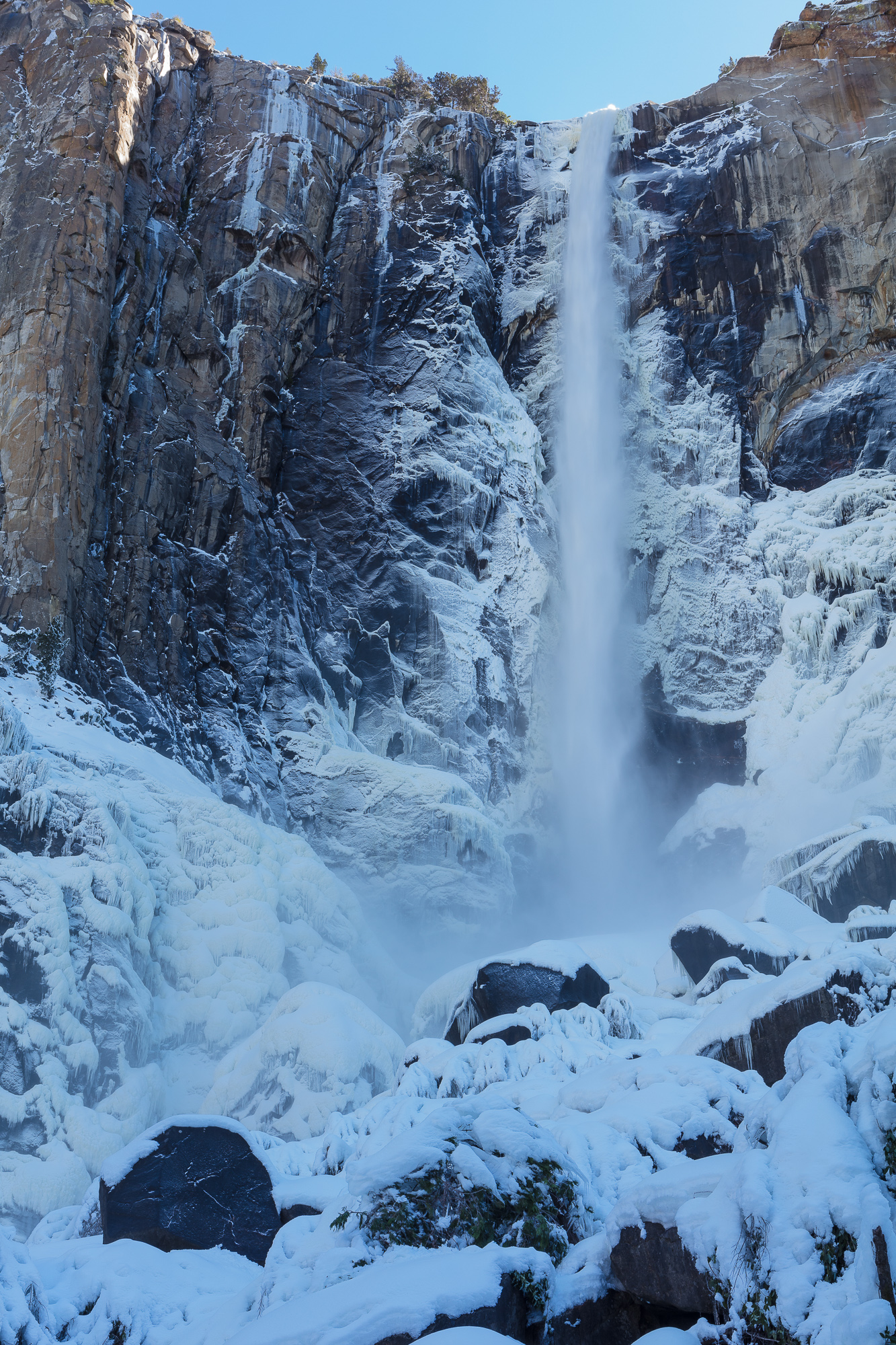
Bridalveil Falls forms an icy sheen on the rocks below, Yosemite National Park, CA.

We stopped off at the Bridalveil Falls trail and scrambled up the slippery path to the base of the falls. Here it became a frigid dance of setting up a shot on the tripod, wiping the icy spray that had accumulated on the lens, and quickly firing a shot. Many times the same shot had to be repeated due to poor wiping skills. Being able to immediately review each shot on the back of the camera was essential for success. With deep respect, I thought of the many photography legends who likely stood in this very spot using much more challenging gear.

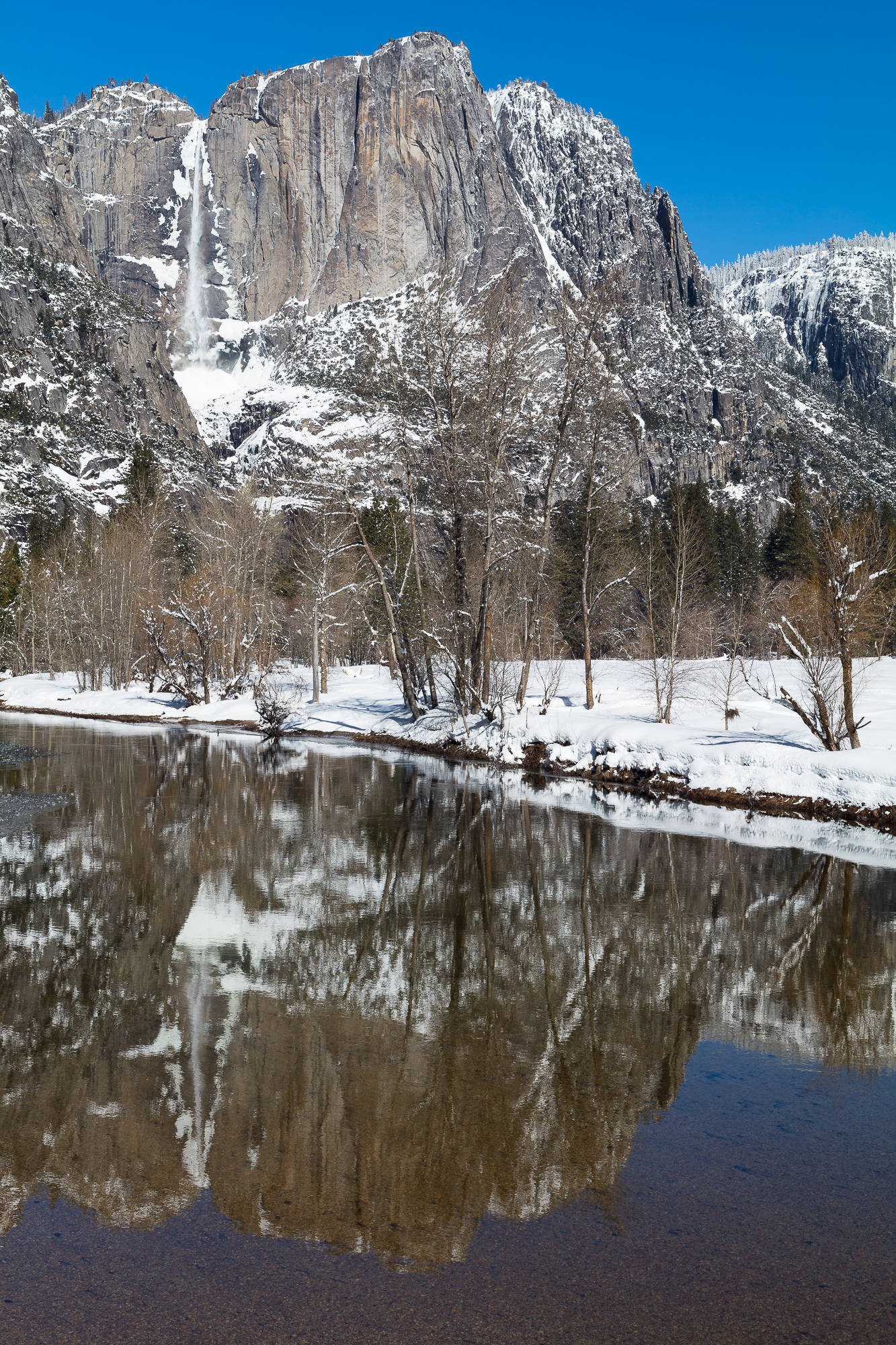
Yosemite Falls is reflected in the calm water below, Yosemite National Park, CA.
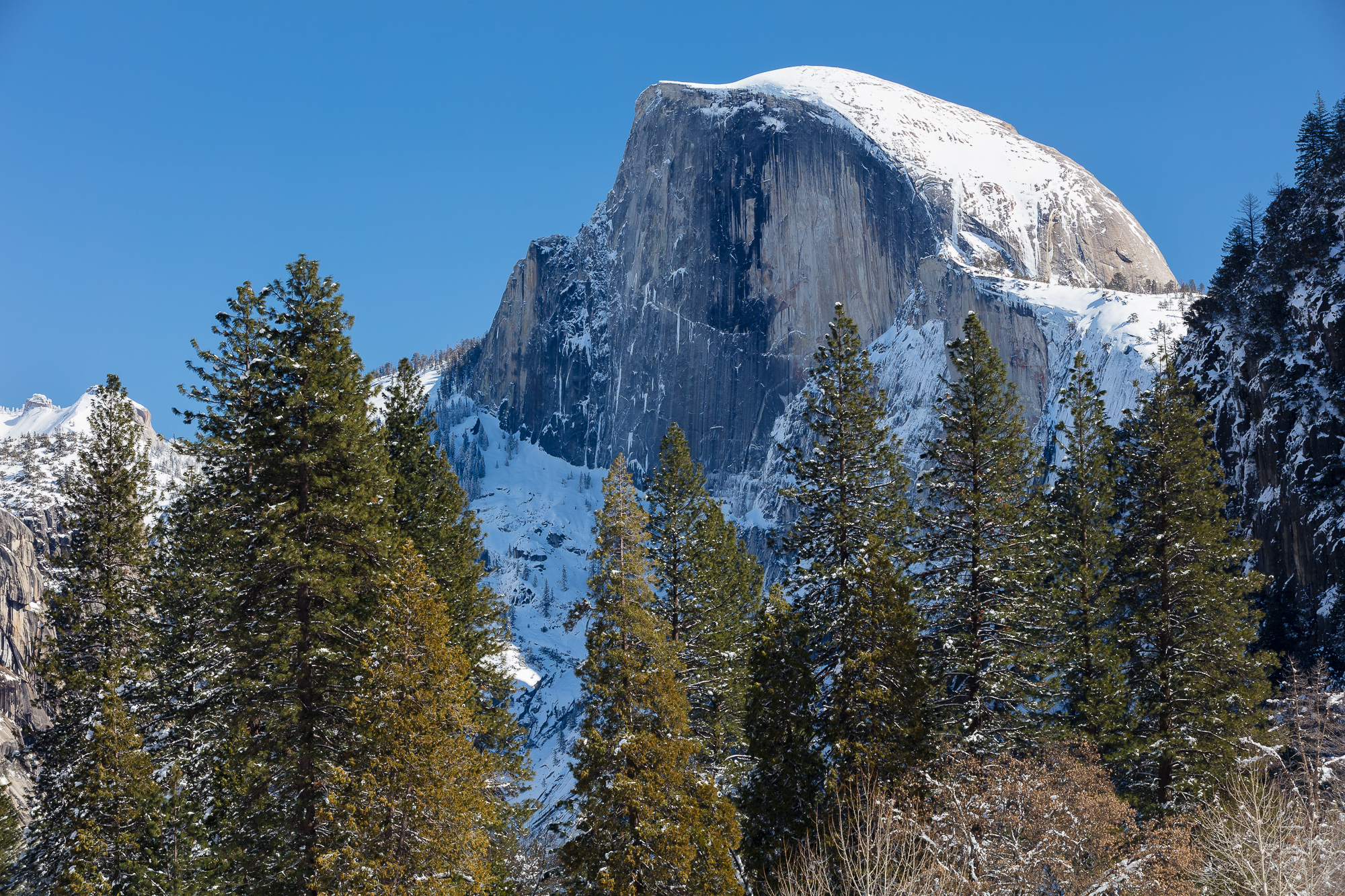
Half Dome towers above Yosemite Valley in winter.

Throughout midday, we were able to capture some of the valley’s most famous icons, dusted in powdery snow.

Finally it was time to prepare for the main event. Many parking lots in Yosemite Valley were closed due to the several feet of snow on the ground. We parked at the closest lot and then snowshoed about a mile to the principal location at which the fire falls phenomenon could be viewed. We set up cameras and tripods at around 2pm, and waited until sunset, which we wouldn’t see for another three and a half hours (yes, landscape photography requires patience!).

For only a few days a year, the setting sun lights up the seasonal horsetail falls, cascading down the sheer face of El Capitan in Yosemite National Park.

Finally, just after 5pm, Horsetail Falls came to life. Starting with an intense yellow, the falls turned to orange lava over the course of ten minutes.

The story of the original Yosemite “fire falls” goes back to the early years of the National Park Service, at a time when it was struggling to define the meaning of “attraction” for park visitors.  One popular sentiment of the day was that the parks had to entertain visitors, much in the way a circus would entertain audiences through spectacle.   As much of the nation was still rural, the idea of simply having access to wilderness was not as precious as today.

For example, when black bears began to raid the poorly maintained Yosemite Valley dump where all food scraps would end up, the first thought was not the safety of the wild bears. Instead of building proper barricades to prevent the bears from habituating to human food, the park service built bleachers around the dump so that visitors could watch the action.  Another such misstep was the nightly building of a large bonfire at the top of Glacier Point.  As the fire burned down, the embers were shoveled off the cliff, creating a “fire fall” to wow the crowd below in Curry Village. Thankfully this practice was eliminated in the early 1960s. Little did people realize that nature was already providing a much more spectacular display of its own.

For only a few days a year, the setting sun lights up the seasonal horsetail falls, cascading down the sheer face of El Capitan in Yosemite National Park.

In 1973, photographer Galen Rowel was coming back from a climb in the valley when he looked up and saw a stunning light display against the shadowed backdrop of El Capitan.  Amazed at what he saw, he rushed to photograph it, only to see the light disappear before his eyes.  Although he didn’t know if he’d ever see something like that again, the next night he was prepared.  Sure enough, around the same time of day, Horsetail Falls (a seasonal waterfall that only flows with the proper amount of snow melt) lit up like a beacon.  He quickly composed an image that would become famous, and introduced the world to this amazing natural “fire fall”, which is now photographed by hundreds of photographers annually.

For only a few days a year, the setting sun lights up the seasonal horsetail falls, cascading down the sheer face of El Capitan in Yosemite National Park.

What Galen Rowel was seeing was the setting sun striking only Horsetail Falls, isolating it against the dark cliffs of El Capitan.  There is only about 10 minutes per day where this contrast can be seen, turning the water a reddish orange just before the sun dips over the horizon.  In addition, this perfect sun angle that is required to light the falls but not the cliff only happens twice a year for a few days at a time. And only in late February is there a chance that Horsetail Falls is actually flowing.  This explains why this natural “fire fall” was such a rare occurrence before anybody knew to look for it.

I was overjoyed to finally witness and photograph this phenomenon for myself.

Gear I used to create the photos in this post:
Copyright 2017 Hank Christensen