Recent Publication – Bay Nature October 2016

Image of a California Condor in Pinnacles National Park used for an article about the rehabilitation and release of Condors.

Run to your local news stand and grab the current issue of Bay Nature. There is an article on California Condors that features one of my photos taken of a condor in Pinnacles National Park. This is a popular release point for these birds bred in rehabilitation centers, and the rocky area has proven a successful wild breeding area. As there are less than 300 of these birds in the wild, each is given a wing tag with a unique tracking number, and a radio transmitter.

A California Condor perches on a branch in front of a rock wall, Pinnacles National Park

The condor feature in my photo had a wing tag of number 340, which allowed me not only identify this as a male, but also get some detailed information about the bird’s history from the National Park Service:

Upon arrival at the Pinnacles flight pen, 340 was by far the most active and aggressive juvenile. Perhaps he was aware of his distinction in being the first chick produced by the Oregon Zoo, where he hatched on 5/9/04. As a culturally significant species to the Wasco tribe, the honor of naming 340 was given to Chief Nelson Wallulutum, who named him Kun-Wac-Shun, meaning Thunder and Lightning.

After his release at Pinnacles in 2005, 340 started to expand his range and quickly ascended the dominance hierarchy. He is outfitted with a GPS tag and has taken flight within 50 miles of the Bitter Creek National Wildlife Refuge condor release site. His continued exploratory flights make him valued within the flock for his ability to lead others to new areas. During the winter of 2013, he began courting Ventana Wildlife Society (VWS) condor 444. Unfortunately, 444 died due to lead poisoning in the summer of 2014. As a high ranking male, 340 found a new mate in VWS condor 236 and they are currently nesting within park boundaries, raising their chick, 828.

https://www.nps.gov/pinn/learn/nature/profiles.htm

It is an honor to view and photograph these gigantic and extremely rare birds.

Sunset Over Damaraland

One of my favorite locations I visited in Namibia was the Damaraland region. I was staying at the Mowani Mountain Resort – a collection of beautifully architected bungalows settled in among giant boulders. Each structure was connected by a series of footpaths, and situated so that each room felt completely isolated. I felt as though I had the entire landscape to myself.

The Damaraland region of Namibia is very dry, and features an occasional white-barked tree growing from the rocks.

The surrounding desert was composed of hard sandy soil and large red rocks. It was occasionally accented by gleaming white-barked trees that popped out of the rubicund scene.

The setting sun turns the boulder strewn landscape surrounding the Mowani Mountain Camp a burnt red, Twyfelfontein, Namibia.

The low sun lit up the rocks all around me, accentuating the ruddy hue.

Godrays stretch out from the sun setting over the African desert region of Damaraland, Twyfelfontein, Namibia.

Luckily there was an interesting cloud bank to the west, blocking the sun and allowing its light to radiate into strong beams. The only element missing was a herd of desert-adapted elephants roaming the desert floor.

Godrays stretch out from the sun setting over the African desert region of Damaraland, Twyfelfontein, Namibia.

I had two camera bodies with me for the shoot, one mounted to a tripod with a medium zoom (24-70mm) and the other with a telephoto zoom (100-400mm) which I was hand holding. This way I could capture the larger scene with the tripod, and still shoot the sun’s transition through the western clouds as a dominant subject with the telephoto. The photo above was taken at 170mm, emphasizing the sun’s rays breaking through the clouds.

Twilight decends upon the landscape of Damaraland, Twyfelfontein, Namibia.

After the sun had set, the landscape radiated a deep blue, beckoning me to keep firing the shutter. This is a crop of a much wider panorama. Sometimes these photographs that appear more muted lend themselves to large wall hangings. Some day I may do just that.

As usual for a sunset landscape session, the action was over too quickly. Soon it was time to pack up the gear, have a quick sleep and prepare for an early safari the next morning.

Rock Hyrax

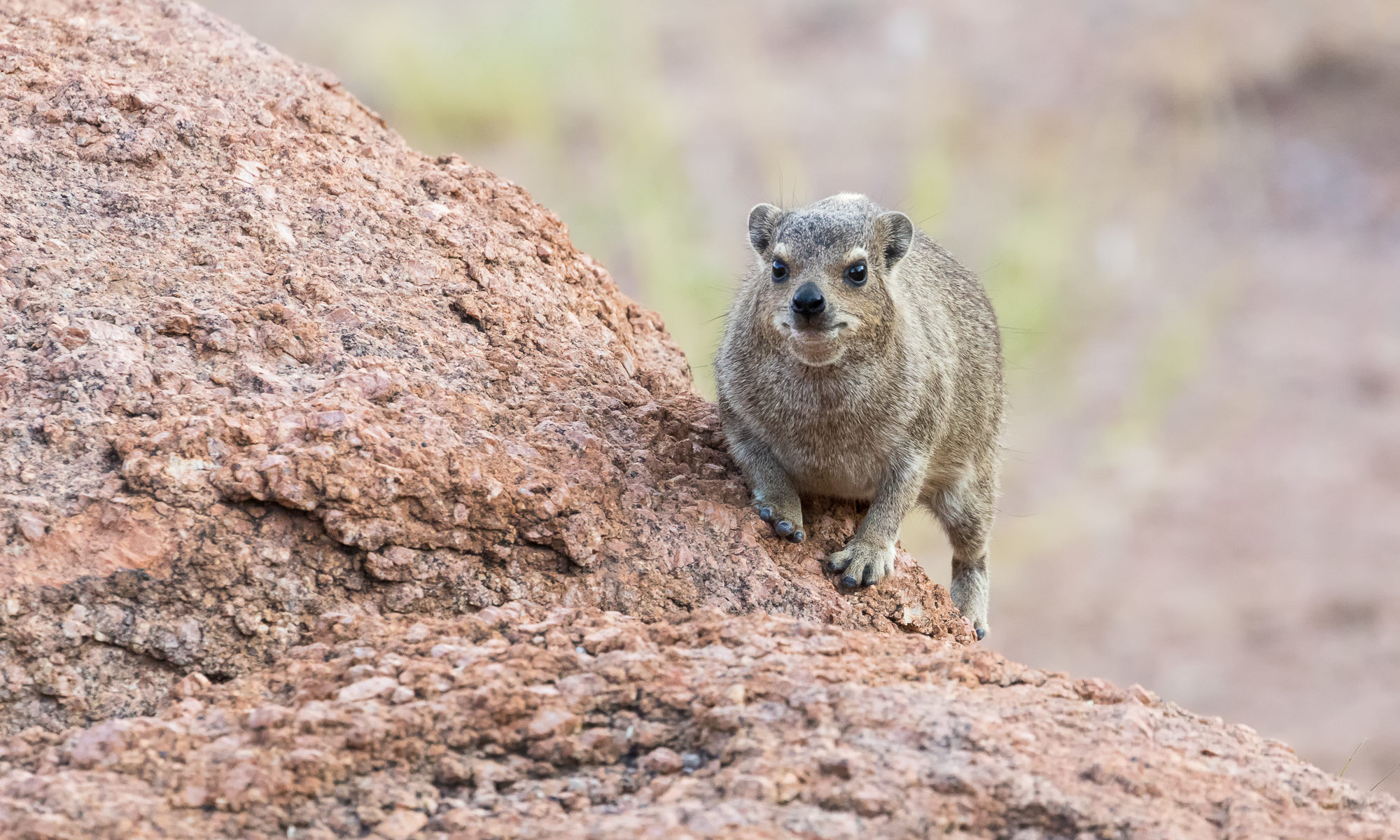
A rock hyrax peaks out from behind a tree, Twyfelfontein, Namibia.

When I was in Namibia earlier this year, I had a chance to see several rock hyrax up close. I came across them in the Damaraland region, living among the boulders in the dry desert landscape. Rock hyrax are small mammals resembling guinea pigs, distributed across Africa and the Middle East. However, their closest living relative is actually the elephant.

A rock hyrax sits on a granite boulder in the Damaraland region, Twyfelfontein, Namibia.

At first they seemed very skittish, but I found that if I just sat down and was still, they could get curious and would creep closer. I small face would appear around the side of a boulder and then quickly disappear, only to reemerge in a closer location.

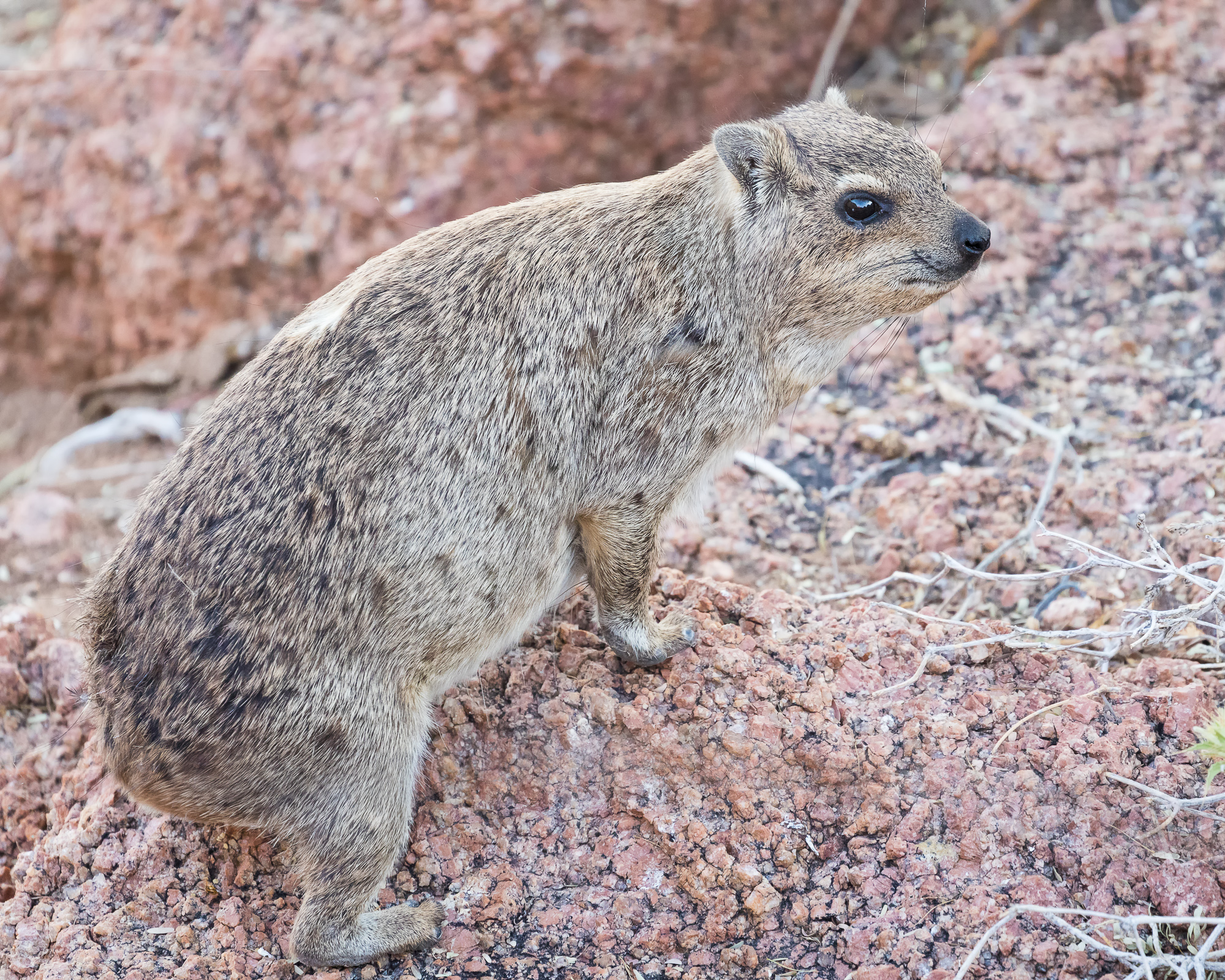
A rock hyrax sits on a granite boulder in the Damaraland region, Twyfelfontein, Namibia.

Unique among the hyrax is a dorsal gland that is used for territorial markings. Here is can be seen as an area of matted down fur on its middle back.

Although they can live among groups of up to 80 individuals, I only saw a few during my stay. They were a cute and pleasant variety to the larger mammals I saw there.

Okaukuejo Waterhole: Wildlife Diversity

My last blog post detailed my experience with five endangered black rhino at the Okaukuejo Waterhole in Ethosa National Park, Namibia. But that’s certainly not all I saw during those long quiet hours in the dead of night.

The sun sets over the Okaukuejo Waterhole, Etosha National Park, Namibia

I arrived at the waterhole just as the sun was setting behind the horizon. Night is the best time to see wildlife here, and to facilitate wildlife viewing, this camp has set up a flood light by which to see the nocturnal visitors. Quite a few people gathered at the waterhole to watch the sunset, but soon they were off to dinner and bed. Over the next hour, the crowds thinned out and only the die-hards remained for a long night’s wait.

Zebra come at night to drink from the Okaukuejo Waterhole. Night is a good time for prey animals to visit waterholes as they have a better chance of escaping predators.

One of the more common visitors were the zebra. One night a small herd came at dusk, but it was those few that crept up to the waterhole in the middle of the night that were more fun to watch. The absolute silence was only disrupted by the soft crunching of rocks under their feet, as they lined the edge of the water to drink. The stillness of the water cast a perfect reflection. However there was no chance to relax, as any little sound had the zebra darting their gaze to the darkness, trying to see beyond the wall of black.

A giraffe stands next to a tree at the Okaukuejo Waterhole. Its body is reflected in the still waters, Etosha National Park, Namibia.
A giraffe stands next to the Okaukuejo Waterhole. Its body is reflected in the still waters, Etosha National Park, Namibia.

Zebra gave way to giraffe, which traveling in ones and twos. In order to capture photos of these animals at night, I had my 400mm lens locked down on the tripod, my mirror locked up, and my shutter speed just slow enough to gather the required light. Keep the shutter too slow, and the animal was more likely to move during the exposure. It was a careful balance of predicting animal behavior, and making sure all my camera functions were set correctly.

Giraffe visit the Okaukuejo Waterhole at night, drinking from its still water, Etosha National Park, Namibia.

One of my favorite sights was the comical way in which giraffe drank water. They had to contort their bodies and spread their front legs in order to bring their heads low enough to the ground to drink.

A springbok visits the Okaukuejo Waterhole at night, its form reflected in the still water, Etosha National Park, Namibia.

In addition to the larger mammals, I saw a couple of antelope species. The ever present springbok made an appearance.

A species endemic to Namibia, several black-faced impala visit the Okaukuejo Waterhole at night, Etosha National Park, Namibia.

As did the endemic black-faced impala.

I did see an elephant in the early hours of morning. However luck was not on my side, and none of my photos turned out. There was too much movement from this giant beast to capture under low lights.

I would certainly recommend this type of experience to wildlife lovers. It was incredibly intimate to watch these animals interacting under the cover of darkness, with nobody else around. It was a wildlife cathedral I was lucky enough to attend!

Copyright 2017 Hank Christensen