Kabini – Nagarhole National Park, India

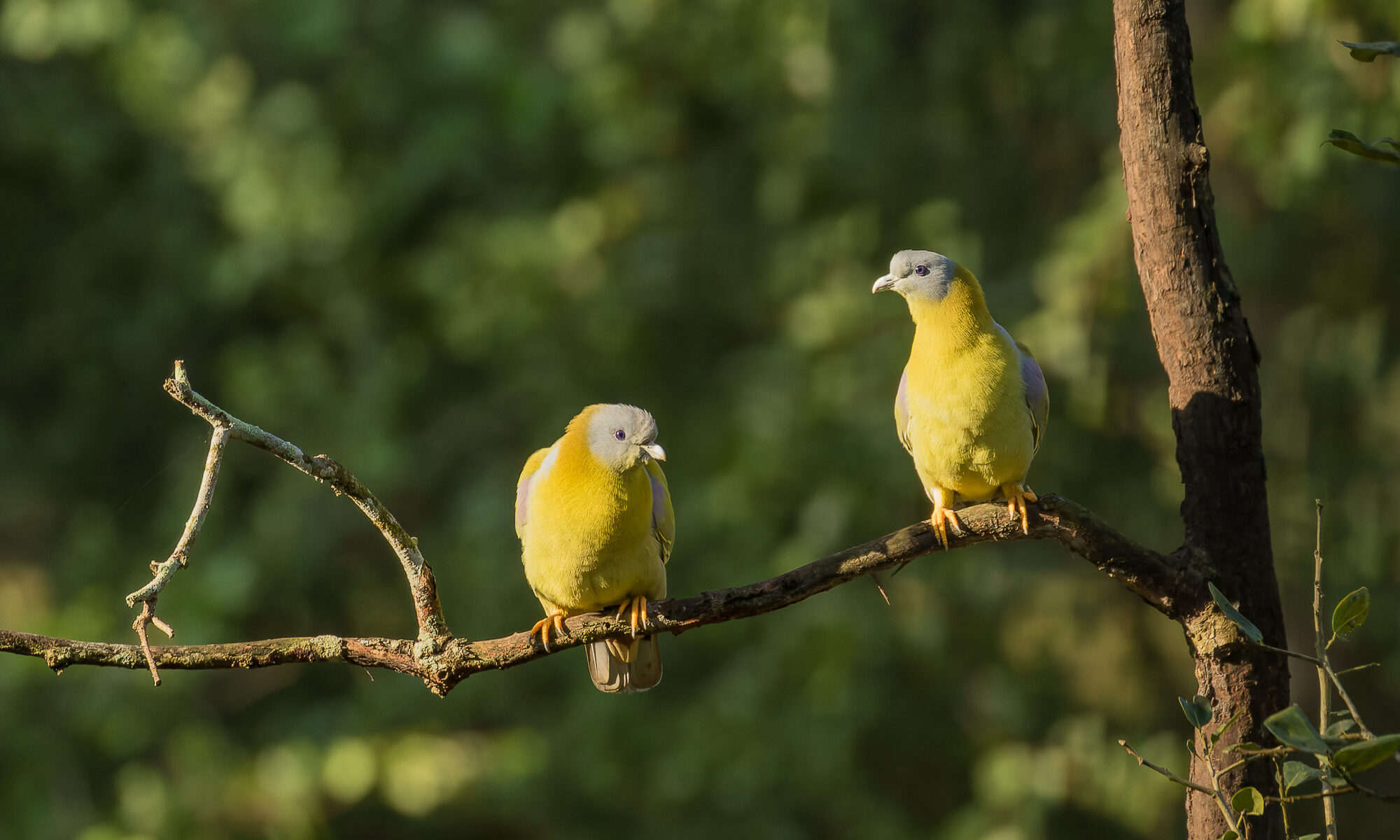
Two yellow-footed green pigeons perch in a jungle clearing, Nagarhole National Park, India.

I’ve been spending some time going through my archives of unpublished photos, and came across a trip to India a few years back where I was fortunate to be able to visit Kabini – a protected wildlife area that is part of the larger Nagarhole National Park in Karnataka.

I was able to do four safari outings over two days into the park, and see some of the local fauna. While I didn’t chance upon any of the area’s tigers, I did see quite a cast of characters.
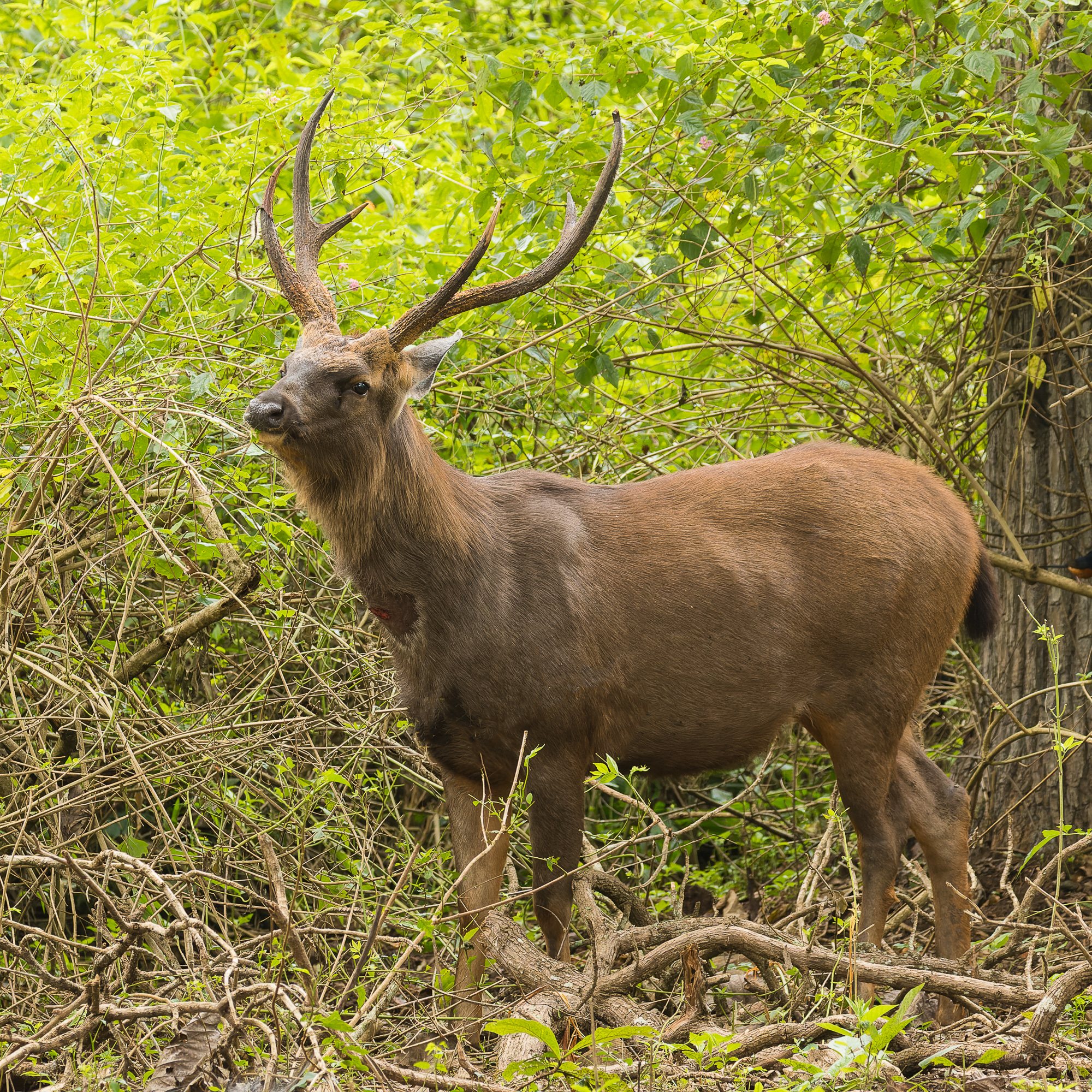
A sambar deer forages in the thick underbrush of the forest, Nagarhole National Park, India.

The sambar deer is large and shaggy, typically alone or in small groups. They remind me most of elk in North America, and as seen in this photo, I’ve usually seen them semi-hidden in dense brush.
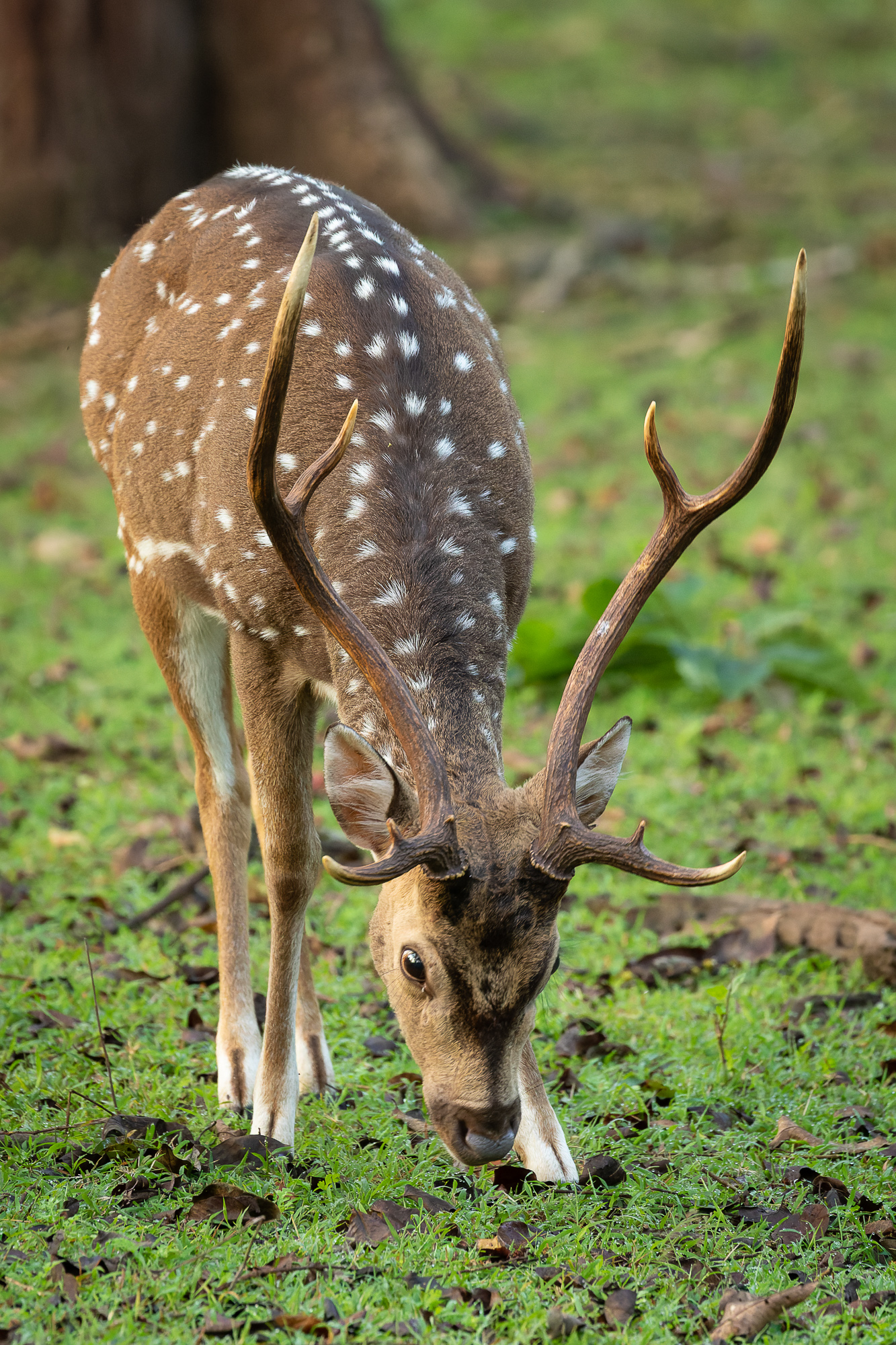
A small chital grazes on the forest grass, Nagarhole National Park, India.

Much more common in the area are chital – a slightly smaller spotted deer that travel in herds. They are not very skittish, usually seen in more open areas.
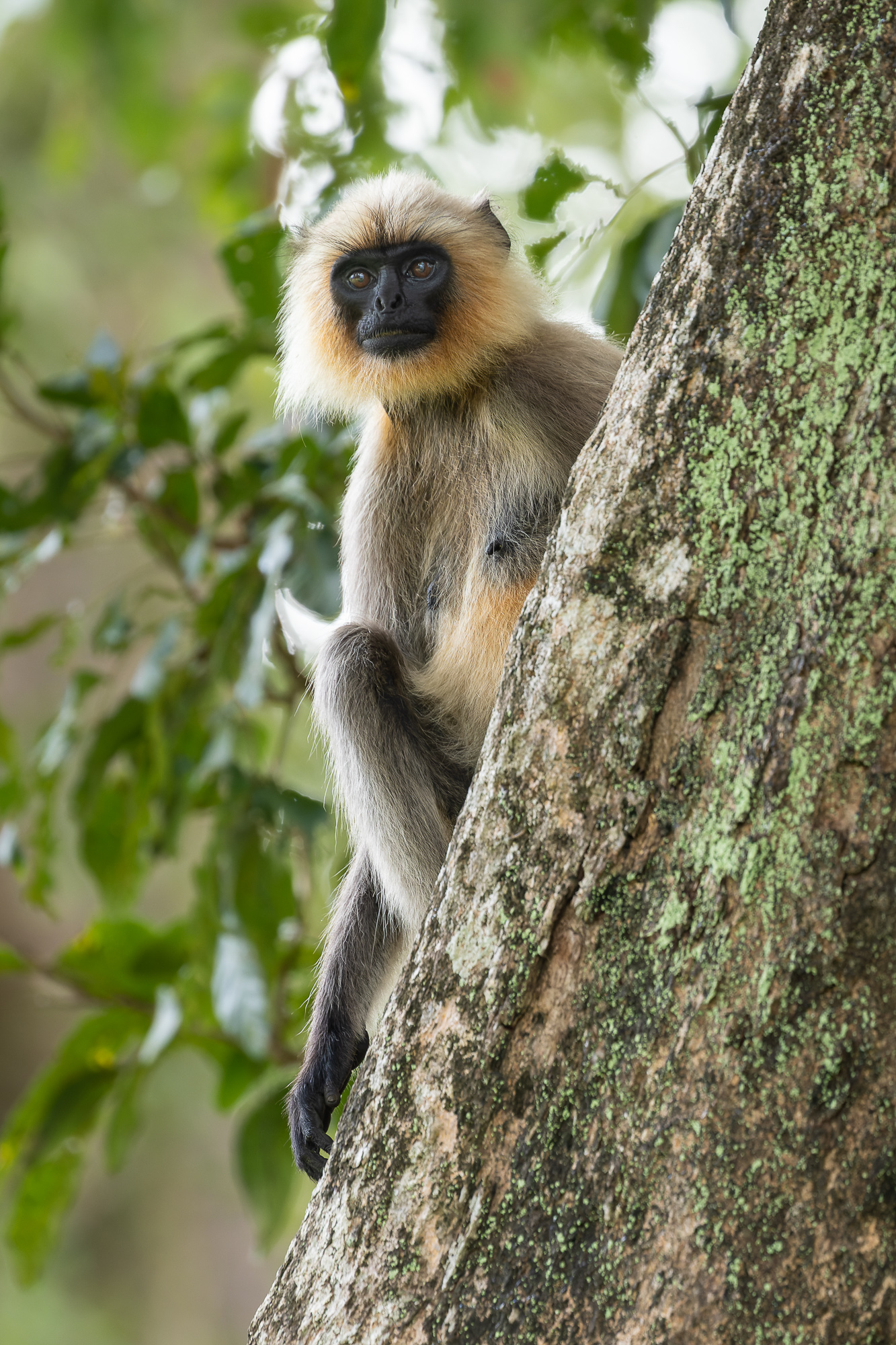
A tufted gray langur sits in a branch surveying the forest, Nagarhole National Park, India.

Occasionally we were treated to troop of tufted gray langurs. I could sit and watch their antics all day, as many of their expressions and movements are human-like. It is nice seeing them play in natural environments verses the multitude of macaques that have invaded some of the towns and cities.
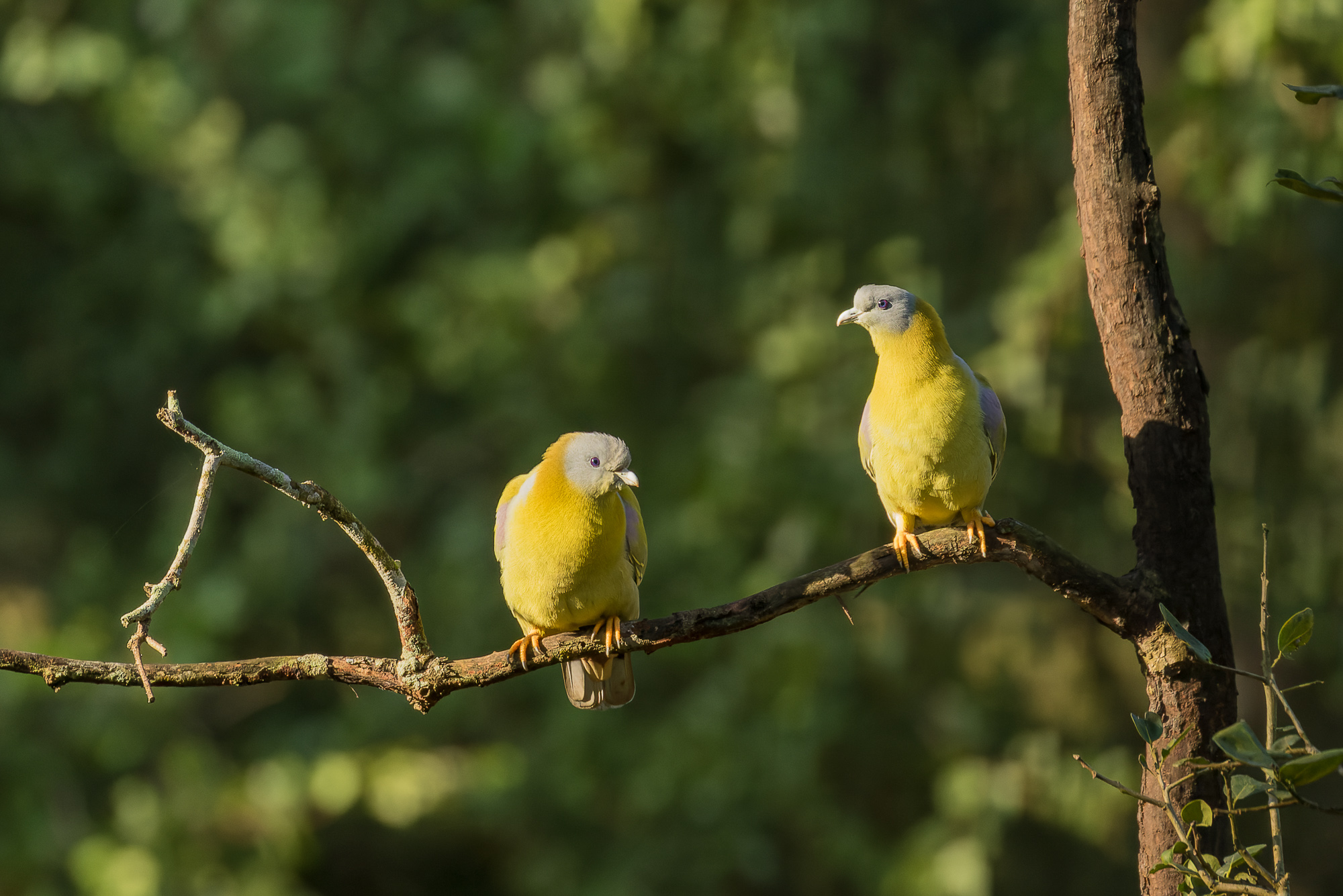
Two yellow-footed green pigeons perch in a jungle clearing, Nagarhole National Park, India.

This was a bird I had never seen before, and had to rely on one of my phone apps to identify. These are yellow-footed green pigeons, and I was lucky to catch them fly up on a bare branch in the sunshine for a brief moment.
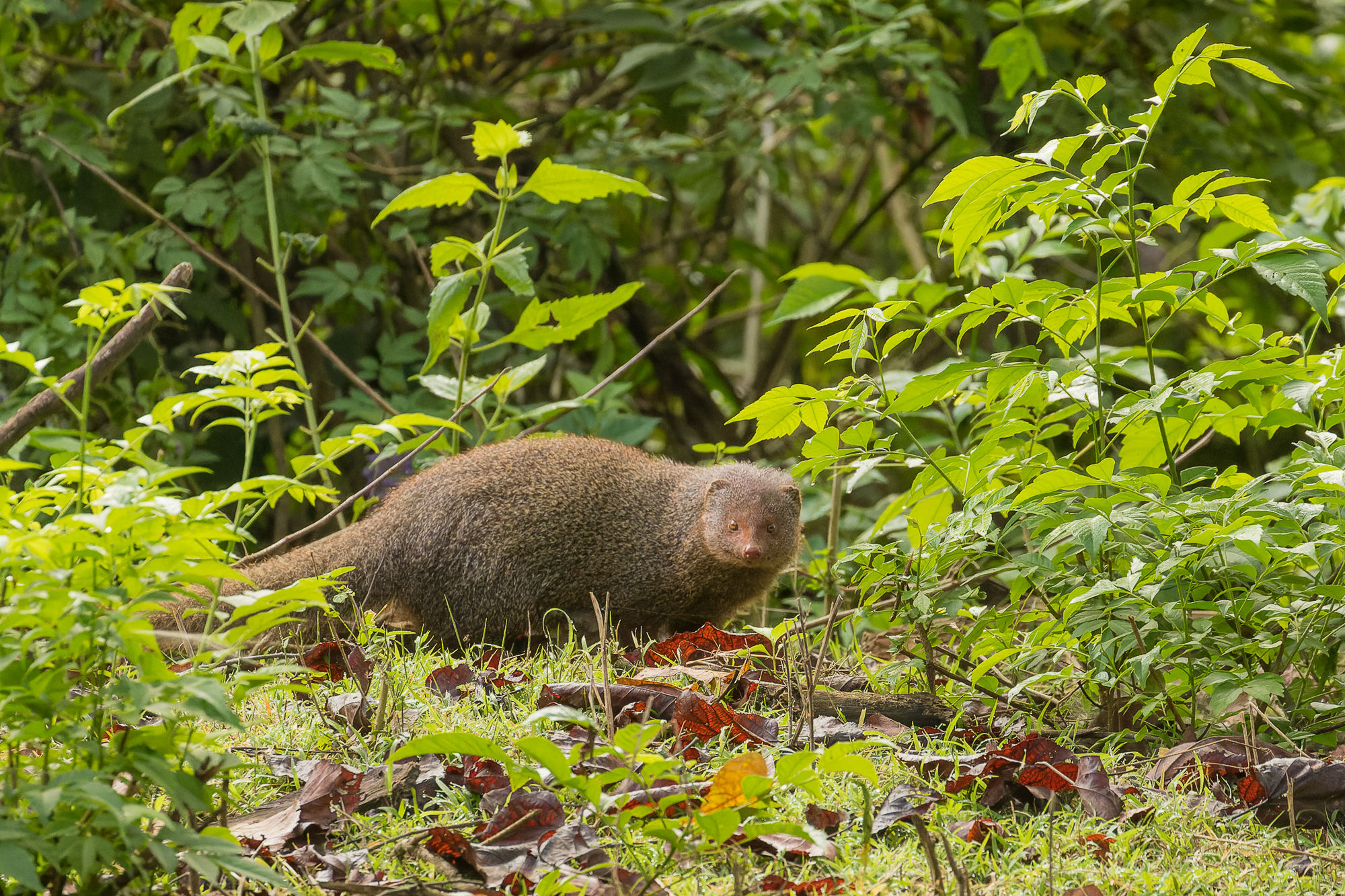
A ruddy mongoose moves silently through the forest, Nagarhole National Park, India.

One of my more memorable sightings of the trip were a couple of mongoose – a stripe-necked mongoose and (as pictured here) a ruddy mongoose. They were fast and elusive, so this was the best shot I got of the sightings.
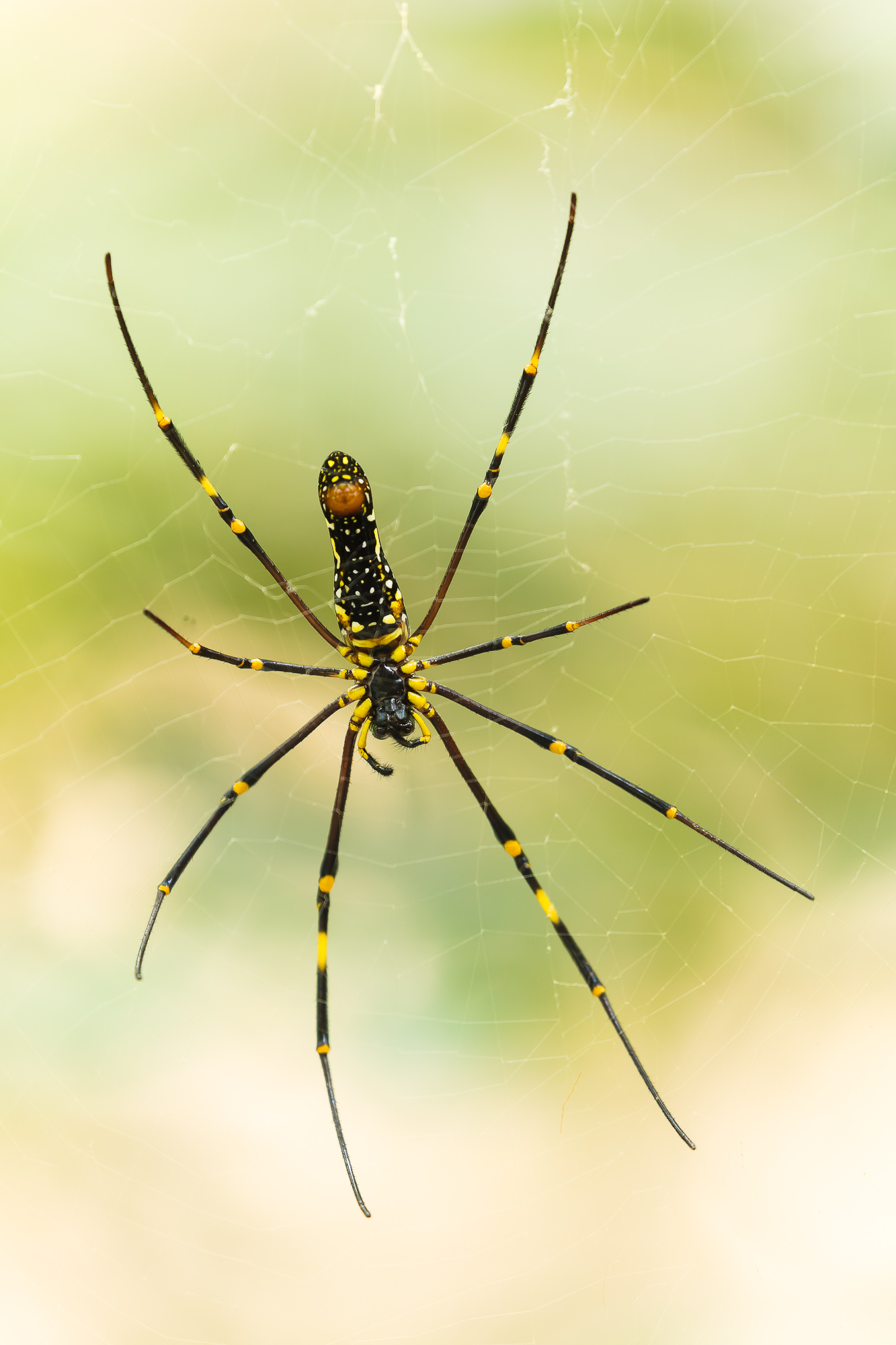
At around 8 inches across (including legs) this female giant wood spider sits on her web in a dense jungle, Nagarhole National Park, India.

Not to be outdone by the mammals, there were also plenty of spiders to see (yay!) In fact, the lodge that my friend booked for us was known for their variety of spider species and even had an onsite naturalist that gave guided spider tours around the property. Of course, had I known this reputation before the trip, I might have requested a different accommodation.

This is a photo of a giant wood spider who had spun a large web next to our room’s staircase. To say it was huge is a bit of an understatement – it definitely filled my dreams with unease while I was there. The wood spiders’ web can reach 20 feet across from one tree to another, creating a wall of death for unwary insects. These spiders are big enough to catch small birds or bats, though thankfully I didn’t see any of that.
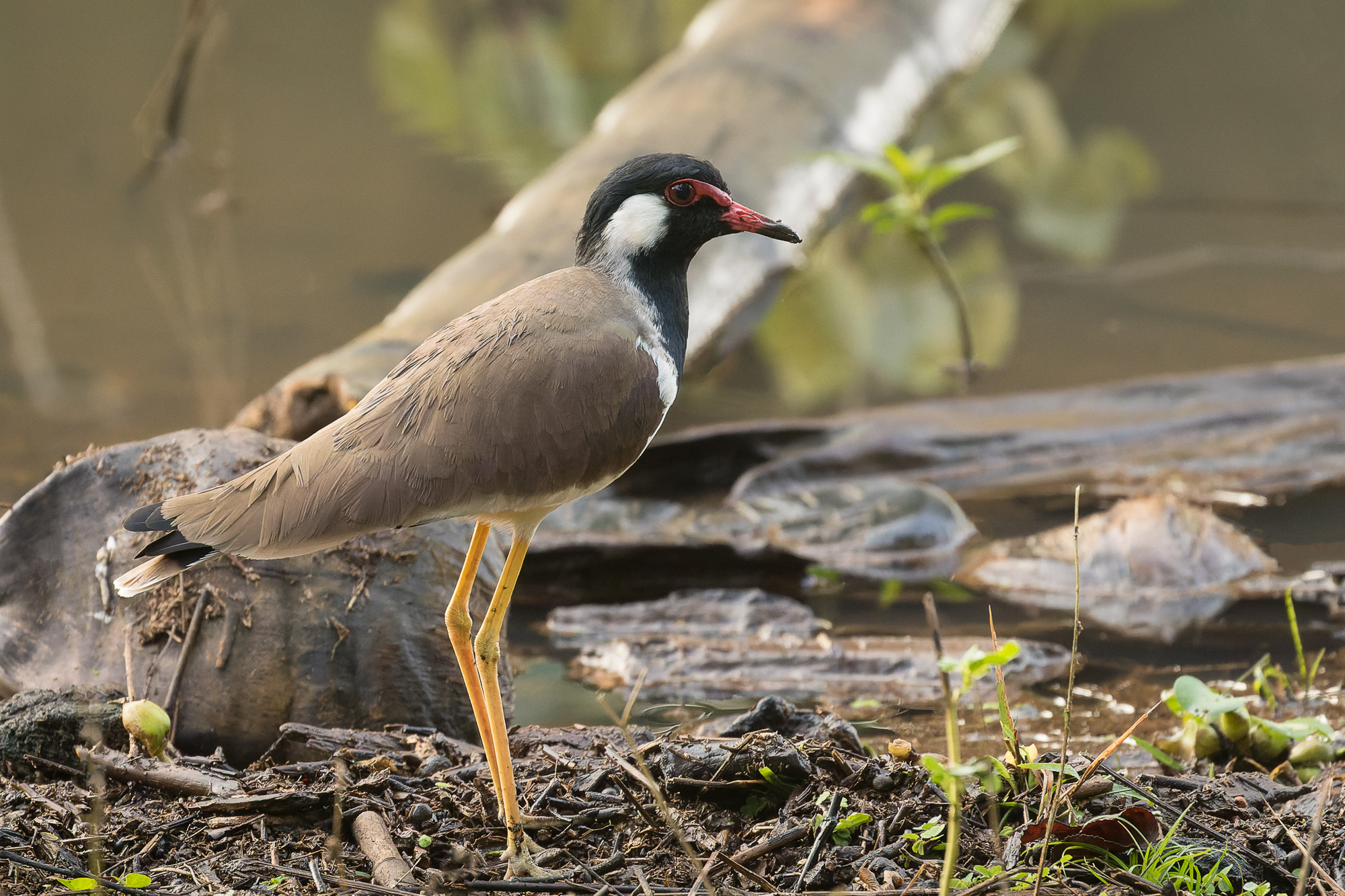
A red-wattled lapwing stands on the bank of a small pond, Nagarhole National Park, India.

On a lighter note, there were several ponds dotted throughout the forest, and I saw a red-wattled lapwing on the edge of one of them. Lapwings are members of the plover family which I have photographed fairly regularly over the years.
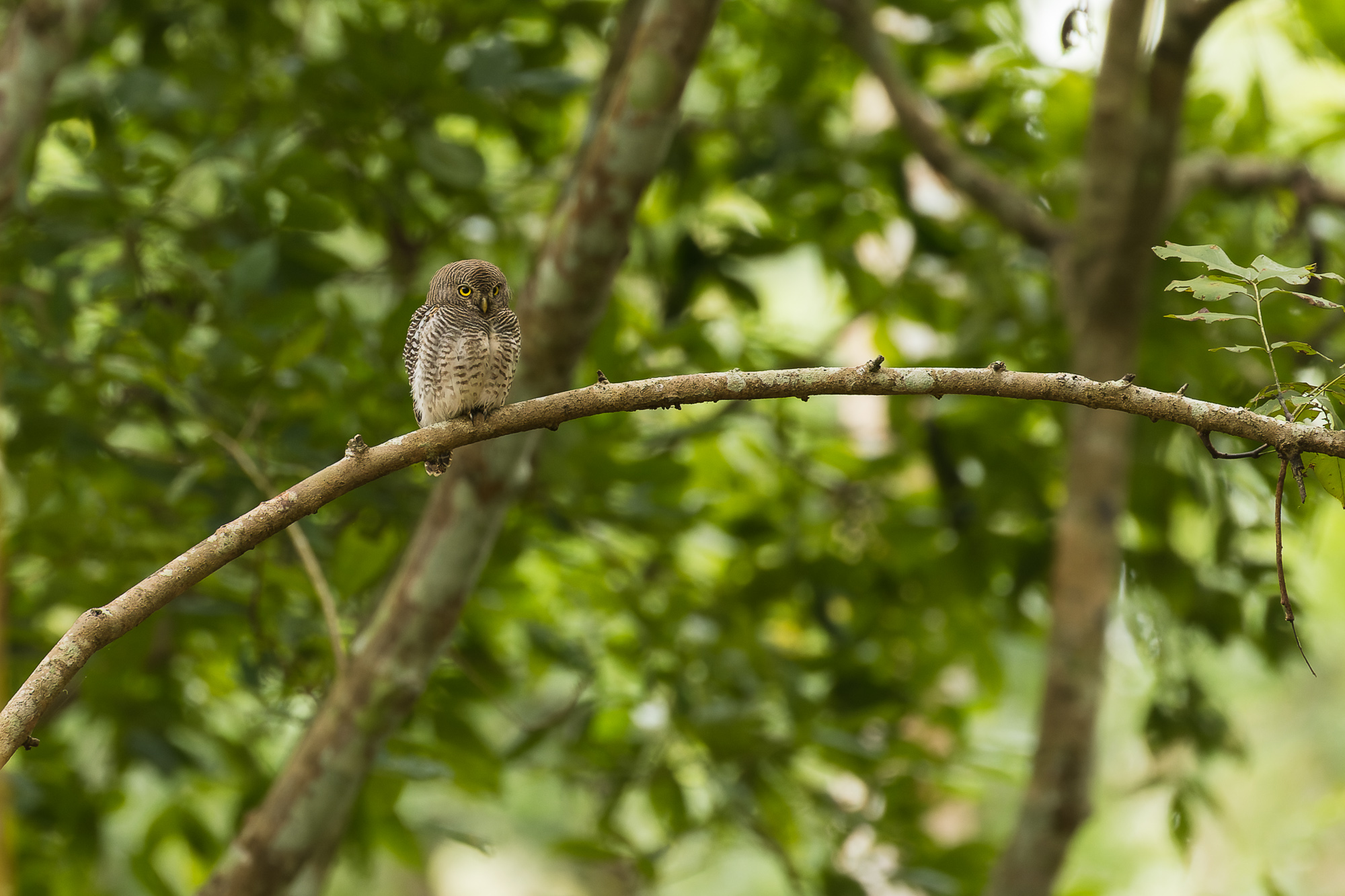
A tiny jungle owlet perches in the dark canopy of the forest, Nagarhole National Park, India.

I was blessed with two owl sightings. First a jungle owlet, the smallest owl I have ever photographed. They are about 8 inches long and weigh approximately 3 ounces. This one was perched quite far away in the dark recesses of the jungle.
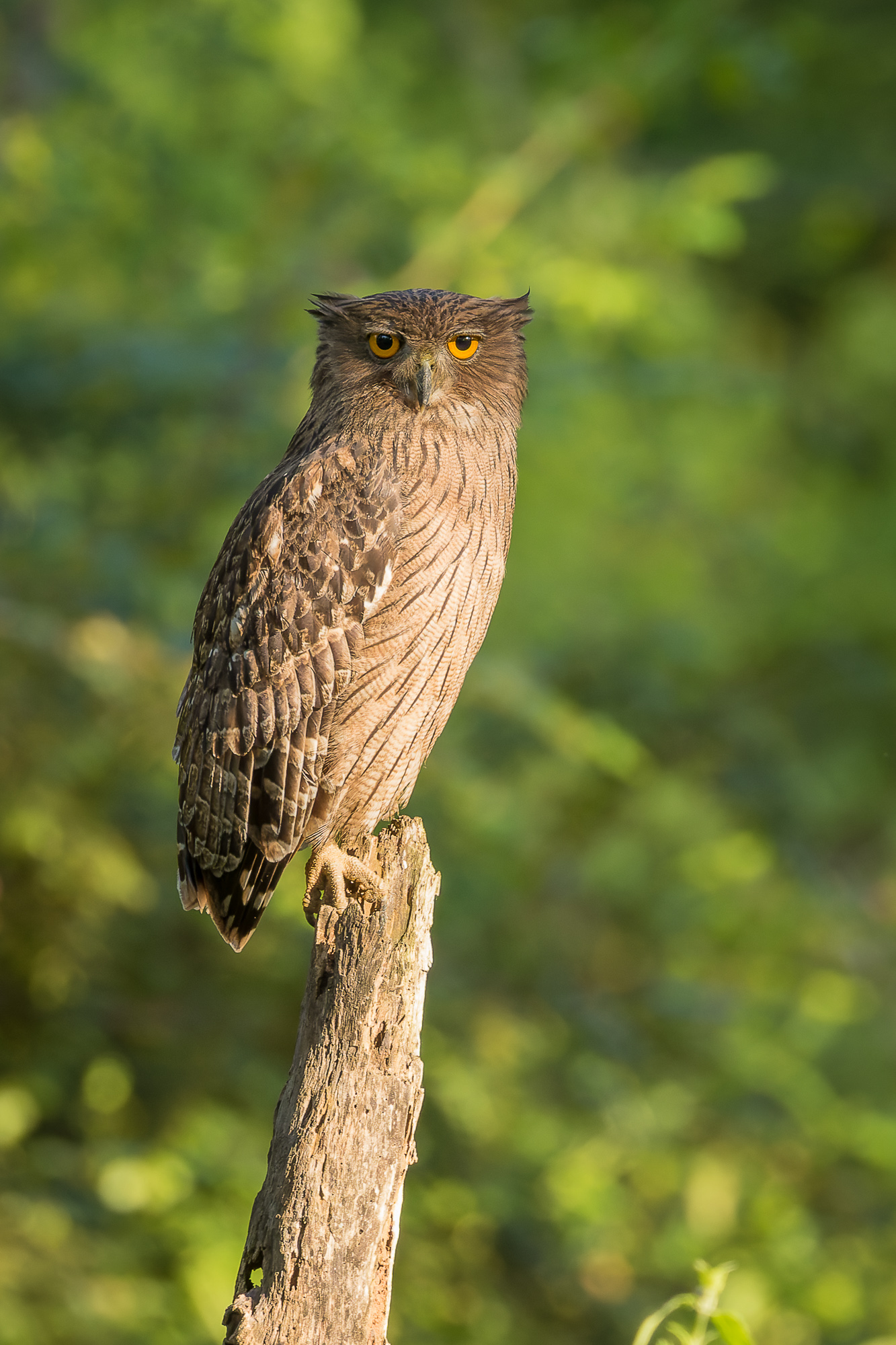
A brown fish-owl perches in a jungle clearing, Nagarhole National Park, India.

Later I encountered a much larger owl, the brown fish owl. This one was perched in a small clearing and we asked the driver to maneuver our vehicle so that the background was as far from the tree stump as possible. This allowed the background to blur away, creating a nice sharp portrait of the fish-owl. These owls can be up to 24 inches long and weigh as much as 5 pounds.
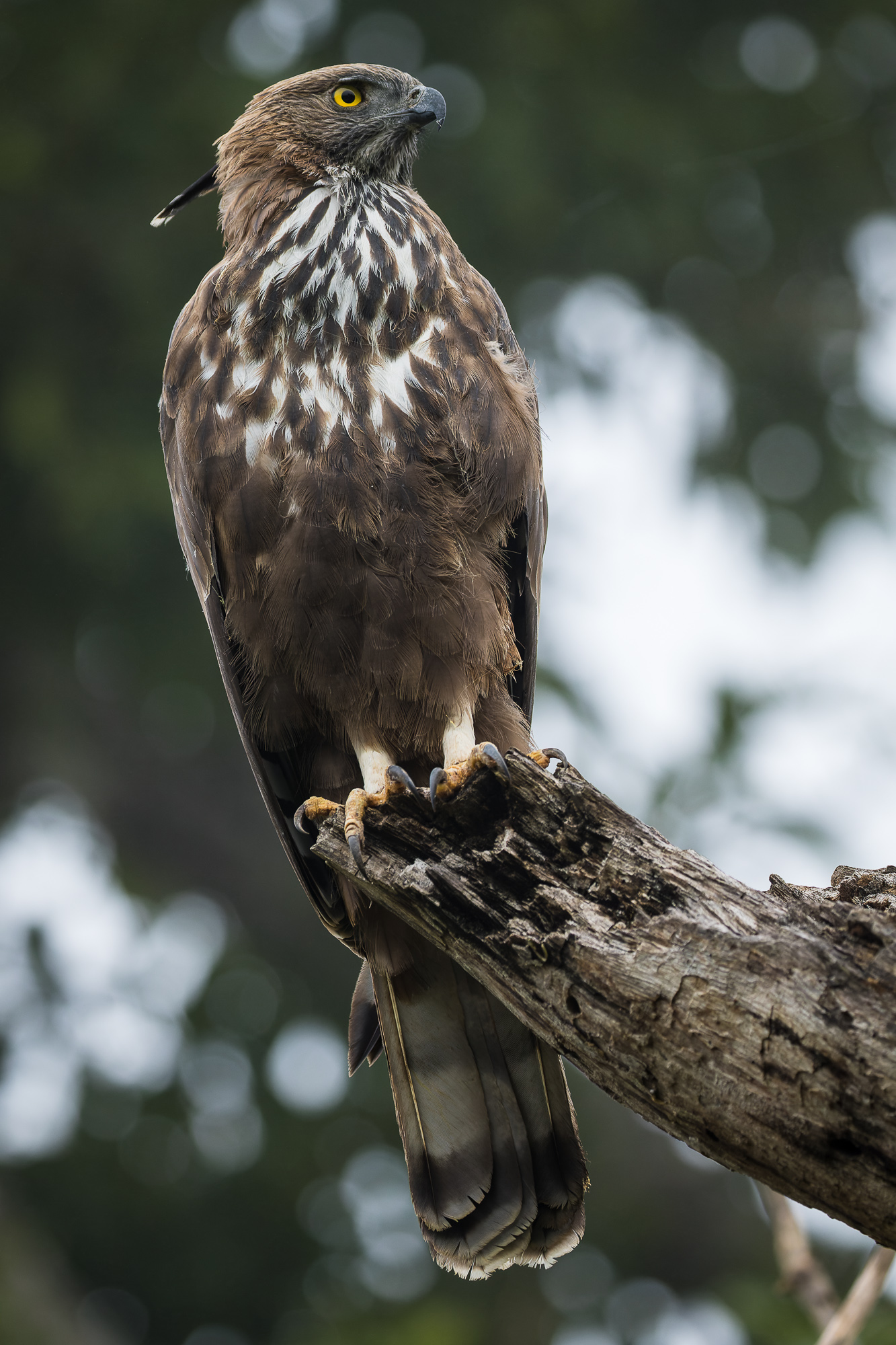
A changeable hawk-eagle perches in a dead tree, Nagarhole National Park, India.

Last notable sighting for the trip was a changeable hawk-eagle. I had seen several of these over the course of the two day excursion, but right at the end of our last day, we got to see this one much closer.

Overall it was a great trip, creepy spiders and all. I’d definitely welcome another opportunity to visit – you never know what you’re going to see in that dark jungle.
The Peacock – The National Bird Of India

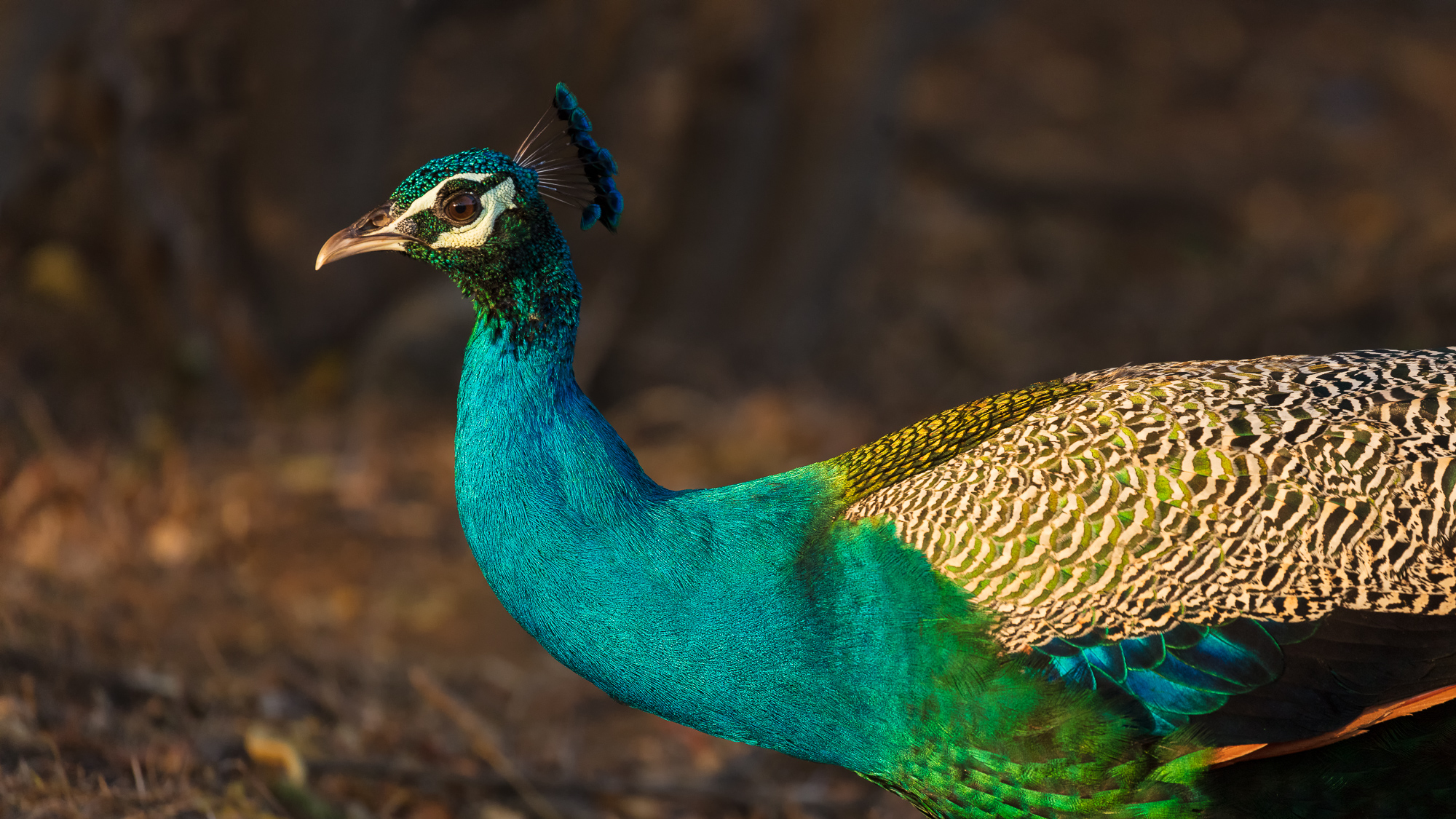
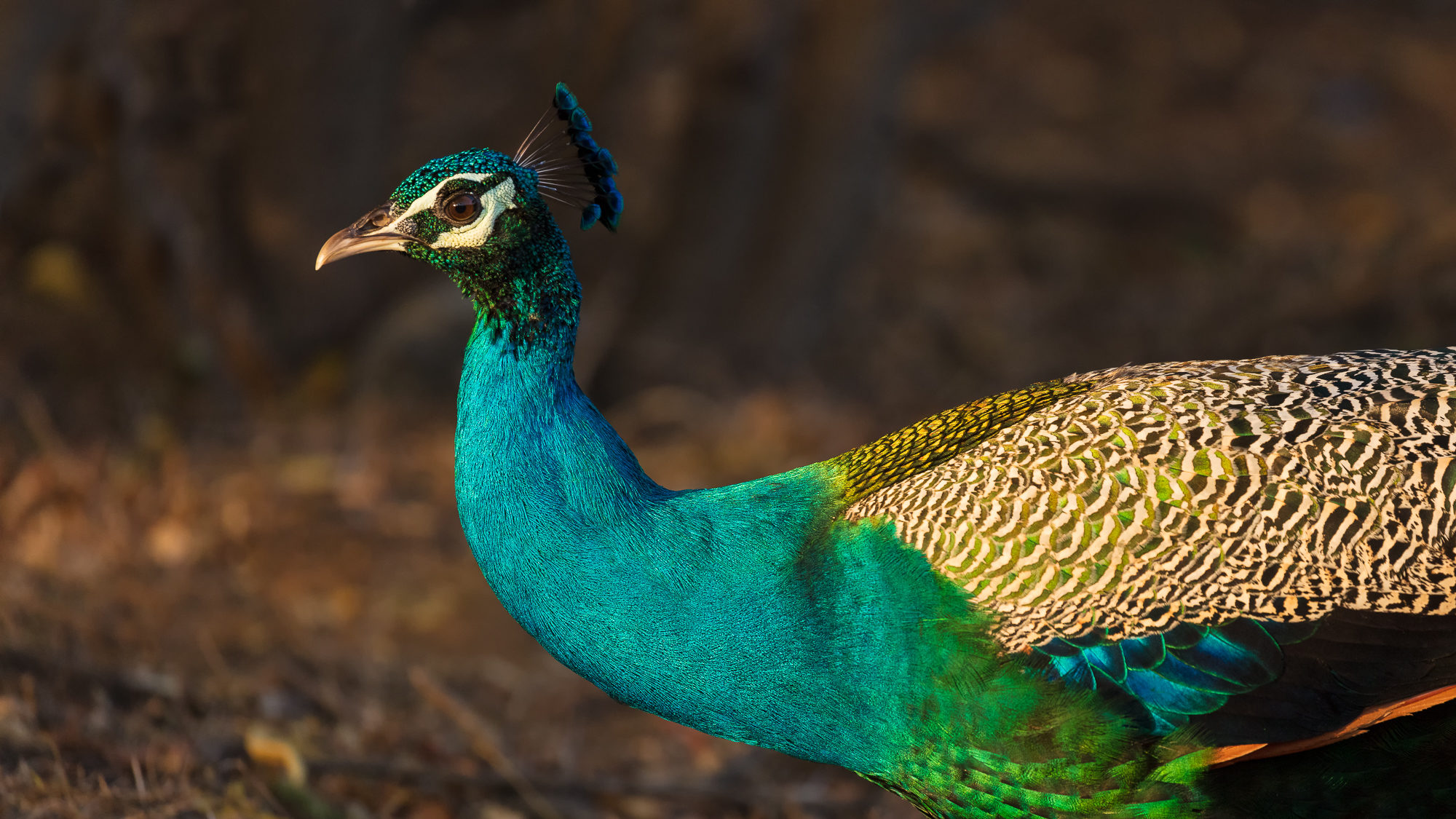
An indian peacock struts along a forest floor, Tamil Nadu, India.

On my last trip to India, I was fortunate enough to have some great sightings of India’s national bird, the peacock (or rather more correctly, the Indian Peafowl (to be fair to both sexes))! In the United States, these birds are often relegated to free roaming status in zoos, so it was nice to see some in their natural habitat.

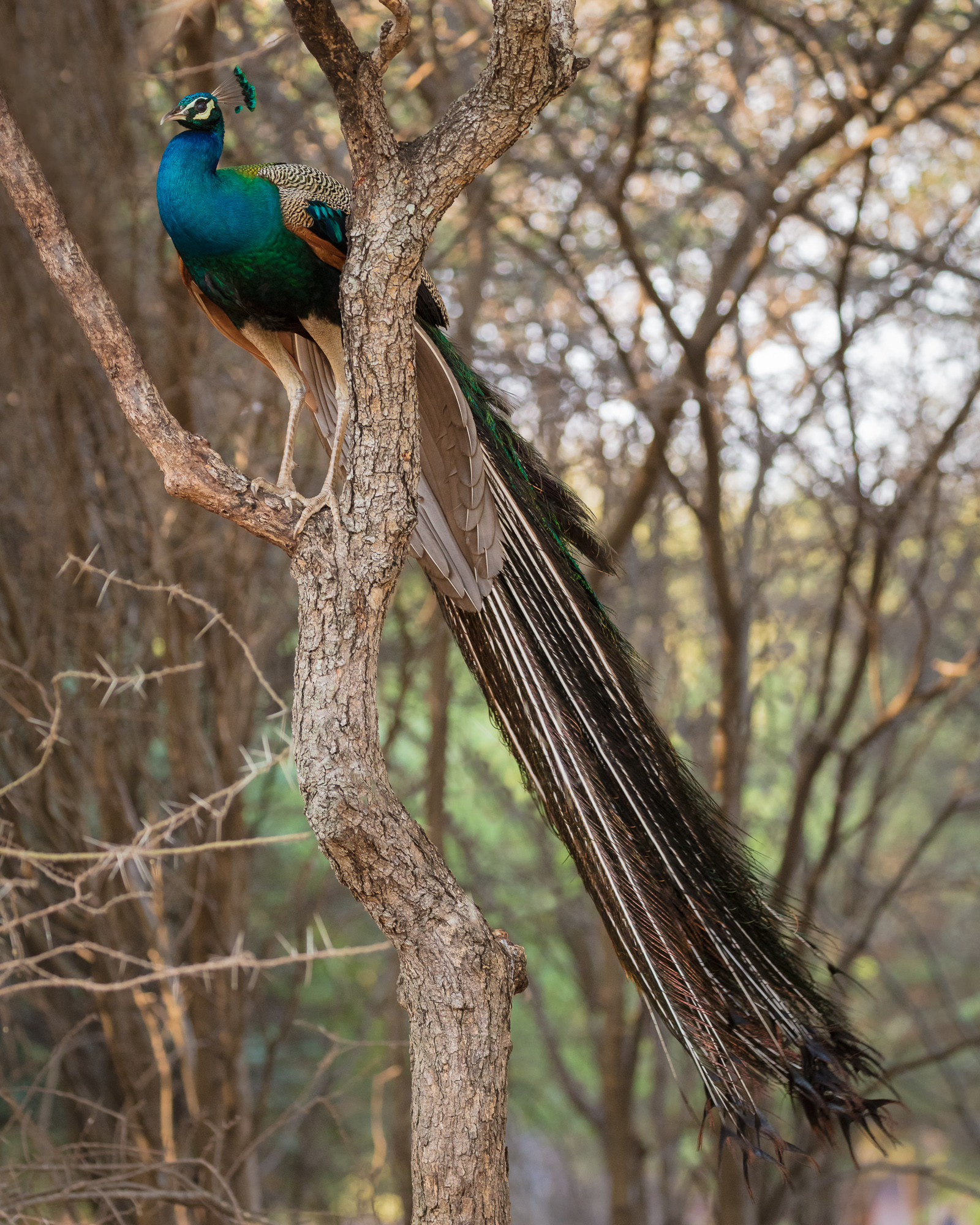
An indian peacock perches in a tree, tail feathers trailing below, Tamil Nadu, India.

While feathers from the peacock are sought after due to their amazing colors and iridescence, I saw peahens showing off as well.

An indian peahen perches atop a stone pillar, Tamil Nadu, India.

One thing that became apparent as soon as I started photographing was that these wild peacocks were extremely skittish and agitated. Any time I tried to approach on foot, they would scamper off into the jungle.

An indian peacock struts along a forest floor, Tamil Nadu, India.

Only by shooting from the window of a car was I able to get close. The “mobile blind” technique often works well with many types of wildlife, though it is essential to have an experienced driver who knows how to slowly creep up on the subject without spooking it.

An indian peacock struts along a forest floor, Tamil Nadu, India.

When you can catch the peacock feathers in the right light, the brilliant colors almost glow. Here you have to be careful about light angles, because at the wrong angle, you can get unwanted glare from the reflective surface of these iridescent feathers.

An indian peacock perches atop a wooden fencepost, Tamil Nadu, India.

I looked for opportunities like the shot above to showcase peacocks off the ground. Here the males can let the full glory of their tail feathers hang to the ground. This was taken at a meditation center in southern Tamil Nadu that doubled as a sanctuary for these wild birds.

An indian peacock struts along open ground looking for food, Tamil Nadu, India.

While I photographed many peacocks over the course of three days, one shot I wanted but didn’t get was that of a male displaying to female. I did see this display in action, but wasn’t able to photograph it well as the birds were stationed behind a wire fence. I figure its always good to want more – all the more reason to keep me coming back in the future!

Gear I used to create the photos in this post:

Sunset Over Azhagappapuram

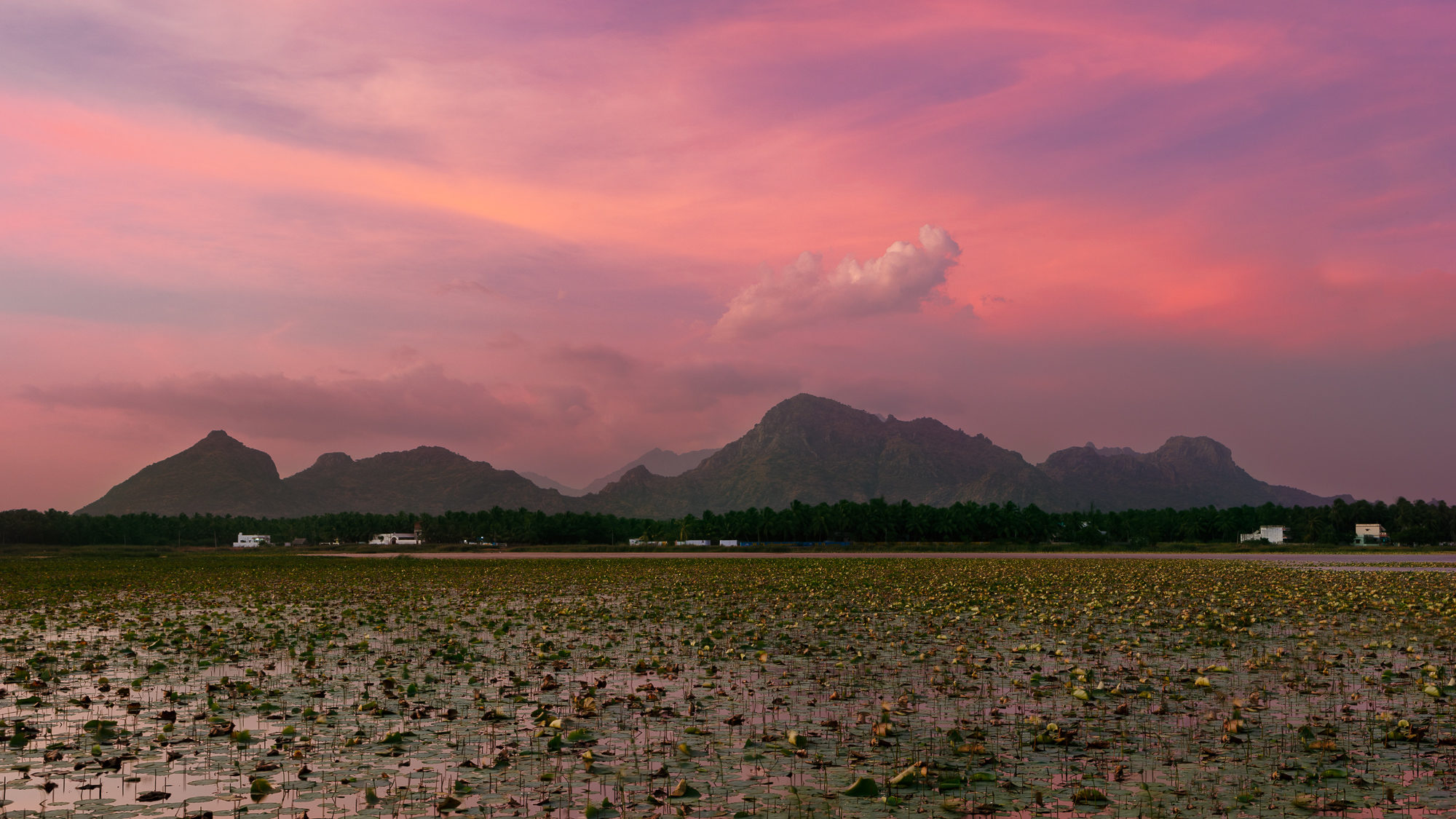
Evening clouds turn to fire over the mountains north of Azhagappapuram, Tamil Nadu, India.

I took this photo on the final day of a fantastic trip to India last year. I was in the state of Tamil Nadu, at the southern tip of India staying with my friend Frans. The village in which he grew up is just on the far side of this small lake, so I only had to travel a few minutes from where I was staying to get this shot.

I had been eyeing the sky for a few days, hoping for some clouds at sunset that would catch the last rays of the day. Luck was with me for my last evening in town, as the clouds started to build in the afternoon.

Unfortunately, I did not get the still water that I was hoping for, in order to create a reflection of the southern most expanse of the Western Ghats. In typical southern Tamil Nadu style, wind was whipping across the water at great speed, creating small white caps (definitely NOT what I was hoping for!) In fact, this area is known for its expanse of wind farms, which should have given me a clue that waiting for a calm day was likely an exercise in futility.

Evening clouds turn to fire over the mountains north of Azhagappapuram, Tamil Nadu, India.

However, I had previously scouted a small area of lotus plants close to the shore, which helped the photo in two ways. First, the lotuses broke up the waves that the wind was creating. And second, they added some level of interest to the foreground. This was the next best option given there was no chance for a reflection.

As a side note, these plants would have been much more beautiful had any blossoms been on the plants. But alas, they were picked clean. As I was wondering about why this was, I saw a man in a canoe further along the shore, slowly making his way through the lotuses and plucking any fresh blossoms. Oh well, maybe time for a little photoshop? Just kidding of course….

Apparently, this area doesn’t see many photographers or foreigners. As I was standing by the shoreline with my tripod, many people stopped on the nearby road to watch what I was doing. That was okay – the resulting photo was well worth the extra attention.

Every day I was there, I discovered more of the natural beauty of the area’s land and animals. I will certainly return to cover this amazing landscape more in depth.

Gear I used to create the photos in this post:

Indian Giant Squirrel

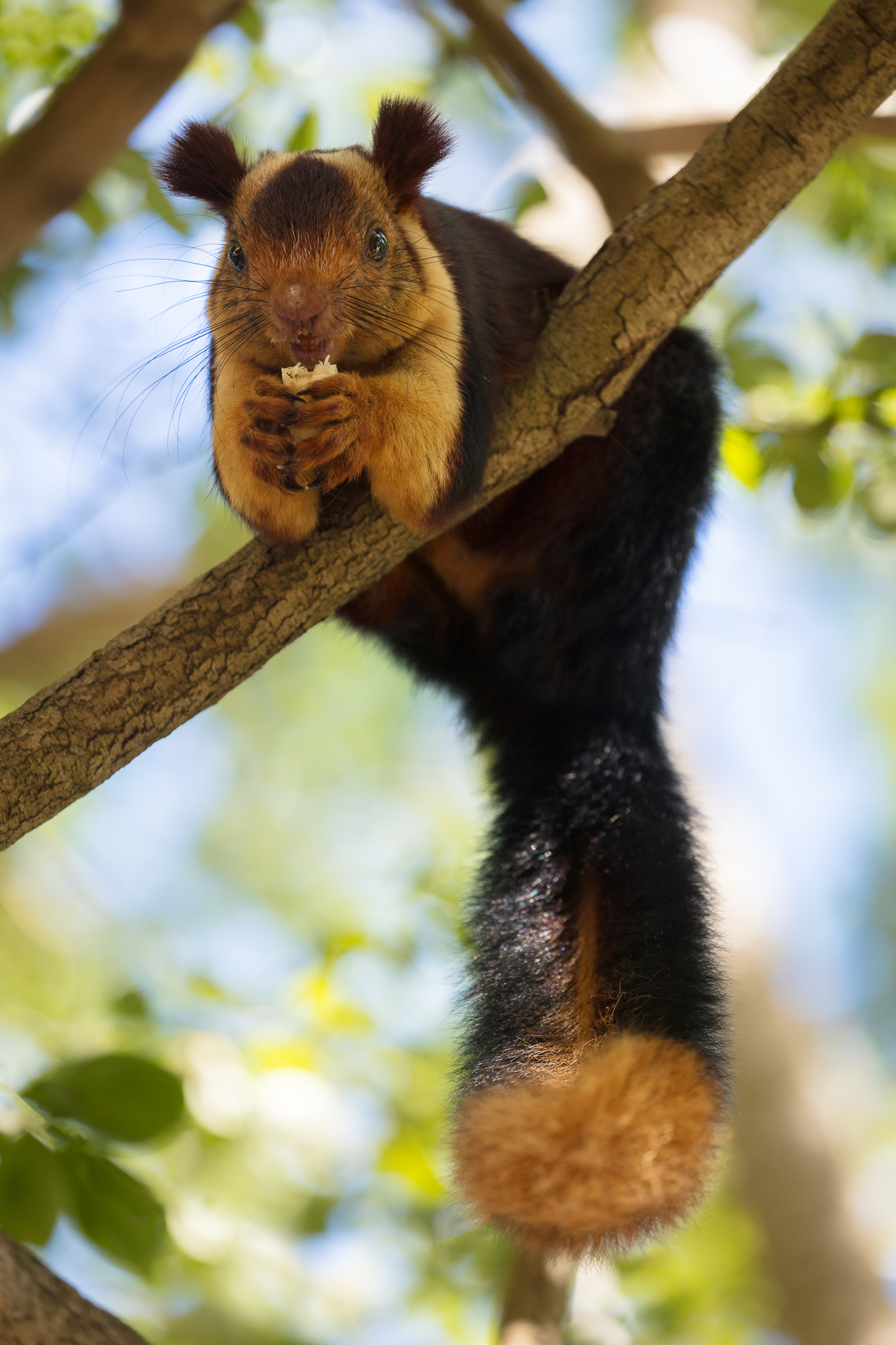
One of my biggest surprises on my last trip to India was encountering several giant squirrels. I am use to the cute and cuddly squirrels of North America, so it was quite a shock when I first saw one of these tree beasts. Measuring a body length of around 14 inches, and a tail length of over 2 feet, these squirrels were bordering on raccoon size!

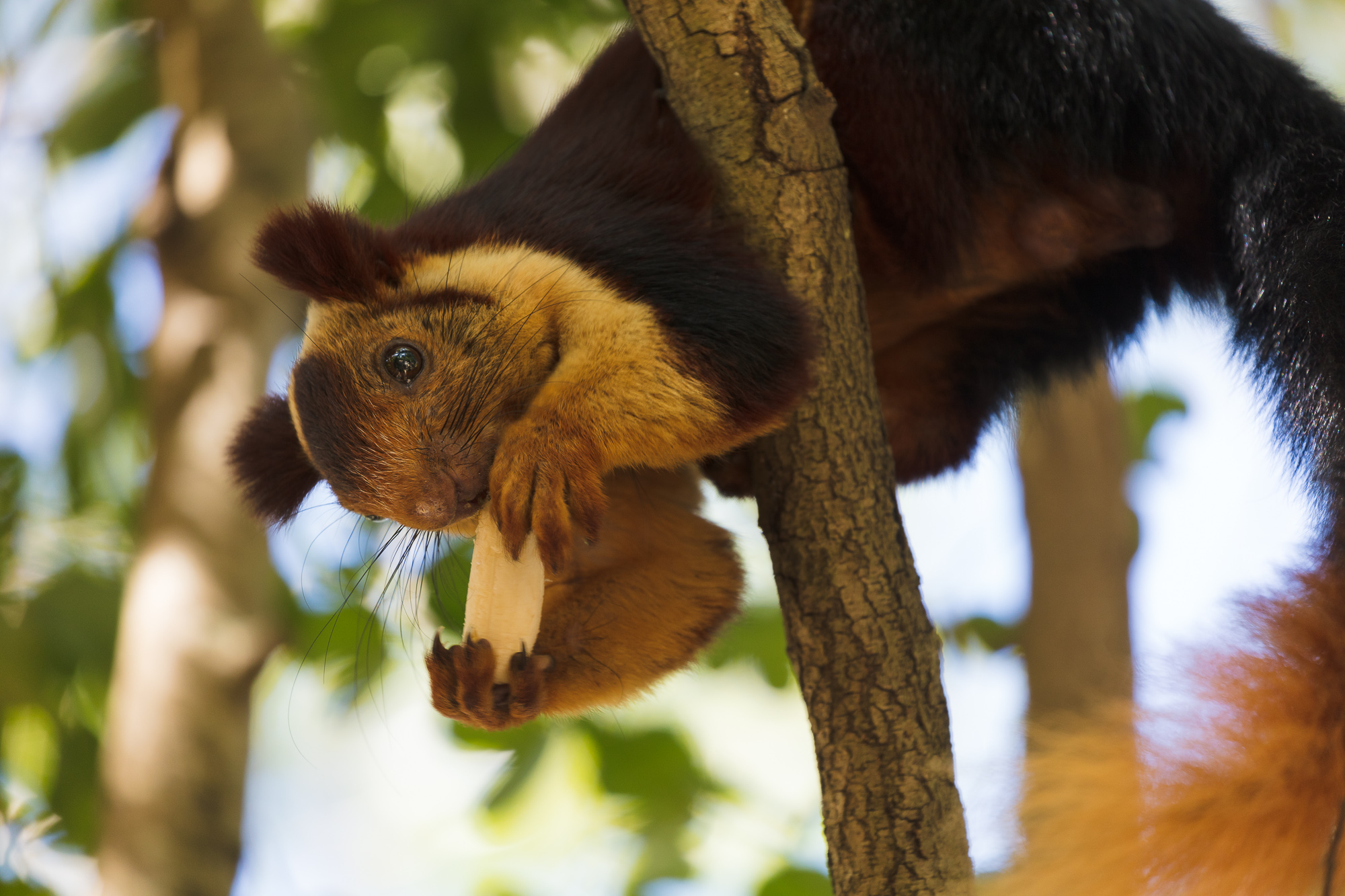
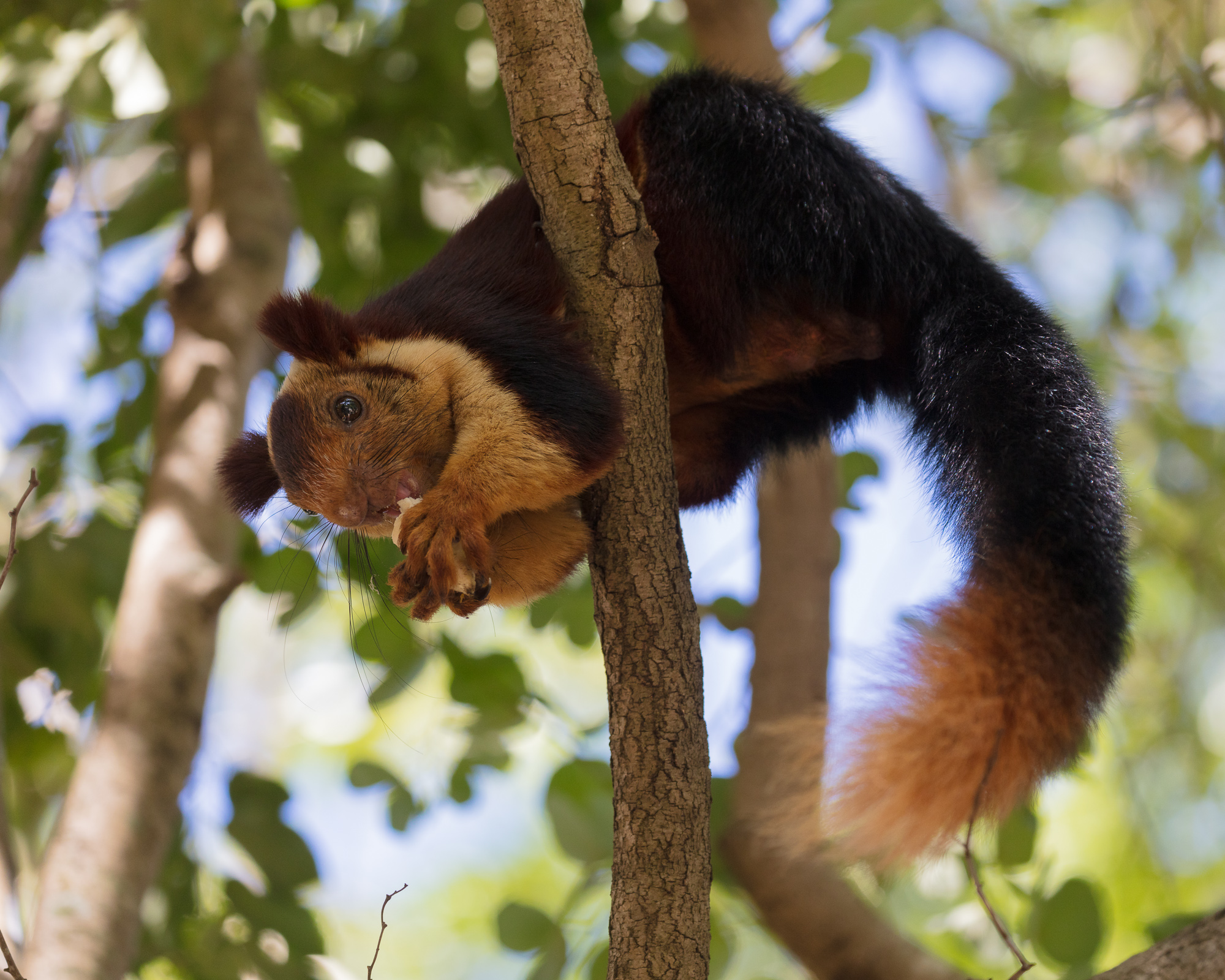
An indian giant squirrel perches in a tree and eats a piece of banana, Mudumalai National Park, India.

Although large, they were still pretty cute, with little round ears that stick up.

An indian giant squirrel perches in a tree and eats a piece of banana, Mudumalai National Park, India.

One of the squirrels had gotten ahold of a banana from someone in our forest camp in Mudumalai. He took it up into a tree and proceeded to devour it, holding it firmly in his dexterous grip while balancing his body weight across a small branch.

An indian giant squirrel perches in a tree and eats a piece of banana, Mudumalai National Park, India.

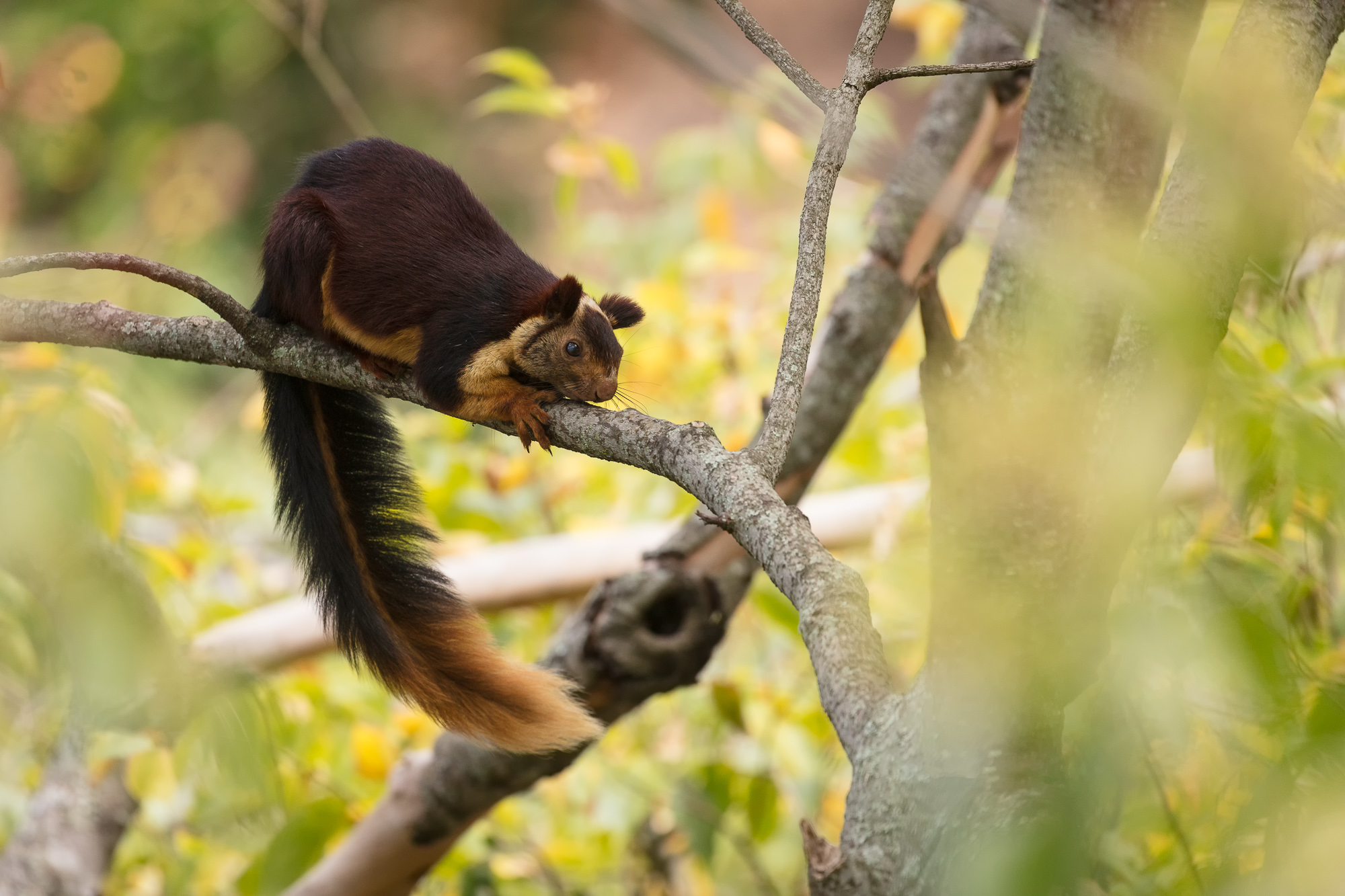
This is a tree dwelling species that rarely leaves the upper canopy. I felt lucky to see three of these shy creatures in less than 24 hours. My last sighting was a stroke of luck. We had pulled over to let the car rest half way up a long a winding climb up to Ooty. One side of the road was a cliff towering above, and the other side was lush with the tops of trees growing far below. And there through the canopy, directly at eye level was another giant squirrel.

With a body length of 14 inches and a tail 2 feet long, the indian giant squirrel is a site to behold. Mudumalai National Park, India.

I got several photos of this guy, but this was my favorite. Although I had a direct view, I shot through some leaves at a wide aperture to give the feeling of peering through a thick forest at a shy, solitary creature.

Gear I used to create the photos in this post:
[amazon_link asins=’B00PF39PEY,B00NEWZDRG,B00IAYFDIC,B00OD71FKU’ template=’ProductCarousel’ store=’hankchristens-20′ marketplace=’US’ link_id=’a2a5a946-90dc-11e7-a7bf-b5ee2948dd18′]

Copyright 2017 Hank Christensen