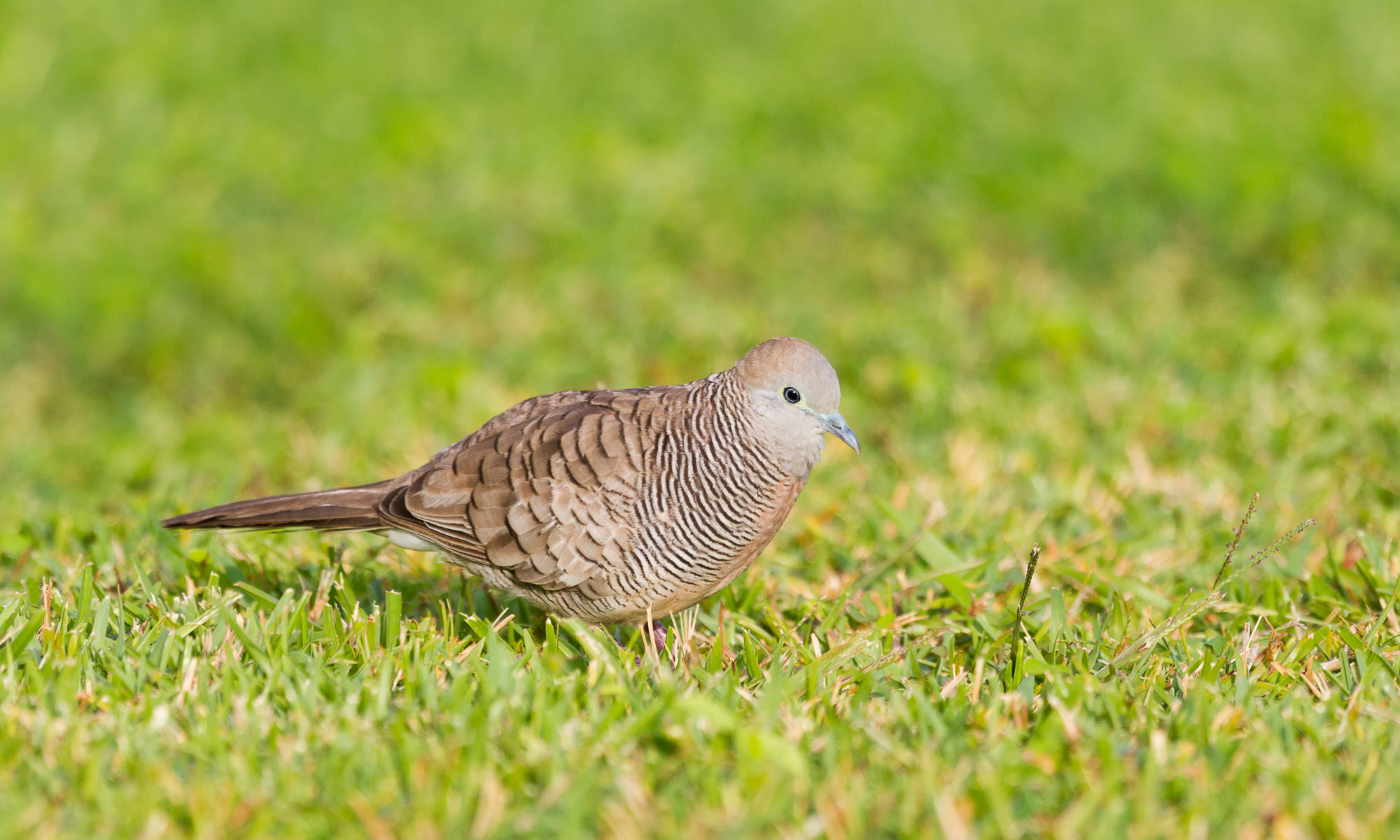
The Hawaiian dove population is dominated by two species, the zebra dove and spotted dove. Parts of Hawaii also contain the Mourning Dove, but its population is small by comparison. Zebra doves are the smaller species, with a distinct barred pattern around its neck and shoulders.
Unlike other doves who forage in large groups, zebra doves tend to eat alone or in pairs. They can commonly be found eating short grass or grass seed.
Spotted doves are larger and feature a spotted pattern around the back of the neck. They can be seen in larger flocks and in populated areas have become accustomed to the presence of humans.
Zebra doves were introduced to Hawaii in the 1920s, and spotted doves were likely introduced around the same time. Both quickly spread to all islands and in some areas are the most populous bird seen.
On my recent trip to Kauai, I got plenty of opportunities to photograph both species in different environments. While both seemed to be more skittish than the Nene, I found that if I was still enough and remained low to the ground these birds would eventually approach reasonably close to me.
If you’ve ever been to Hawaii, you’ve probably seen the Hawaiian Goose, or Nene. A decedent from the Canada Goose, this bird is the official state bird of Hawaii, and is found wild exclusively on the islands of Kauai, Maui, and Hawaii. One of its main distinctions is the ruffled feather patterns down its neck. The Nene derives its name from the soft call it makes, sounding like “nay, nay.”
Like many once populous species, the Nene has had a difficult recent history. In the early 20th century, due to hunting and introduced predators, the entire world population was reduced to 30 birds by 1952. It was successfully bred in captivity and reintroduced into the wild, and today it is estimated that 800 Nene live in the wild. Even after these re-population efforts, it is the rarest goose in the world.
A nene stands for a headshot in front of green grass
On a recent trip to Kauai, I had many great opportunities to photograph Nene. Unfortunately, many had become used to tourist’s food, and were quite fearless in their approach. I found if you sit still long enough, some would practically come sit in your lap!
Everywhere I go for bird photography, I see starlings. Sometimes alone, sometimes in huge flocks, these birds are very common throughout much of the world. Here in the US, they are known as European Starlings (as they are native to Eurasia), elsewhere as Common Starlings, and in Europe, simply Starlings.
Because of their ubiquity, they are generally regarded as pests or just ignored by the general population. However, closer inspection reveals a beautiful feather display and a strange and sometimes unbelievable vocalization. Adults have an iridescent black feather coloring, and in winter, it becomes speckled with white flecks. At the right angles of light, the black feathers reflect a glossy green or purple.
A European starling perches on a branch of a white-barked tree
They can be excellent mimics, repeating various bird songs and sounds from the environment. Each bird has its own repertoire with more proficient birds having a range of up to 35 variable song types and as many as 14 types of clicks.
Here is a sample vocalization from a common starling:
Taken individually, they can be a quite striking bird. But real amazement comes from their behavior in a flock, or murmuration. Changing speed and direction based on their closest neighbors, they fly as one shape-shifting organism, with the ability to perform a beautiful aerial ballet. A YouTube video gained popularity a few years ago showing off this behavior.
The next time you see one of these birds perched in your neighborhood, take a moment and admire them for the interesting species that they are.
Clouds build over the northern mountains of Yosemite National Park. In the summer, afternoon thunder storms are common, often lasting less than an hour.
Recently I made a short overnight backpacking trip to the Ten Lakes region of Yosemite National Park. The trail to Ten Lakes starts at Highway 120 and heads north, into the Yosemite high country. Unfortunately, the sunrise and sunset weather conditions were not optimal for my particular location. With a large cliff to the west of my camp site, I was more or less blocked from the setting sun. Sunrise came with blue bird skies – definitely not what a landscape photographer is hoping for!
However, some of the best atmospheric drama came from the typical afternoon cloud buildup over the high peaks. As my group reached Ten Lakes Pass, we were greeted with a large cumulus buildup, and distant showers, providing a dramatic topper to a never ending mountain range to the north.
There was such detail in the cloud textures that I began thinking instantly of Ansel Adams, and the magnificent work he created on similar afternoons in the high country. I began thinking in black and white, centering my composition on the clouds, and using the mountains as nothing more than to give the photo a sense of place. The stark blue sky above the clouds was turned black by applying a strong orange filter (in post processing of course!), which rendered the isolated cloud bursts below the clouds in lighter grays.
That evening, I watched the sun settle with bland ambivalence behind the ridge line to the west. It was not quite yet true sunset, but my world was thrust into shadow. Dark, colorless clouds spotted the sky, but I couldn’t tell if the western horizon was free of cloud cover or not. Just as I was about to give up and pack the camera, the bottom of the clouds lit up in a surreal magenta. With nothing to anchor the shot, I began creating cloud abstracts, loving the way the sun colored the bottoms of the clouds, leaving the upper clouds dark and mysterious.
Although I took many other landscapes on the trip, nothing spoke to me like these two cloud images. I was satisfied returning with these two images and happy memories of being out in the wilderness.