
Strive For Separation

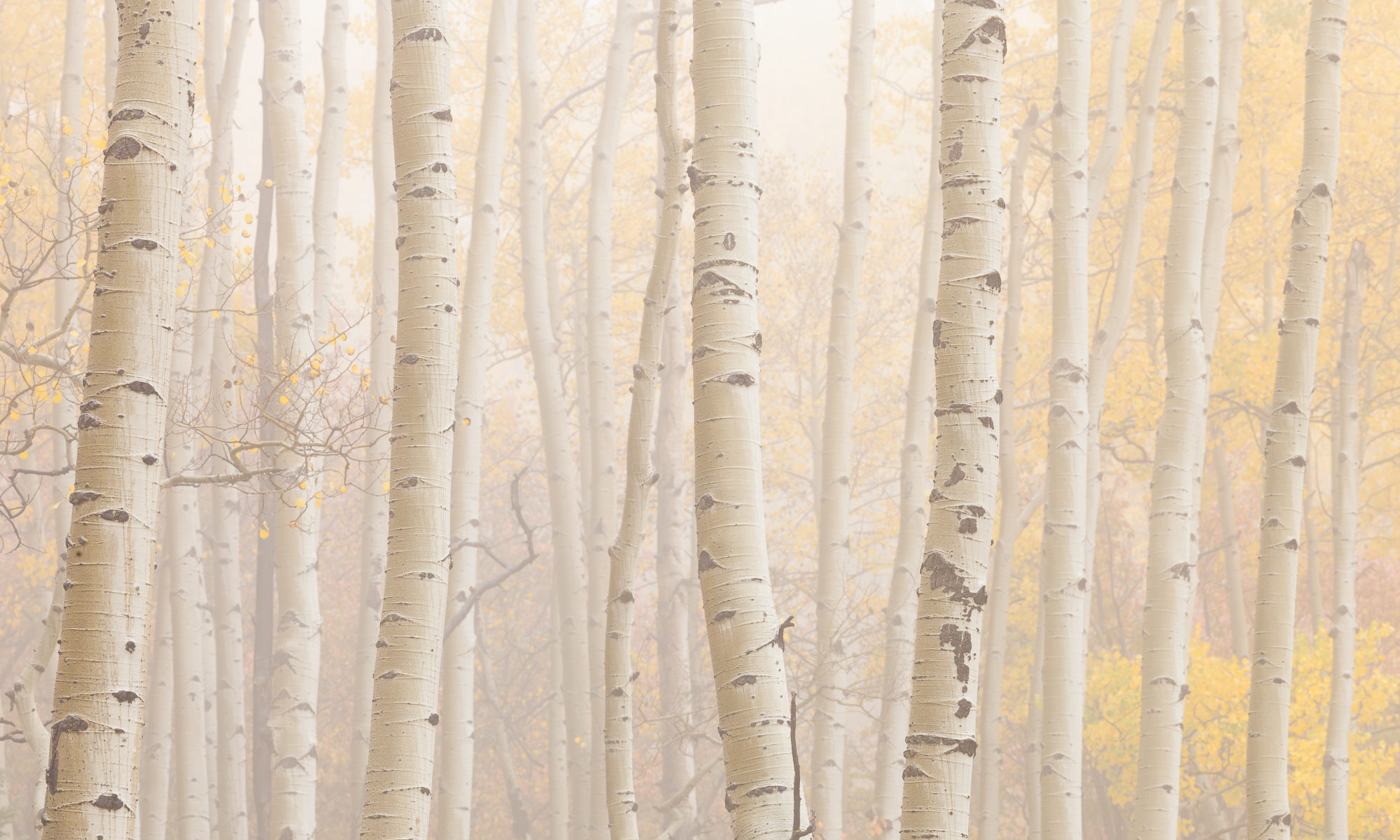
Thick fog shrouds a forest of aspen, Ridgway, Colorado

One goal of nature photography is to take the chaos of a wild landscape, and using nothing but the perspective of the rectangle of your camera’s view, to simplify and distill the scene into a singular message. One of the most chaotic environments in which I shoot regularly is a forest. Once you combine tree trunks, branches, leaves, and vegetation, you are often presented with quite a mess of a scene. Finding patterns and removing the extraneous elements can be a huge challenge.

One technique I use to help the viewer see the intended patterns I am trying to convey is to use and pay careful attention to the separation of the main elements of my photo. Here are several forest scenes that I shot on a recent trip to the San Juan mountains in Colorado. With each, I spent a great deal of time in the field moving the camera and field of view to just the right location, to make sure the trees were not merging with each other in ways that detracted from my vision.
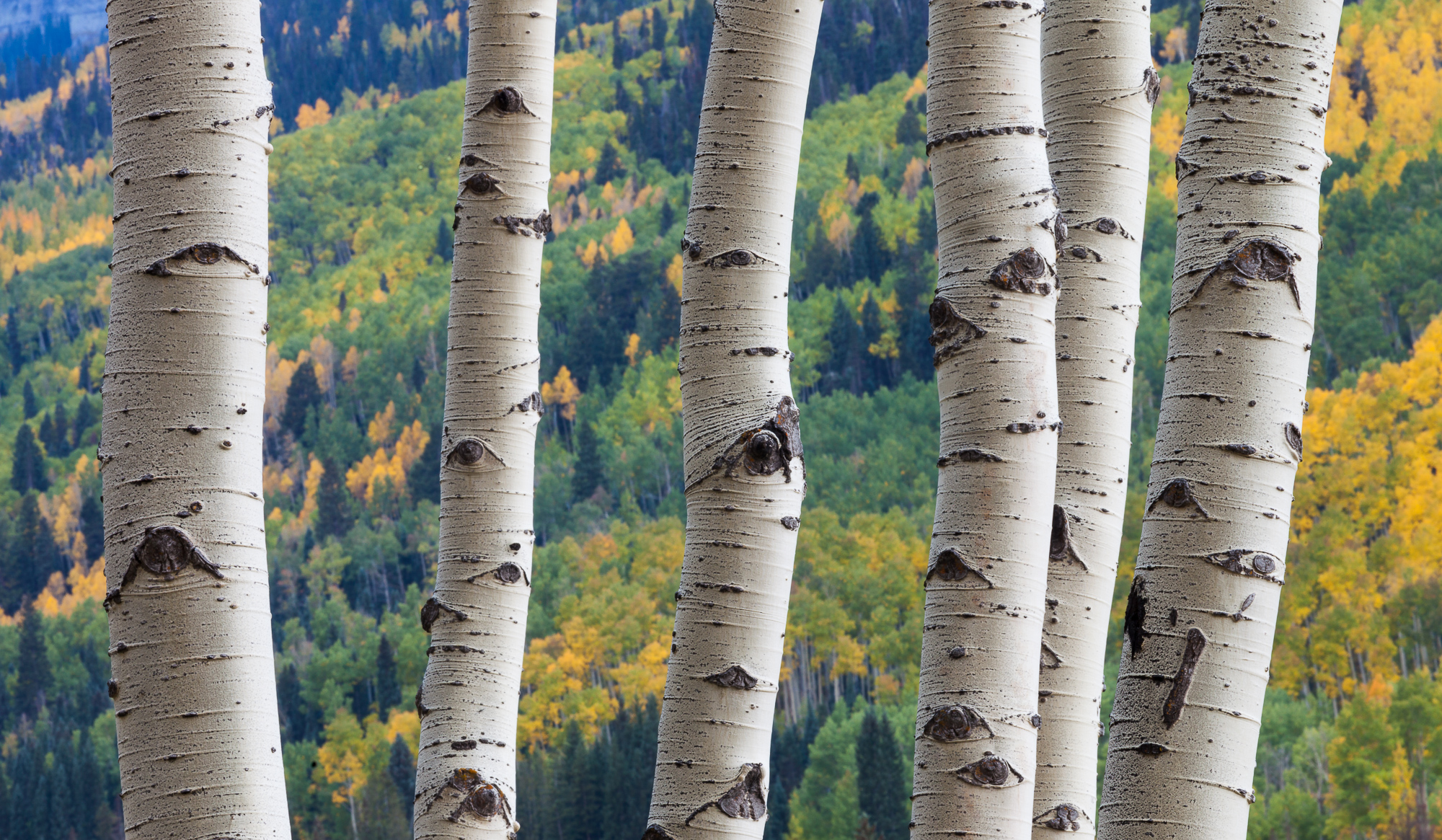
Bone white aspen trunks create abstract lines over distant fall foliage, Ridgway Colorado

When I took this photo, I was in a location with a dirt road running along one side of a narrow valley. The opposite side of the valley was covered with a kaleidoscope of fall colors – a beautiful display. Above the road on my side of the valley was a stand of aspen, with perfect bone-white trunks. I knew the shot I was looking for – now it was a matter of hoping I could find the right composition.

I moved up the steep slope and into the aspen grove. Using a medium to long lens and moving up-slope above the trees, I could shoot straight through a select group of trunks, using the beautiful colors from the other side of the valley as my backdrop. Now was the truly challenging part – I needed to find just the right group of trees that showed a consistent pattern of separation from one another. I finally found some good candidates and spent a while getting my tripod into the right location. Working on such a steep muddy slope made the work slow and arduous. I slipped more than once, preferring to let my clothes take the brunt of the mud rather than my expensive gear.

In the photo, you’ll notice that the spacing between the left and right edges and the left and right most trees is the same. I tried to keep similar spacing between each tree, so as to repeat this pattern across the frame. The trouble trees are the three right most; but after working with them a while, I began to really like how they broke the perfectly even pattern. It brings just a touch of wildness into the photo, hinting at the chaos of this forest.
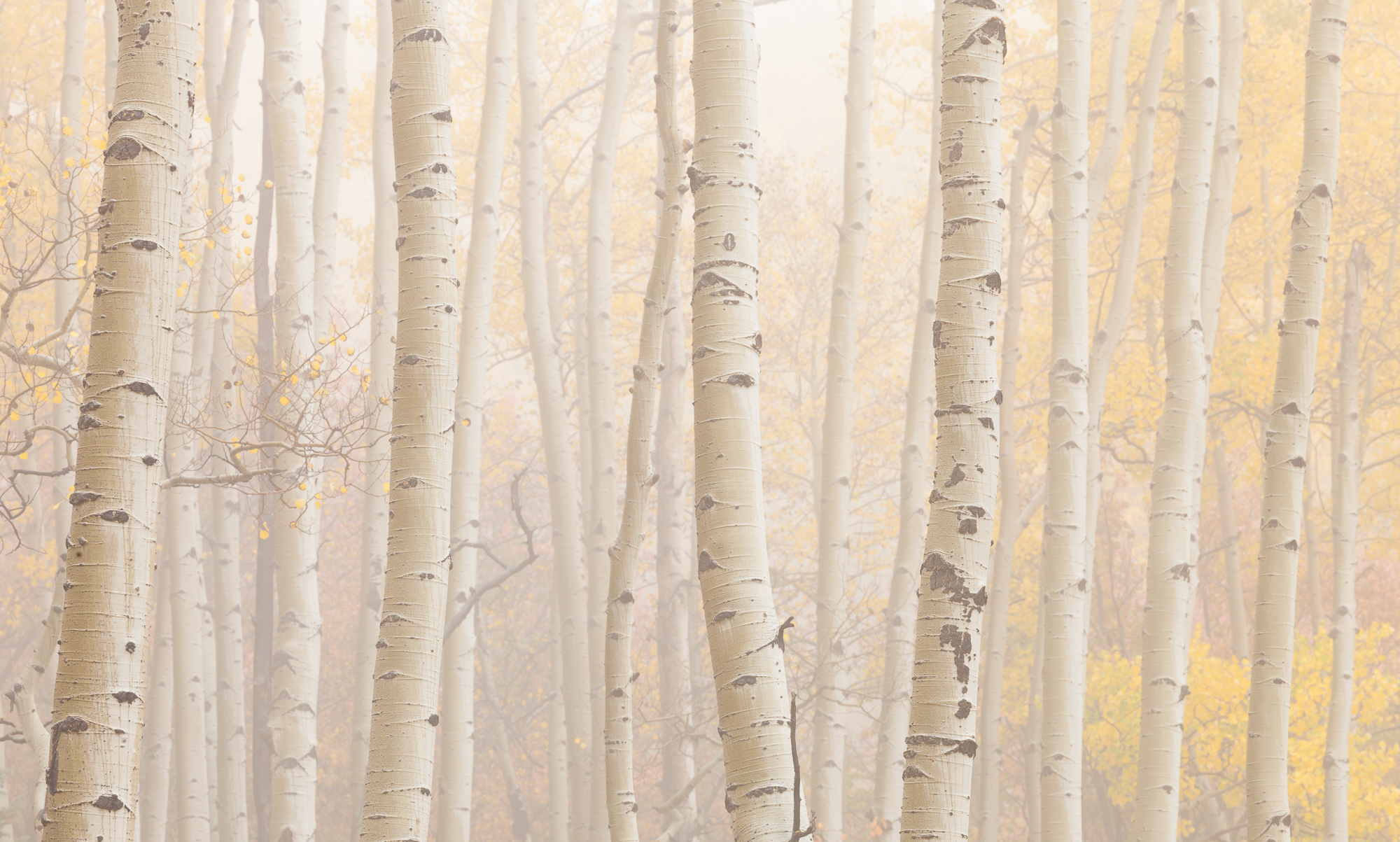
Thick fog shrouds a forest of aspen, Ridgway, Colorado

Another great natural phenomenon to take advantage of to help simplify a scene is fog. This can work especially well to simplify a forest scene, and it worked very well with aspen. Again, I worked on creating an even spacing across the closest trees, knowing they would be rendered in the photo with the most contrast. With these photos, it is especially important to pay very careful attention to the edges of the frame.
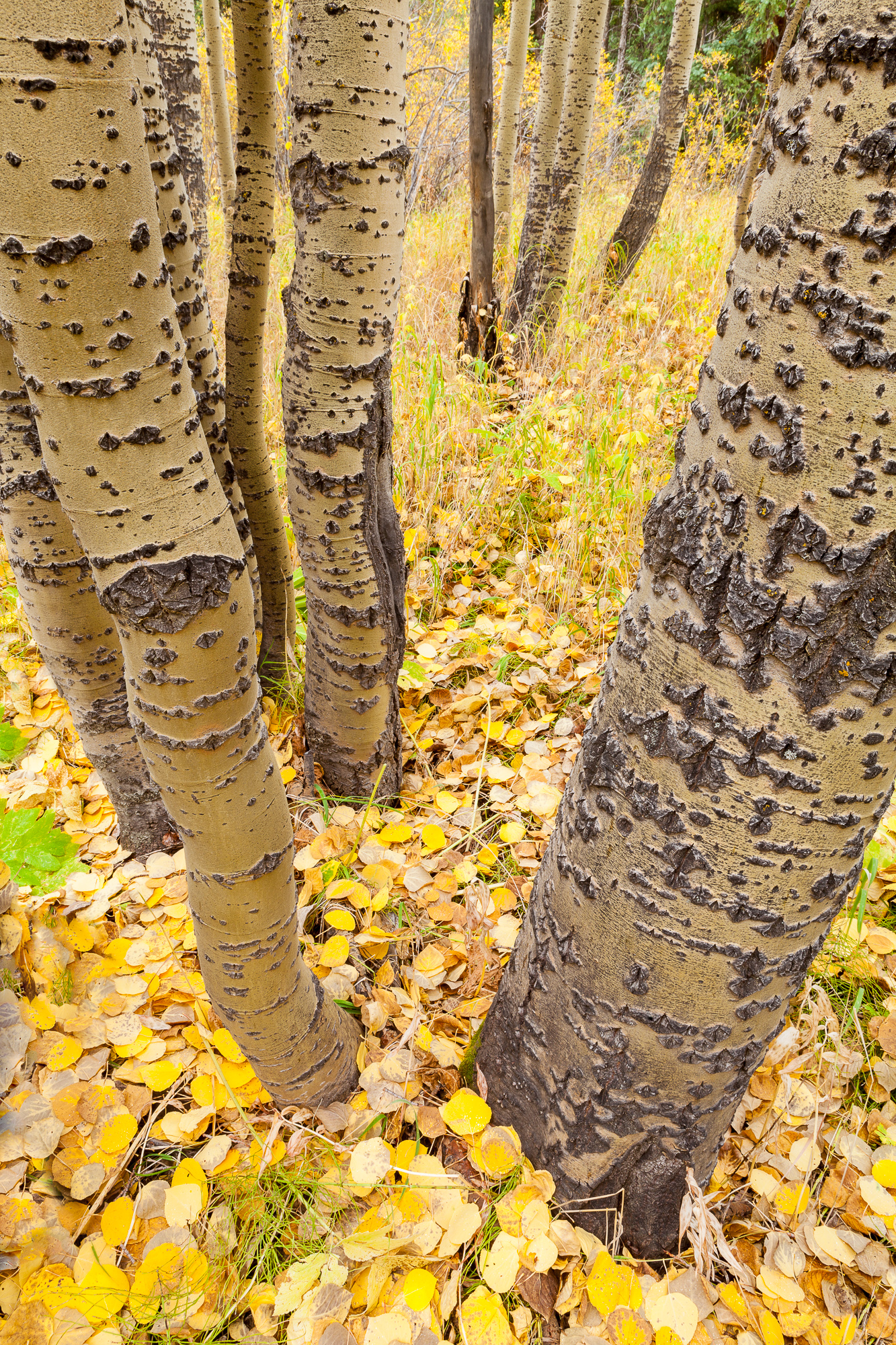
Fallen aspen leaves carpet the forest floor casting the trunks in a golden white

This last photo was perhaps the most difficult of the three. I saw the foreground cluster of trees, and as I moved closer, I saw a repeating cluster in the background, a perfectly placed V shape in the similarly shaped void between the right most tree and the trees to the left of the frame. However, seeing it and shooting it were different beasts. Instead of using my perspective to flatten a three dimensional scene across the frame as in the previous two photos, here I was using the shapes to accentuate the depth of this pattern.

Once I got the tripod and camera in place to get the background cluster of trees where I wanted them, I spent time working on smaller separations appearing in the left most cluster. Some of the trees I could stack on top of each other and hide from the camera’s view-port, but there was one distant tree that kept creating problems. Finally, I got into a position which put the distant tree into a spot that prevented it from peaking out from behind the foreground trees, and I knew I had it.

Although I was working with depth in this photo, the goals were the same as the previous photos: to simplify the chaos of nature into a digestible, understandable subject. Paying special attention to control the spacing between primary elements in the photograph can help achieve this goal.

Yankee Girl Silver Mine

In the late 1800s, the Yankee Girl mine was one of the most profitable mines in the history of silver mining in the United States. At its height, Yankee Girl produced 10 tons of ore on a daily basis.

Last month, I took a great trip out to Colorado to shoot fall colors in the Rockies with some friends. One of my favorite locations to visit (we went back several times because the area had so much to offer) was the Yankee Girl Silver Mine, south of the town of Ouray. Nestled in the San Juan Mountains, Yankee Girl was operational until the early 1900s. In the late 1800s, the mine was one of the most profitable mines in the history of silver mining in the United States. At its height, Yankee Girl produced 10 tons of ore on a daily basis, some of which was carted out by 75 mules every day.

Silver ore was carted out by 75 mules every day. Here the old mine is front lit with dramatic dark skies beyond.

A dirt road winds up into the mining area from the highway, which is comprised of several sites, all of which are in various stages of decay. While these abandoned buildings are interesting enough to explore and photograph, being surrounded by intense fall color foliage added an extra layer of interest to the photos.

There remain many small details of interest scattered about this area.

When covering an area photographically, it is important to look at a subject from many angles and to incorporate elements that help the viewer understand what the scene was like. Here I used old weathered boards to lead the viewer’s eye up into the frame, showcasing the main building. I’m sure if I spent an afternoon roaming the hill on which the mine buildings were perches, I could find many more such elements (old rusted pipes, mined rocks, etc) to incorporate into interesting compositions.

One of the smaller mine structures of the Yankee Girl Silver Mine sits perched over a valley of colorful fall aspen, Ouray, Colorado

Here is one of the smaller buildings in the mining complex. While not as attractive as the main building, it was perched on the edge of a hill with a magnificent color display on the opposite slope. I stitched multiple frames together to create a large resolution panorama.

Stay tuned for more posts based on photos from this trip.

Evening Grosbeaks

An evening grosbeak perches on a branch of a chinese pistache tree, Sunnyvale CA.

I recently finished processing a series of photos I took of a flock of evening grosbeaks that invaded a neighborhood in Sunnyvale, CA, a little south of my home. For several days, the birds were repeating a pattern of flying into the area in the morning, and perching on a row of chinese pistache trees, so I decided to head down and see if I could locate the flock.

I arrived in the neighborhood just after dawn when I figured the birds would be busy eating. I began to walk up and down the streets, occasionally stopping to listen for the distinct crunching sound of the birds eating the fruit off of the trees. All the while I was under the watchful eyes of the residents, who probably don’t often see someone walking past their house with an 800mm lens mounted to a large tripod.

An evening grosbeak perches on a branch of a chinese pistache tree and eats a small seed, Sunnyvale CA.

Finally, I was on the verge of giving up and decided to make my way back to my car. On my way back, I passed under one of the many chinese pistache trees and heard the soft crunch crunch crunch. Looking up I could just see one or two of the grosbeaks in the upper most branches. Thrilled, I set up my gear on the sunny side of the tree (so that the birds would be front lit), and waited until some of them ventured to lower fruit.

An evening grosbeak reaches for food on the branches on a chinese pistache tree, Sunnyvale, CA.
An evening grosbeak reaches for food on the branches on a Chinese pistache tree, Sunnyvale, CA.

In all I hung out for about 20 minutes before the birds lifted off and flew elsewhere. It is always a treat to get such opportunities to photograph seasonal migrants.

Hiker And Halfdome

A backpacker stands on an outcropping admiring the view while Half Dome rises high overhead, Yosemite National Park

I created this photo on a backpacking trip a few weeks ago. I set out with a couple of friends, Frans and Mark, and our three day plan was to hike along the northern rim of Yosemite Valley from Snow Creek to Yosemite Falls.

I knew our best photo opportunities would likely be on the first evening. Snow Creek is located along the rim of Tenaya Canyon, directly across from the face of Half Dome. I had been here once before, and ever since that trip I had been visualizing the photos that I wanted to create there.

Primary on my list was a shot of a backpacker with the face of Half Dome looming high above. Half Dome is most famously viewed from the side, as most photographs of it are taken from the perspective of Yosemite Valley. In order to be successful, this photo had to have a few specific characteristics.

First of all, I knew I needed to use a long lens. I wanted to render the backpacker fairly large in frame, but also render the dome as large as possible. This meant that I needed to be close to the hiker and stack the layers of depth on top of one another, so that both near and far subjects would be large in the photo. Had I used a wide angle, the dome would be much smaller than in my vision.

Secondly, I wanted to shoot this in late afternoon with clear skies to the west. When the sun sets, its light moves all the way up Yosemite Valley and strikes the face of Half Dome, giving it a warm orange glow. On this particular day, I could have done with some clouds to the south and east, so that I’d get a little sky interest, but I worked with what nature gave me.

One thing I didn’t think about beforehand was the fact that the plateau from which I was shooting would be completely in shadow. This meant that in order to properly expose the cliff face, the backpacker would be too dark to clearly see details. After some experimentation, I decided to go with high contrast and render the backpacker as a detail-less graphic silhouette. I think this works very well in the final image, as it creates more emotional impact for the viewer. Those who travel this nation’s back country can easily see themselves standing in the photo, experiencing a glorious sunset.

Mark and Frans graciously volunteered to be my models, and I ended up choosing this photo of Mark as my favorite. In order to add more of the scene, I took additional photos of Half Dome and stitched them to the first shot to create a panorama. This really completes the scene, showing the entire cliff from which Half Dome emerges. We had a great (and cold) three days in the wilderness, and as I suspected, the photos I took from Snow Creek ended up being my favorites.

Copyright 2017 Hank Christensen