
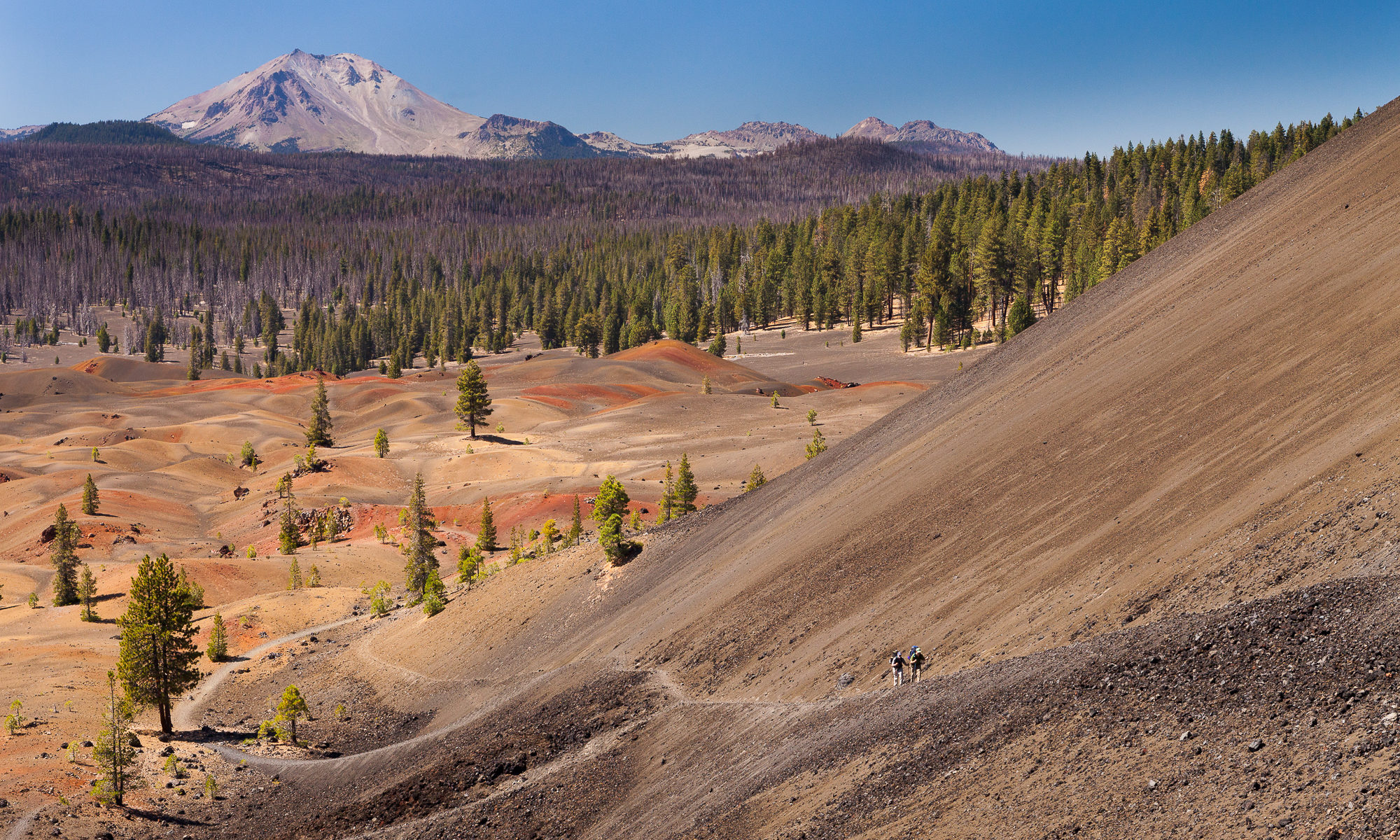
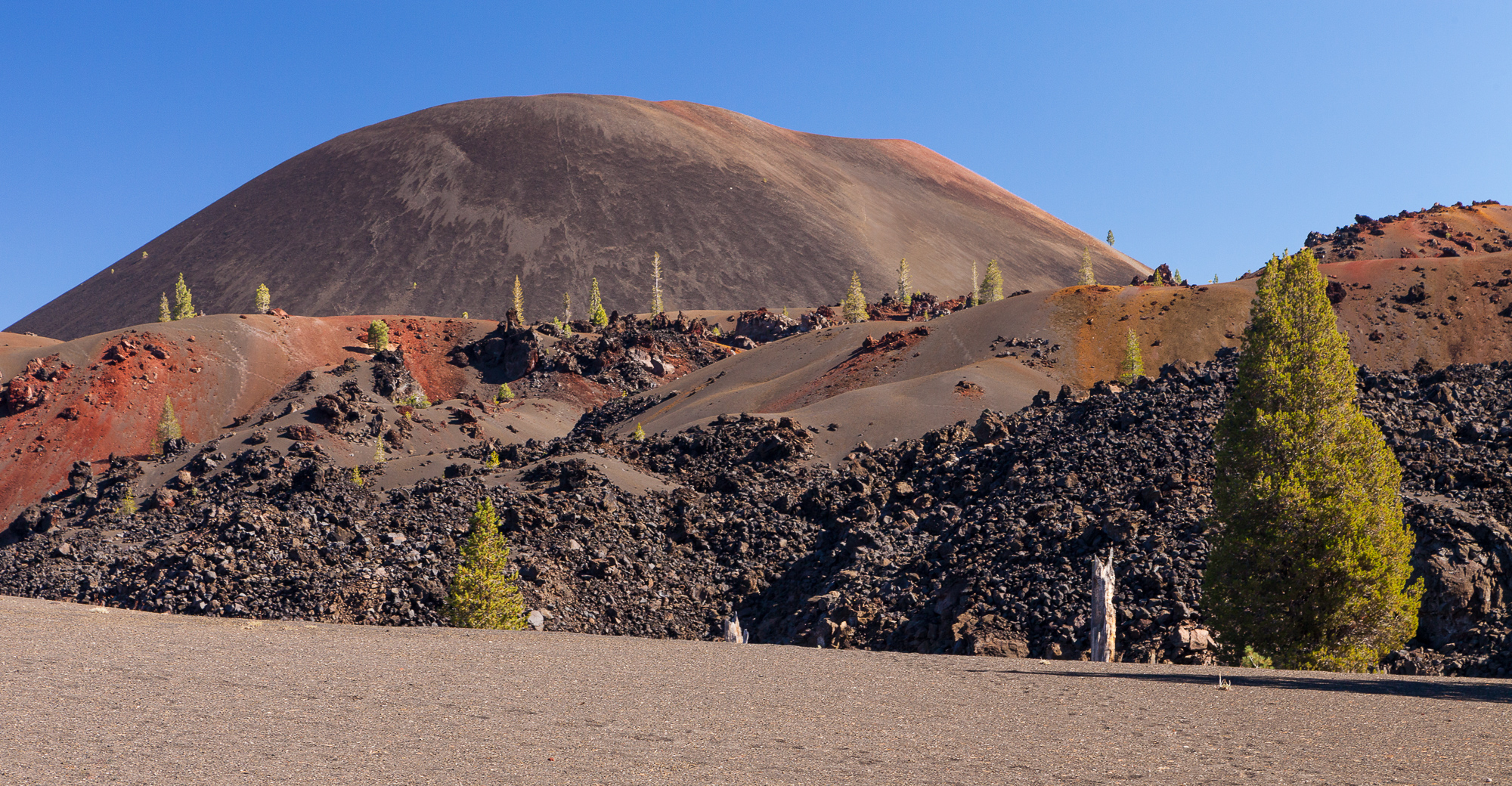
Lassen Cinder Cone

The Lassen Cinder Cone forms a large round hill when approached from the west, Mt Lassen National Park.

A couple of summers ago I met my brother and dad in Mt. Lassen National Park for a backpacking trip. This park sees one fraction of the backpacking that other national parks get. As a result, you get the feeling of having the back country to yourselves. More importantly for me, this trip would revolve around revisiting the Lassen Cinder Cone that sits in the east part of the park. We had been there many years before on a day hike, but backpacking would give me more time to explore it photographically.
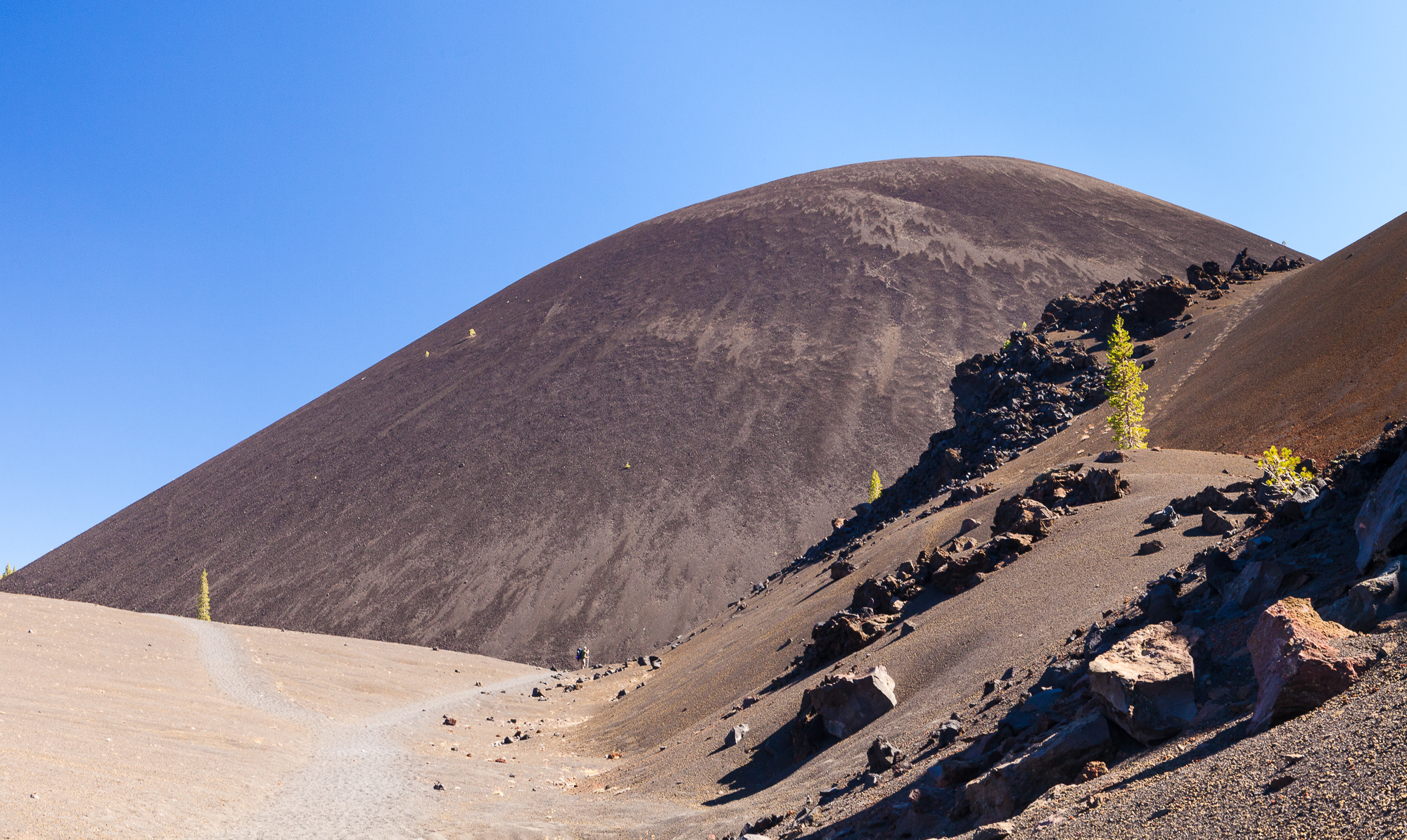
A backpacker is dwarfed by the large Lassen Cinder Cone as he heads up the steep trail to the top, Mt. Lassen National Park.

We spent the night at Snag Lake, and in the morning, approached the Cinder Cone from the south. From there, we reached the steeper of the two trails that wind to the top. In the photo above, you can see my brother as a small speck as we neared the cone from the west.
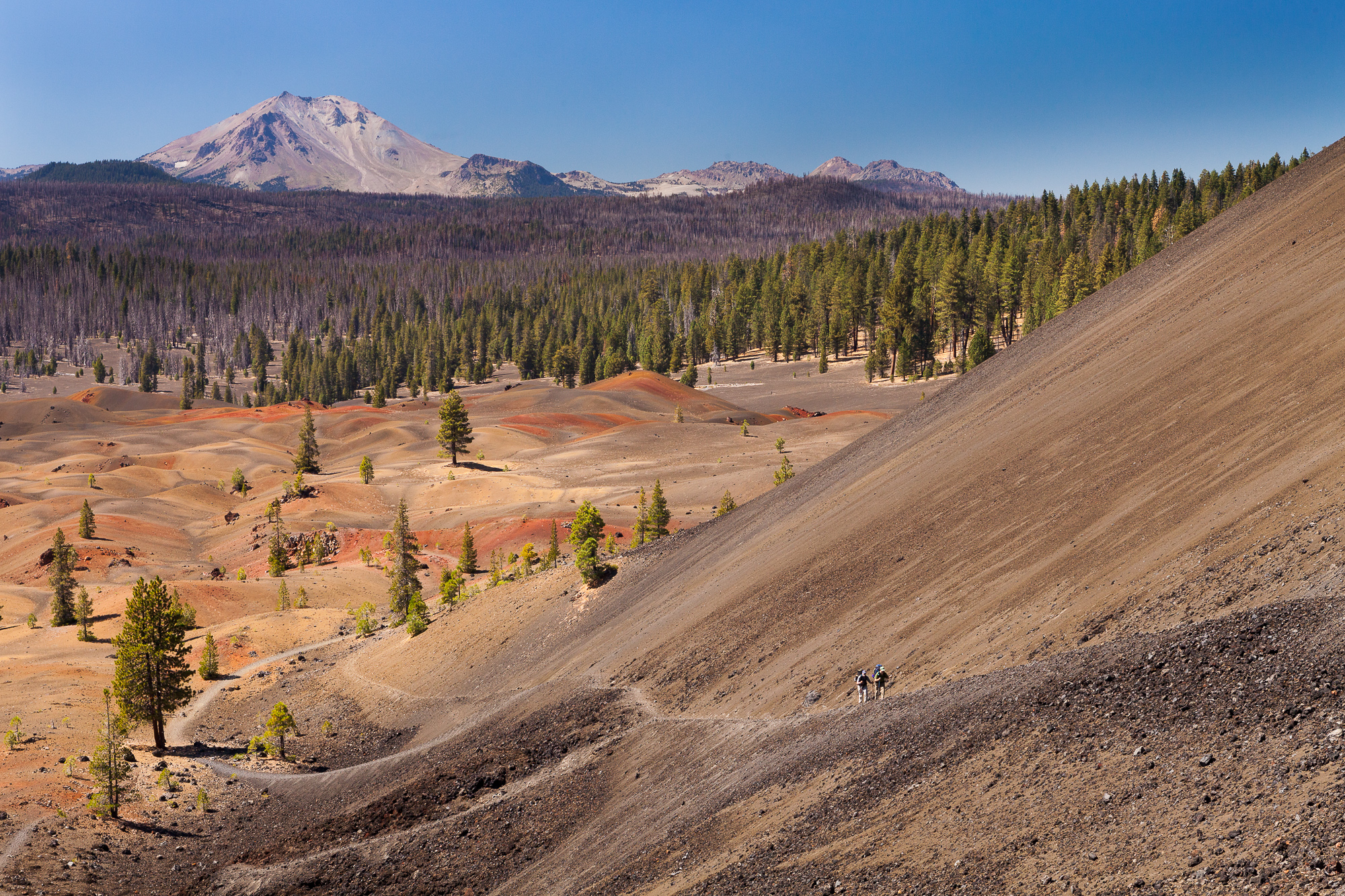
Two backpackers climb the steep southern trail up the Lassen Cinder Cone. Mt Lassen and the Painted Dunes can be seen to the west.

The trail to the top is built using the loose volcanic scoria that makes up the cone itself. It is only a little more solid than walking up a sand dune, and is not for the faint of heart. This is due not only to the phyisical exhaustion that comes from pushing up such a slope, but also the steepness of the trail itself. At times I felt like I was going to tumble backward down the trail as my backpack made me somewhat off balance.
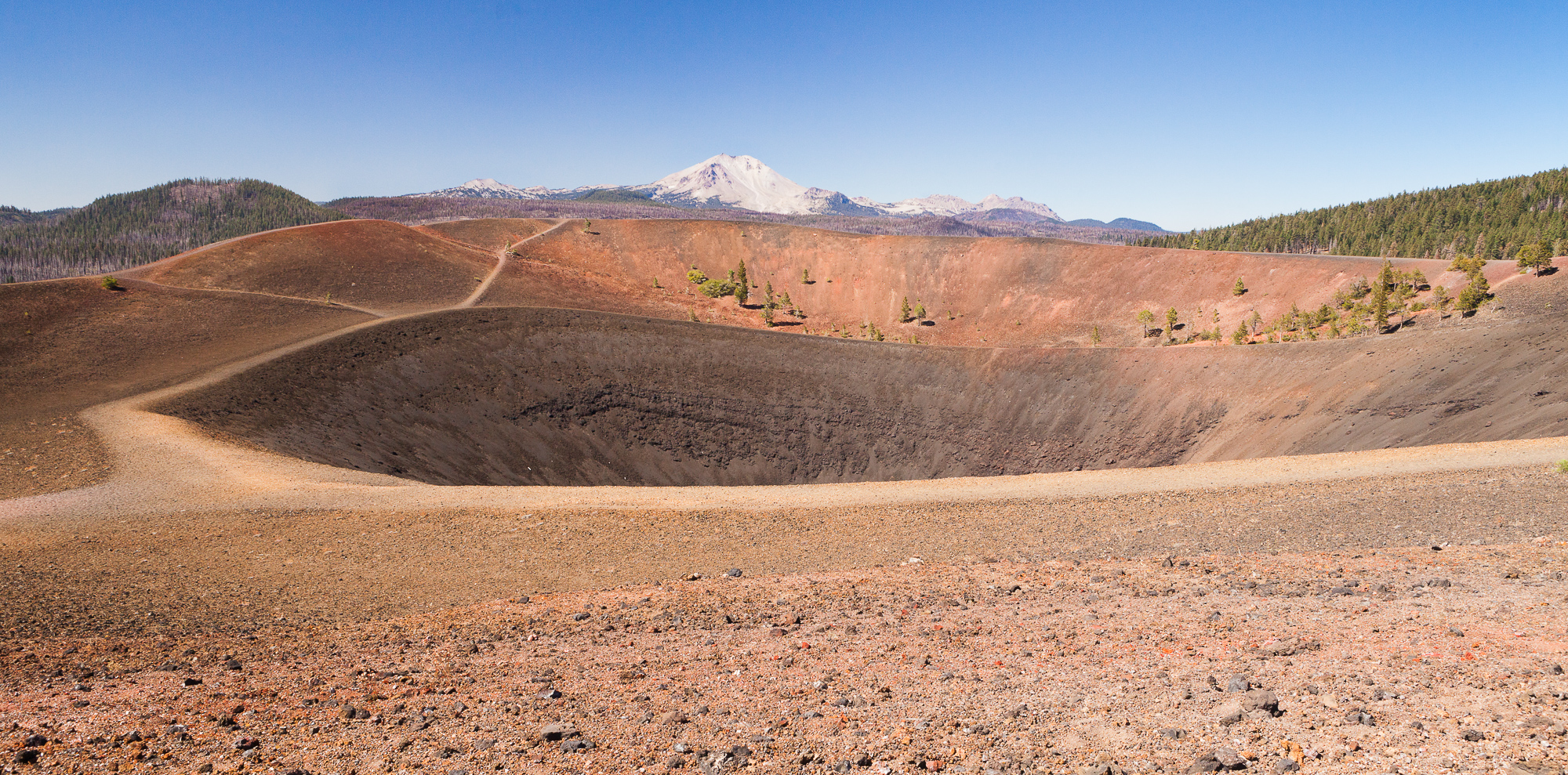
A large cinder cone sits to the east of Mt. Lassen in Northern California. A trail decends a hundred feet into the mouth of the cinder cone to a large steam vent.

Those who reach the top are rewarded with spectacular views of Mt. Lassen to the west, as well as a chance to peer down into the crater of the cone. A trail even descends into the mouth of the crater, where you can stand next to thermal steam escaping from the ground.

The cinder cone was formed long ago by many small eruptions that threw lava into the air, which cooled into the loose, porous volcanic rock. Over time, this piled up into the 700 foot tall cone that we see today. It is thought to have erupted as recently as the 1650s, though the only activity that remains today is the steam rising from the crater.
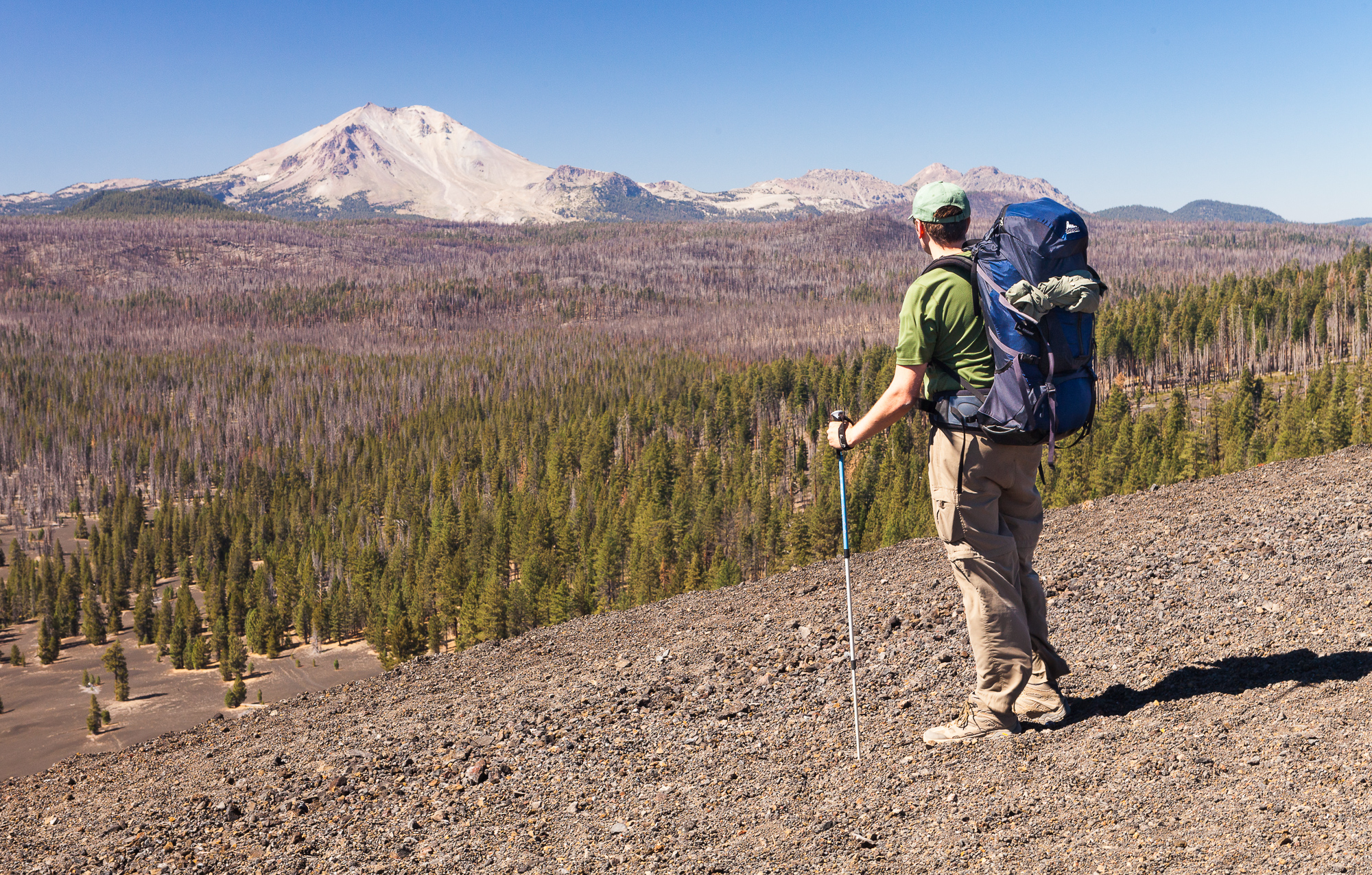
A backpacker looks at Mt. Lassen from the top of the Lassen Cinder Cone.

Walking to the western edge of the crater, we were rewarded with views directly across from Mt. Lassen, as well as views of the Painted Dunes below.
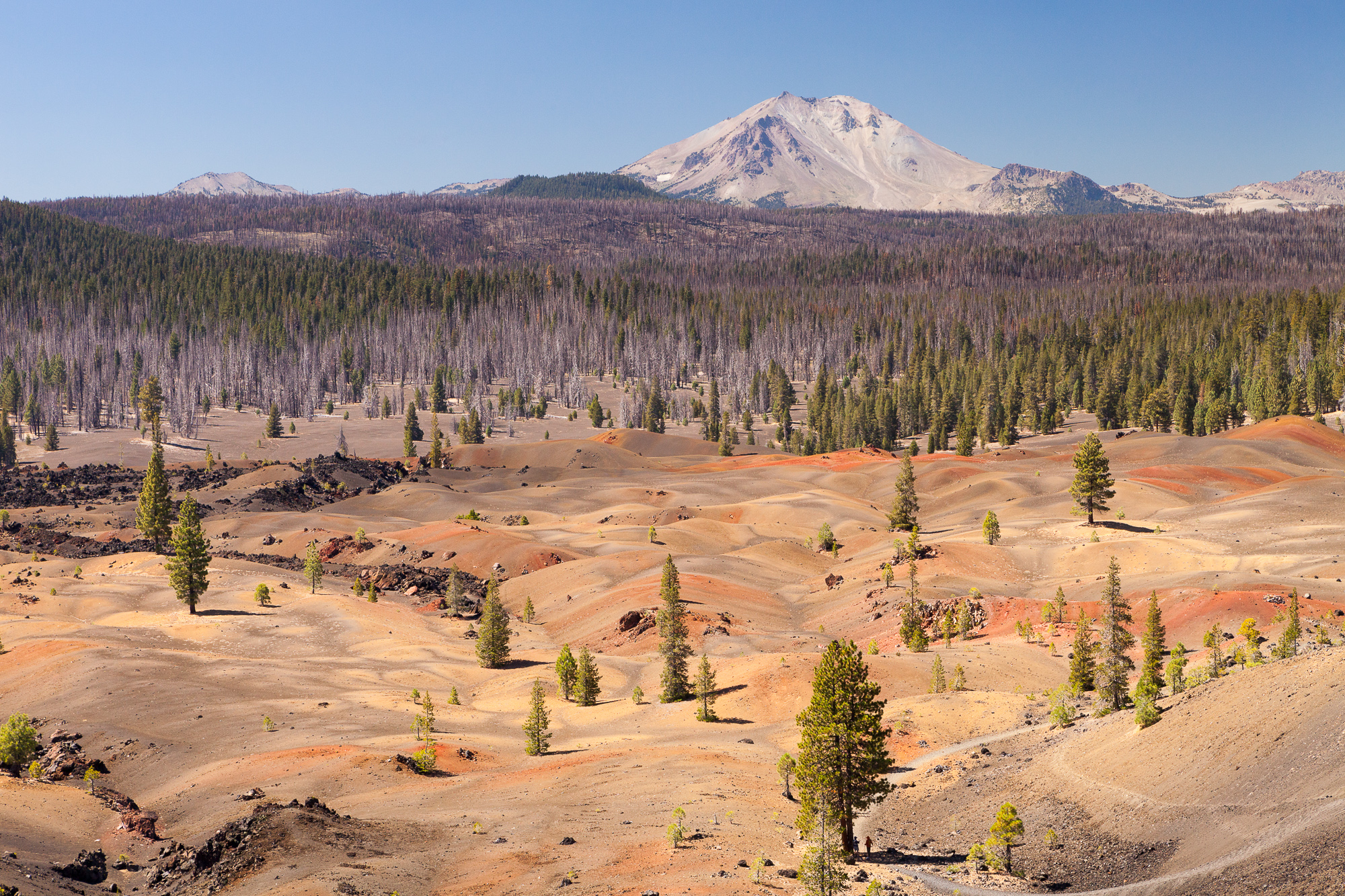
The Painted Dunes extend to the forest surrounding Mt. Lassen in Northern California. These volcanic dunes were formed by a thousand year old cinder cone.

The painted dunes are pumice fields formed by oxidation of volcanic ash from earlier eruptions of the Cinder Cone. Its beautiful colors formed because the ash fell on lava that was still hot and forming.
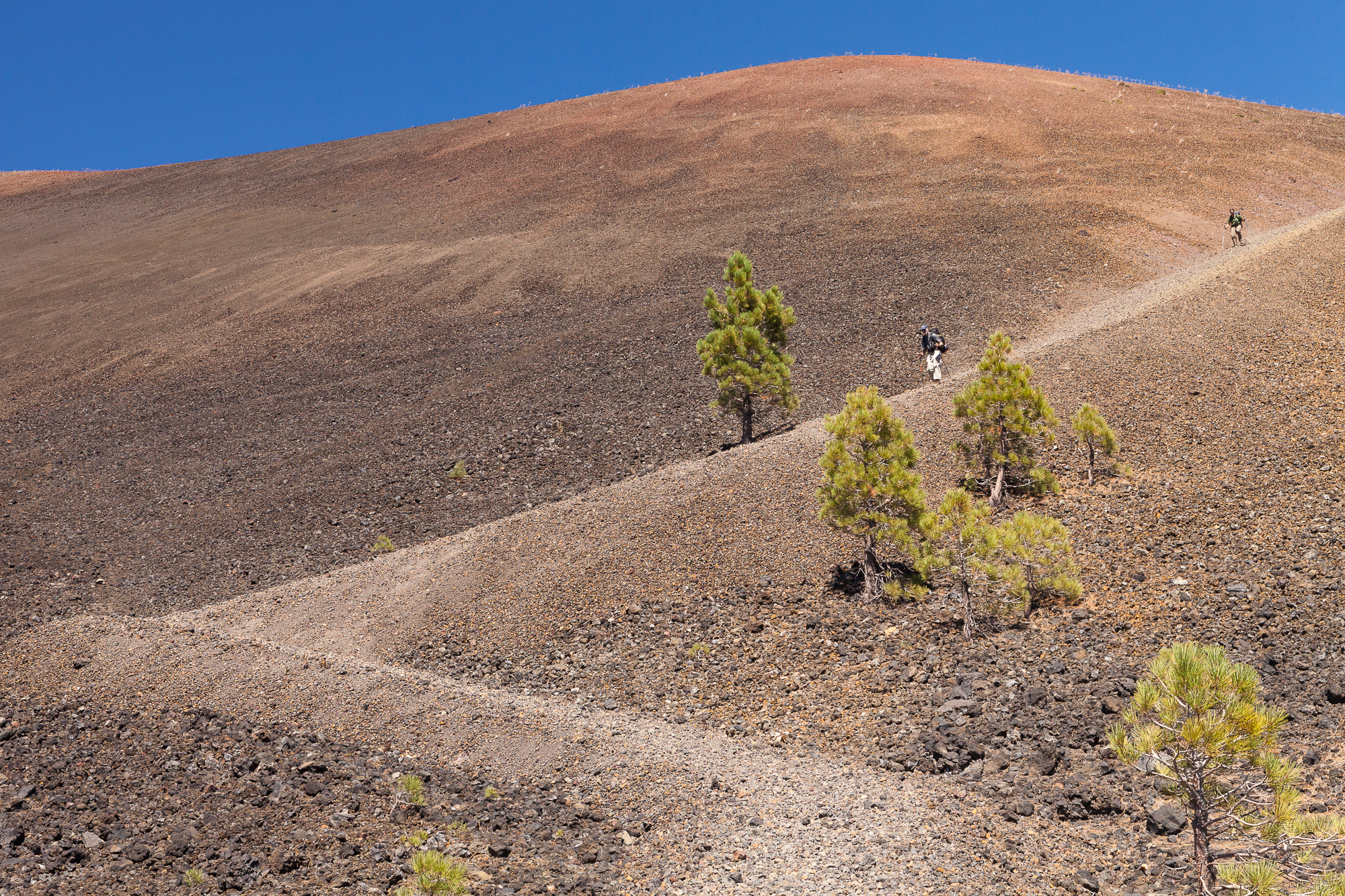
Two backpackers decend the steep southern trail of the Lassen Cinder Cone, Mt Lassen National Park.

After a while at the top, and after we tired of braving the fierce wind, we descended the way we had come up. I tried not to think about the consequences of losing my footing, and took it step by step.
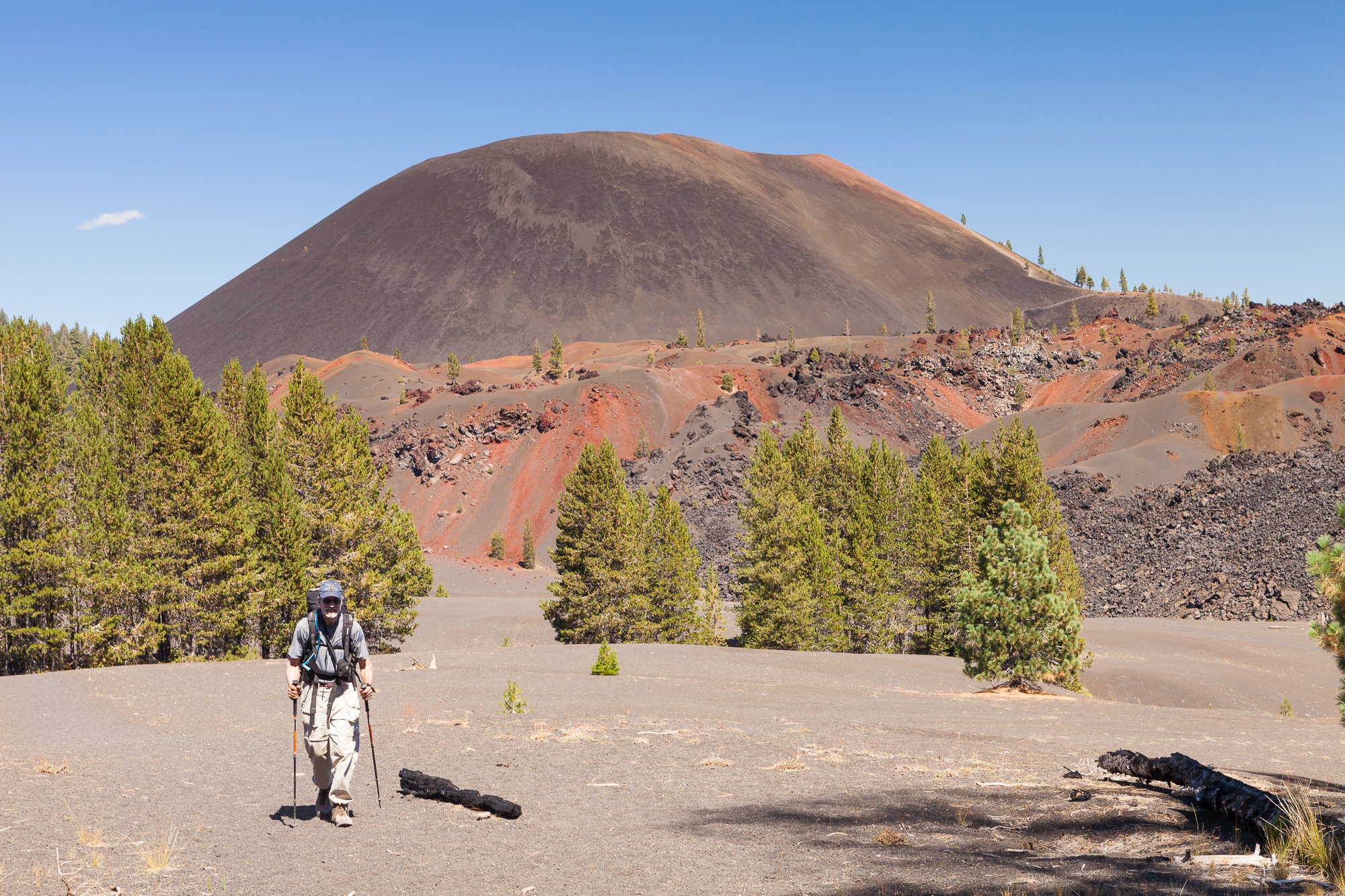
A backpacker heads west away from the Lassen Cinder Cone, Mt Lassen National Park.

Soon we were down and continuing our day’s hike to our destination of Summit Lake. The promise of camp chairs and cold beer quickened our step. It was great to spend time up close with this unusual creation of nature.

Bandon Moody Mornings

A moody sky breaks in early morning over Bandon Beach, Oregon

Recently I published a post about my trip to Bandon Oregon and some of the sunset conditions I faced. Here is a counterpart to that article about the mornings I spent on the beach. Due to the weather, most mornings were overcast and very moody. It was a perfect opportunity to capture a quiet beach in somber lighting.

A moody sky breaks in early morning over Bandon Beach, Oregon

Most mornings had a very low tide, offering more compositional opportunities than sunset. For the photo above I spent some time studying the interplay of shapes between the sand, water, rocks, and their reflections. It is important to separate out the graphical elements in your image to prevent strong lines from overlapping. I had to carefully balance the space in between the large rock reflection and the sand bar jutting into the tide pool, with the spacing between the mid-frame rock and the sea stacks out on the horizon.

Low tide uncovers clusters of mussels, Bandon, Oregon

On another part of the beach, I found a large group of exposed mussels and decided to use them as leading lines out to the large sea stacks in the water. Getting down low with a wide angle lens helped emphasize the mussels in the foreground. Here I used focus stacking to ensure sharp focus throughout the frame.

A low tide exposes large stones and carved sand along Bandon Beach, Oregon

The flat light of the morning lent itself well to black and white conversions. What attracted my eye to this area were the deep lines in the sand cut by the receding water. By converting to black and white, I was able to emphasize these lines by increasing the contrast and bringing out the drama of the image. I also liked the randomness of the rocks strewn about the background of the image. Compositionally, it is a nice juxtaposition of the round shapes of the rocks with the jagged straight lines cut through the sand.

The sun rises on a blue, dreary day along Bandon Beach Oregon

Sometimes instead of adding contrast to an image (as in the black and white image seen above), it is better to showcase the low contrast qualities of the scene. Many mornings there was a foggy mist that settled around the rock formations, and here I wanted to show that atmosphere as well as the blue light cast of the morning.

The sun rises on a blue, dreary day along Bandon Beach Oregon

Finally, this image was shot on the same day as the image above, but I increased the contrast to show off the sharpness of the foreground rocks leading to the rock spire.

It was a lot of fun to really think about why I was attracted to each of these images and use the processing stage to convey those thoughts to the viewer. It is also a reminder that taking the photos is only half of the story. A lot of communication comes through in the processing itself.

Bandon Sunsets

The sun sets behind the western horizon, casting the offshore sea stacks into shadow, Bandon, Oregon

This spring I made a trip with a friend to photograph the area around Bandon, Oregon. Bandon is a very popular golf destination, and in recent years has become a gathering point for many photographers. Mornings and evenings can see dozens of tripod wielding forms roaming up and down the beach, searching for that unique perspective. Here are a collection of sunset photographs I made over the course of several days.

The setting sun at Bandon Oregon turns the sky an orange pink and turns the sea stacks into silhouettes.

While I was there, I was blessed with some reasonable low tides at sunrise, but unfortunately, most sunsets coincided with higher tides, moving me further away from some of the spectacular sea stacks for which this area is known. However, you always have to work with what nature gives you, and I used the varied tides to give me a wider variety of images.

In the shot above, I worked with a lower tide, which allowed me to use a wide angle and get very close to the foreground rock. This gave the beach a lot of depth, and pulled the sea stacks farther into the background.

However, in the shot below, the tide was in much further. This allowed me to use a longer lens and compress the rocks together, giving much more weight to the background sea stacks.

The setting sun at Bandon Oregon turns the sky an orange pink and turns the sea stacks into silhouettes.

In the hour before sunset, I moved closer to one of the sea stacks and played with sun stars along the edge of its silhouette. The sinking sun forced me to constantly change my tripod position, but it helped to have a vertical line to play against. This gave me many more opportunities than if the sun sank behind a horiztonal-oriented object. To catch a good sun star, you have to use a stopped down aperture and catch a light source right on the edge of an obstruction.

The setting sun at Bandon Oregon turns the sky an orange pink and turns the sea stacks into silhouettes.

Unfortunately for much of the trip, we had clear skies in the evening. We did get the sunset glow over the horizon, but the color interest faded to dull grayish orange as you moved up in the sky. This kept most of my compositions low to the horizon, choosing instead to catch the color interplay of red and blues in the moving waves.

The sun sets behind the western horizon, casting the offshore sea stacks into shadow, Bandon, Oregon

It always helps to get a variety of lens lengths to capture a subject in different ways. In the shot above, I used a long telephoto to compress the waves and rocks together, creating a more graphical image. In the shot below, I went much wider, including more of the sky and much more of the incoming waves.

The sun sets behind the western horizon, casting the offshore sea stacks into shadow, Bandon, Oregon

In all this was a sometimes frustrating trip due to the weather. Many mornings were socked in with fog and the evenings saw blown out clear skies. But trying to pull variety out of the location is always a challenge I strive to overcome. I know I’ll be back to this location in the future, hoping for more changing conditions and weather variety.

Sunrise Sunset, Hawaiian Style

Okay, so I’m REALLY behind on my photo editing. I try to keep up to date with important photo shoots, but that often means that my less important photos fall into my backlog for later processing. Here is a set of images I shot in Kauai in 2013. Like I said, I am very behind!

Clouds billow over the water at sunset, Kauai, Hawaii

Often when I’m shooting landscapes, I create images that has a foreground, middle ground and background, to create depth and lead the viewers eye into the frame. However when I was in Hawaii, I found myself simplifying ocean images into nothing but clouds, colors and water. These images are really all about the colors and texture of the clouds, and most are shot with longer lenses.

Pastels color the northern sky at sunrise, Kauai, Hawaii

While I was there, I had a mixture of dramatic sunrises and sunsets. As I was situated on the north shore of the island most of the time, I had similar side-lighting on each end of the day.

Clouds billow over the water at sunset, Kauai, Hawaii

However, sunrise gave me the most dramatic clouds and lighting. When shooting into the rising sun, I used silhouetted tree tops to give a sense of scale.

Dramatic shadows play across the thick clouds at sunrise, Kauai, Hawaii
Palm trees are silhouetted by sunrise clouds, Kauai, Hawaii.

And when appropriate, I included a bit of shoreline to the east and west, depending on sunrise or sunset.

Clouds to the east light up over Kauai's north shore at sunrise
Clouds to the east light up over Kauai’s north shore at sunrise
The sun sets behind the northern cliffs of the Napali coast, Hanalei Bay, Kauai

Overall, the colors and lighting of the Kauai sea were spectacular enough to hold their own without a strong foreground. When seen together, they paint a picture of the drama that can play out between light, clouds and ocean.

Copyright 2017 Hank Christensen