Sooty Grouse

Female sooty grouse can be seen in wooded areas, usually on or close to the ground.  Males can be heard throughout the Sierra Nevada, but are much harder to spot, as their deep booming vocalizations are difficult to triangulate. Yosemite National Park.
Female sooty grouse can be seen in wooded areas, usually on or close to the ground. Males can be heard throughout the Sierra Nevada, but are much harder to spot, as their deep booming vocalizations are difficult to triangulate. Yosemite National Park.

On a recent backpacking trip to Yosemite I managed to see and photograph a female sooty grouse. I had been hearing the booming calls of the male all day long as I made my way up switchbacks out of the valley, climbing ever higher into the high country. Although very vocal, the males are very hard to spot. They create a deep booming call that resonates at a low frequency. This allows the call to travel a great distance, but it is difficult to discern directionality of the sound. In addition, males will fly up into tree branches to broadcast, while most of the life of the female is spent foraging on the forest floor.

A female sooty grouse picks through the forest needles looking for food, Yosemite National Park.

Indeed this is where I found the female – scratching for food in a sparse forest next to a creek. This situation called for me to stretch my stalking skills to the maximum, because my longest lens I had with me on my trip was my 70-200 mm, and this was on a full frame camera. I usually photograph birds with an 800mm on a 1.6X cropped sensor, so I was at a severe disadvantage to my usual setup.

Creeping ever closer, I managed not to disturb her too much. My best shots came when she ducked behind a tree and wandered into a small clearing. I managed to sneak up directly behind the tree, and then peak around the side.

Trying for these shots in a dark forest required I gather as much light to the sensor as possible. This meant shooting wide open (f/4 was the best this lens had to offer), using the lens’ image stabilizer (of course!), and shooting at a high ISO.

Although this is not the most colorful bird I have ever photographed, I was excited none the less. It was a life bird for me, and it was thrilling to have such an opportunity when I was not on a trip specifically geared toward bird photography, and I didn’t have my optimum gear with me.

White-tail Kite Fly By

A white-tailed kite perches on a tree stump, surveying the landscape around it

A little while ago I visited Arastradero Preserve in Palo Alto, CA in order to get some photos of some of the white-tail kites that live there. And I was certainly not disappointed. I climbed a large hill in order to get above some of the trees on which they perch while they are not hunting. I quickly saw one of the kites and slowly made my way toward its tree.

A white-tailed kite perches on a tree branch, surveying the landscape around it

With my eye glued to the view finder, I had my lens tight in on this bird, capturing shots of it flying up and back to various branches on the tree. Suddenly a dark form darted by just above the kite. Luckily, my photography training was to shoot first and ask questions later, and I capture a single frame of what I later saw to be another kite flying at the first one.

A male white-tail kite flies past a female, which reacts to his close proximity

I quickly realized what was going on, as the male came in for another pass, this time reaching his target, and landing on top of the female.

A male white-tail kite approaches a female from behind and mates with it

The male quickly mated with the female, and just as quickly flew away. And before you ask, yes I do have photos, but hey, this is a family friendly blog!

A male white-tail kite approaches a female from behind and mates with it

I’ve never seen this before or since, and I definitely know that I wouldn’t have been able to capture these shots if I hadn’t already had the female framed and in focus. Sometimes you just get lucky….

Try, try, and try again

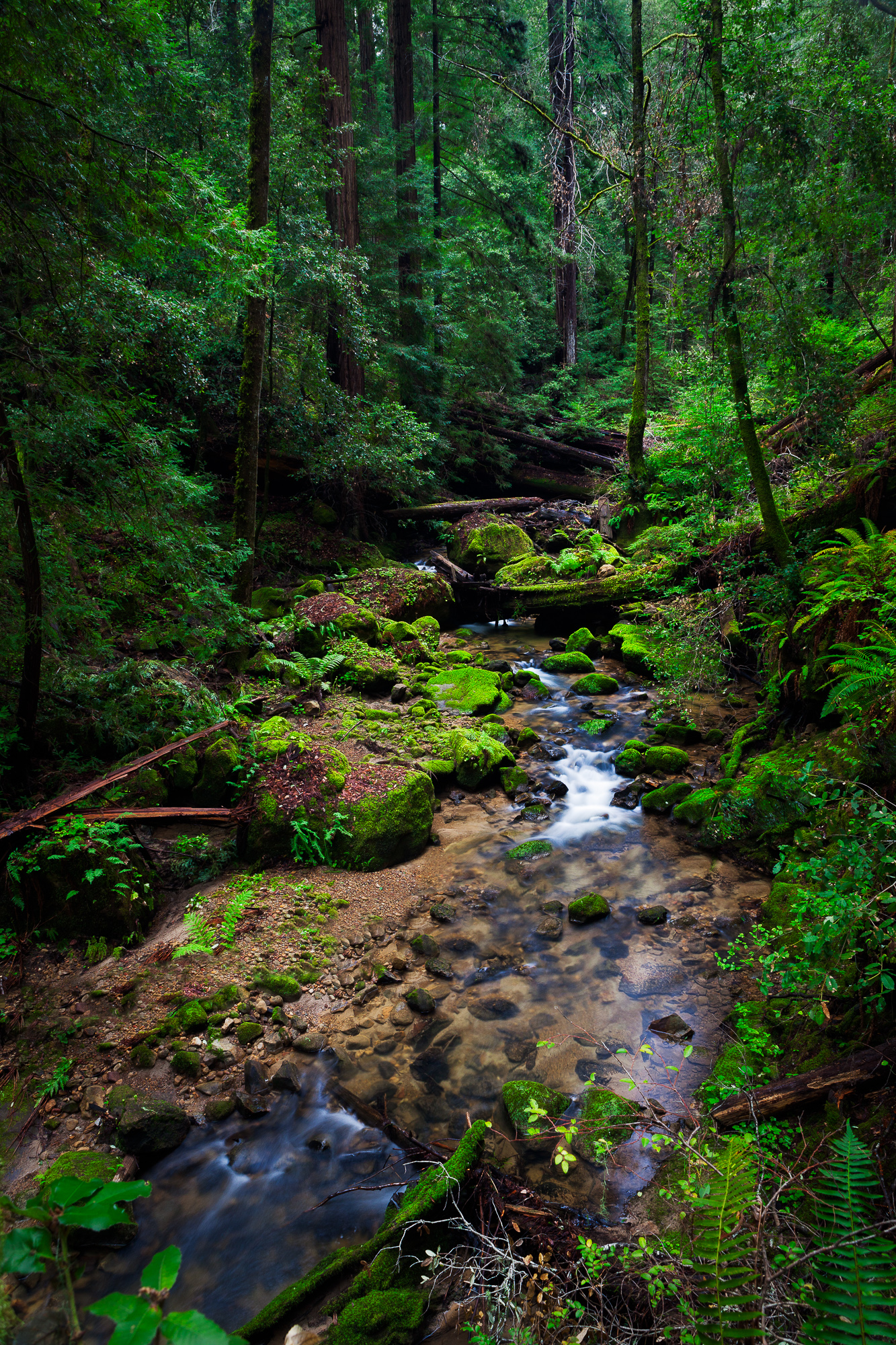
Waddell Creek flows through a green forest along the Berry Creek Falls trail, Big Basin Redwoods State Park

One of the keys for any budding photographer is to shoot often, and stay well organized. You never know when photos you have taken in the past might some day become marketable. Several years ago, I shot a series of photographs on spec for a national magazine, including the photo you see here. Shooting on spec means that the magazine is requesting a photo with particular specifications, but has not given you an assignment and guaranteed publication. This is something I wouldn’t recommend unless it is almost no cost to you (including time spent!). My brother graciously volunteered to come along an be my model for the day.

Unfortunately, the magazine didn’t use my photographs for the intended article (in fact, I don’t know if they ended up running that article at all). This happens all too often with editorial publishing, which is why shooting on spec is almost never a good idea, especially if photography is your primary source of income. However, a couple of years later, that same national magazine did print one photo from this outing for a different article, and just recently another magazine is looking at these photos for publication as well.

The only way this was possible was for my photos to be well organized so they were easy to submit for other uses over the years. This means they were well captioned, titled, and tagged with keywords. Even though the original intent for the photos fell through, they were still very usable and have become part of my photo archive. Who knows when one of these photos will be used again in the future?

Dark-eyed Junco

A dark-eyed junco perches on a tree branch and flashes his tail feathers

Dark-eyed juncos are most often seen on the ground, pecking around for bits of seed. But in this photo, I managed to capture one perched for a long period of time in a tree branch, seemingly displaying his tail feathers.

Normal courtship behavior for a male is to stand on the ground near the female, dip his head and raise his tail feathers while fanning them out to each side. I had never before seen one fanning its feathers up in a tree. And no females were anywhere to be seen. If this bird was attempting a courtship display, he was going about it all wrong.

But it was amusing for me, and I snapped away, capturing a behavior and location that I had never seen before with this bird.