
Lake Vernon Loop

The spray from Wapama Falls creates a rainbow as it rushes into the Hetch Hetchy Reservoir, Yosemite National Park

Recently a friend and I headed up to Yosemite for an early season 4-day backpacking trip. It was a good excuse to loosen up the joints for the summer and get out in the Sierra backcountry. We chose the area around Lake Vernon as sort of a staging point from which to launch an off-trail loop into some of the less explored drainages. Supposedly, this area was relatively snow-free compared to other areas at similar elevation (7,000 – 9,000 ft).

We decided to hike up out of Hetch Hetchy due to the easy access. Because permits are issued at the entrance gate, you can get a wilderness permit the night before as late as 9pm. That is a huge help for those driving up after work from the Bay Area. We got there Friday night, got our permit, and settled in at the backpacker’s campground overlooking O’Shaughnessy Dam. We were up at 5:30 the next morning, and hit the trail by 7am. We had a very long day of hiking and lots of climbing, so we needed the early start.

The uneventful hike along the edge of Hetch Hetchy reservoir was punctuated only by the raging waters of Wapama Falls (see photo above). A couple of weeks earlier, the flow from the fast snow melt was so great that park rangers closed the bridges across the falls and shuttled people by boat around the dangerous spots. I was happy that we timed it such that it was a easy walk through the water spray.

We reached Rancheria Falls by 9:30 and began our long climb up out of the lower elevations of Hetch Hetchy. After a long day of absolutely nowhere to camp (not that we were ready to stop anyway), we reached our destination of Lake Vernon. It ended up being a 16 mile day with 4800 ft of elevation gain. Not surprisingly, we were pretty worn out for a first day of the season! With little time to scout before it was fully dark, I set my alarm to wake up before sunrise and do some quick scouting for shots along the shoreline.

Twisted trunks of trees are reflecting in Lake Vernon are silhouetted against the pre-dawn light, Yosemite National Park

One of the features of the lake that struck me was that all along the shoreline, trees were growing directly out of the water. I’m guessing that the Lake was at peak capacity and was flooding the base of the trees, but it definitely made for an interesting silhouette abstract. The sun soon rose into a cloudless sky, and we were quickly packed up and ready to hit the trail once again.

Above Lake Vernon, we hit quite a few places where the trail was under one to two feet of water. Large patches of snow began appearing amongst the trees. As we climbed higher, we began to worry about our original plan of climbing off trail to 9,000 feet and from there, exploring some of the ridge lines. As we got closer to our destination, we could see the ridges were still full of snow. With no choice but to change our plans, we camped up above Lake Wilma on some flat granite slabs next to a quiet cascade.

Water cascades down flat, open granite above Wilma Lake, Yosemite National Park

The next morning we decided that the best course of action was to more or less retrace our steps back to Lake Vernon, as we were pretty worn out from trudging through flooded meadows and snow drifts. At least this day would be mostly downhill (only 1500 ft of elevation gain), as the previous two days combined were close to 8,000 ft of gain. Walking downhill most of the day allowed us to enjoy the beauty of Falls Creek, which the trail followed most of the day.

We set up camp in the same spot along Lake Vernon that we had used two nights earlier. A bonus was getting to use the rest of the firewood we had already gathered! The next morning was quiet and beautiful. The surface of the lake had settled into a mirror, reflecting everything along the shore with perfection.

A large pine grows out of a pile of granite boulders along the shore of Lake Vernon, Yosemite National Park

After enjoying a leisurely morning at the lake, we didn’t hit the trail until 9:30, our latest start yet. That was okay, because we had only an 11 mile hike out to the car, downhill almost the entire way. We left the lake opposite our entry point, creating a loop from Hetch Hetchy to Lake Vernon. We made quick time, blasting out of there in 4 1/2 hours. The most scenic part of the last day was descending the old construction road from Beehive Meadows. This was a road built to service the building of the dam, which has been converted into a hiking trail. A few chunks of asphalt were still seen here and there, but for the most part, mother nature had wiped out this road long ago with severe freeze/thaw cycles and many rock slides. Although the exposed decent was hot and hard on the joints, it did offer some stunning views of the reservoir.

Lupine blooms adorn the hillsides surrounding the Hetch Hetchy Reservoir, Yosemite National Park

As I was reaching the waterline, I couldn’t help but try to visualize what this valley would look like in its original condition, before the dam was built. I couldn’t help but feel a touch of remorse as I imagined John Muir shaking his head in disgust.

We reached the car by 2pm and began the drive home. It was a great first trip of the season, clocking in at 3 1/2 days of hiking, just over 50 miles covered, and over 10,000 ft of elevation gained. If this was a warmup trip, what’s the next trip going to be like?

Eye Of Stone

Petrified sandstone forms in layers of design along the walls of Mosaic Canyon, Death Valley National Park

This week’s photos are late-comers to the blog from my recent Death Valley trip. They are sandstone detail shots taken near the mouth of Mosaic Canyon, shot mid-day under a partially cloudy sky. The patterns of the canyon were really wild – these are just a sampling of the swirling colors and carved shapes.

In order to get the colors of the sandstone to really show, I needed full shade – here direct sunlight was not my friend. I would have preferred a cloudier day, but one must work with what they are given. As it was, I was forced to shoot only the side of the canyon that was in shade, and that shade was disappearing by the minute as the sun moved directly over the canyon opening. As the sun crept up the wall that I was shooting, I began to wish for a large shade (and an assistant to hold it too!)

Petrified Sandstone ripples in layers along the wall of Mosaic Canyon, Death Valley National Park

Chestnut-backed Chickadee

A chestnut-backed chickadee poses on a small branch whose leaves are beginning to turn colors

One of my favorite local passerines is the chestnut-backed chickadee. It is common enough to be seen semi-regularly, but just rare enough for those sightings to be special. Here is a photo I took last November, as the leaves were turning color on the trees. I love how the chickadee’s colors compliment the fall colors of nature.

Another reason that I enjoy chickadee sightings is that I always think of them as “bonus” birds. I never set out to specifically find one of these guys (if I did so, I’d probably be searching for days). Usually I’ll go looking for a different target species (be it a shorebird rarity, newly hatched chicks, etc) and only after I successfully (or unsuccessfully) photograph my target do I look around to see who else is present. And that’s when a chickadee might show up.

The biggest challenges in photographing birds like this are their size and speed. They are a relatively small bird. When working with a large lens (as I normally do for birds), that means working at or less than the lens’s minimum focusing distance. That also means that finding your subject at that magnification is like finding a needle in a haystack! And the speed? The only time this bird sits still is when it stops to sing. Otherwise it is flitting from branch to branch – very hard to track with a long lens. Here patience and practice (and some times a little luck) pay off.

Teaching A Middle Aged Dog New Tricks For Old Photos

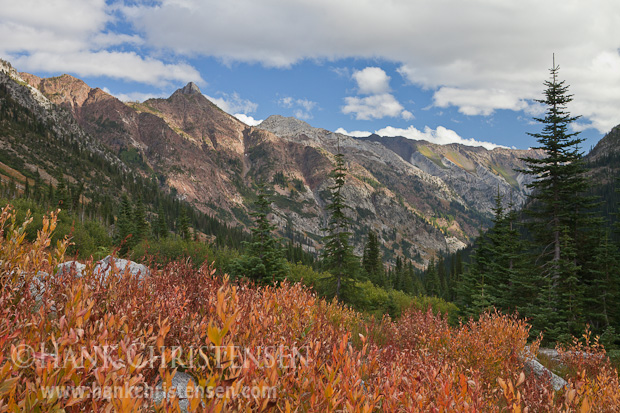
Painted cliffs descend to a mixture of fir and pine along East Eagle Creek, Eagle Cap Wilderness, Oregon

For me, learning happens in spurts. Call it a growth spurt of the mind. Over the last few weeks I have been spending many hours learning advanced Photoshop techniques to help me process my photos. This gives me better tools to recreate exactly what I saw, and the mood I felt when I took the photograph.

Now, I’m no slouch when it comes to Photoshop, but that application is so deep and allows for so much creativity, there is always more to learn. Once you’ve become expert in all the individual tools Photoshop has to offer, combining them to work for you becomes a life-long practice.

Needing to try out some of the new techniques I was exploring (detailed selections, channel masking, blending modes, etc), I decided to reprocess the photo above, which I took two years ago in Eagle Cap Wilderness. I always loved the photo, but never felt that I achieved that sense of awe that I experienced hiking down East Eagle Creek canyon. My latest reworking of the photo is above – here is the result of my original processing two years ago:

Painted cliffs descend to a mixture of fir and pine along East Eagle Creek, Eagle Cap Wilderness, Oregon

One of the things that I love about digital is that as time goes on, the experience I gain not only impacts my photographs going forward, but can have a positive impact on old photos as well. It can also be seen as a curse – that feeling that you’re never really finished working on a photograph. But I’d rather see my work (even old work) improve over time, and I’m more than willing to put in the time to make that happen.