
Zabriskie Point Sunrise

Clouds explode with light over the multi-colored rock at Zabriskie Point, Death Valley National Park

During my recent visit to Death Valley National Park, one morning was spent at Zabriskie Point, a popular roadside overlook filled with tourists. Usually, I try to avoid these places, but it was my first visit to the park, and as much as I hate to admit it, these roadside tourist zoos were put there for a good reason. They offer amazing views! So, it was time to buck up and stand elbow to elbow with every other photographer in the park that morning.

The sky turns pink at first light at Zabriskie Point, Death Valley National Park

No one there that morning was disappointed. As the sun rose behind us, the sky to the west exploded with light. Unearthly pink hues skipped across the bottom of the clouds, topping the canyon of ribboned stone below with a surreal canopy. A hundred clicks echoed off the walls of the valley before us.

Dawn light permeates the clouds at Zabriskie Point, Death Valley National Park

It was on. I felt myself move into the space between consciousness and dreaming, where my creative mind took control and the technical operations of my camera faded from thought. Landscape, portrait, panorama, zoom in, pull out. My fingers flew over the controls as my mind prepared the next shot. In an instant, it was over and all around me came a collective sigh of relief. The race to capture first light was over – time to have a brief pause before the sun started peaking over the eastern hills.

Muted light plays across the ridges of rock at Zabriskie Point, Death Valley National Park

Soon people were packing up to leave. I took this opportunity to capture some of the details of the rippled rock below. It was still in shade, but with so much light bouncing off the bright walls of the canyon, all the shadows were full and rich in detail.

Before long I was packing up as well. The streams of outgoing photographers were replaced with point-and-shoot tourists, fresh after a morning breakfast. I knew that seeking originality from Zabriskie Point was likely a lost cause, but it was hard not to be inspired by such a light show. I left with a huge smile on my face, thankful for the unending gift of nature.
Mesquite Dunes, Death Valley National Park

The Mesquite Dunes stretch across the valley just north of Stovepipe Wells, Death Valley National Park

I just spent a week in Death Valley National Park attending a workshop with landscape photographer Jack Dykinga. It was an amazing week catching up with old friends, doing a ton of field work, and trying to soak in Jack’s incredible talent whenever possible. One of my favorite places to shoot was the sand dunes of Mesquite Flat, just north of Stovepipe Wells.

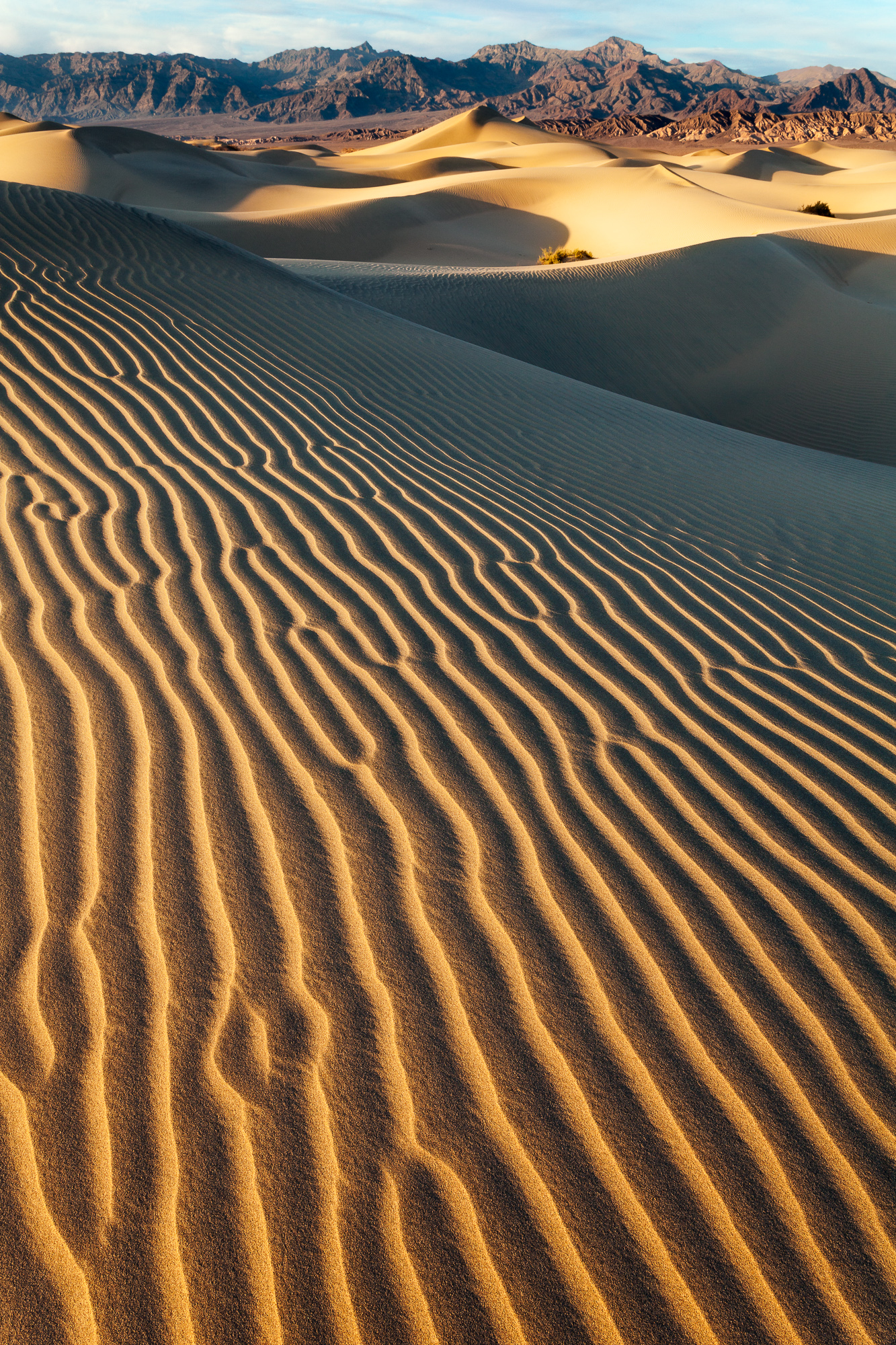
Wind and weather carve the Mesquite Dunes into endless shapes and textures, Death Valley National Park

The dunes provided an amazing array of shapes and pattern with which to craft photographs. It was a place that really clicked for me, and it was a joy to shoot. An hour or two before sunset, the sun was still high enough to provide strong shadows and side lighting.

Death Valley's Mesquite Dunes are a study of form and lines
Death Valley’s Mesquite Dunes are a study of form and lines

At this time of the day, I really wanted to capture strong contrast which let the eye see the huge variety of patterns in the sand.

Visitors to Stovepipe Wells are treated to a view of wind carved sand dunes across Mesquite Flat, Death Valley National Park

As we got closer to sunset, the dunes and mountains to the east began to reflect that sweet magic hour light. Using a longer lens to stack the dunes against the mountains helps to give the viewer a sense of place.

Mountains rise beyond the sand dunes of Mesquite Flat, Death Valley National Park

My favorite time of day to shoot however, was after the sun had set. The light across the dunes evened out, filling in the shadows and giving the dune contours a milky softness.

As the sun sets, the soft light give the sand dunes a buttery feel, Death Valley National Park

Black and white photos still worked well in this light. Instead of cranking up the contrast to show those sharp lines, the key here was to keep it soft and lower contrast. I tried to find compositions that allowed the eye to move easily up into the frame, flowing through the dunes.

Soft light across the dunes adds a milky texture to the wind carved lines, Death Valley National Park

As the valley settled into shadow, the sand was cast in a cool blue light.

In the moments after sunset, the light softens to accentuate the subtle curves of the sand dunes, Death Valley National Park

As I had never spent much time photographing sand dunes before, I was thrilled with the experience. It is definitely a subject that offers endless variety and continual learning. These are my favorite kinds of photographic subjects – challenging and varied, forcing me to adapt and grow.

If you are serious about your photography and want to learn from one of the masters, I highly recommend putting Jack on your short list of workshop instructors.

Creature From The Deep

A harbor seal pops its head above water as the sun sets behind it, Redwood Shores, San Francisco Bay

I often photograph out in Redwood Shores, CA, a town within Redwood City that juts out into the San Francisco Bay. It is a suburb consisting of homes and townhouses built around a network of man-made water channels, offering many backyards direct water access. All that water also attracts a great variety of birds.

A little while ago I was tracking a bird down at the edge of one of the water channels. I was about ten feet below the bay trail, out of sight of any passerbys. As I was looking through my lens, I heard a soft “sploosh” very close to me. I could tell something big had disturbed the water to my left. At first I though that maybe someone was throwing rocks into the channel, but then I realized the sound was too gentle to have been caused by a rock. I looked up and scanned the water, but all I saw were concentric rings emanating from a spot about fifteen feet from shore.

Then, suddenly a large head emerged not far from that spot – big eyes staring into mine.

With eyes and nose just above water, a harbor seal cruises through the still waters of a slough, Redwood Shores, San Francisco Bay

I was surprised to see a harbor seal pop up and investigate me. We sat there for a while, just looking at each other as the sun set and everything fell silent. He obliged while I swung my camera around to photograph him. Then he submerged and over the next ten or fifteen minutes, he appeared at various distances, each time looking in my direction.

A curious harbor seal emerges from the water enough to watch the shore of a small slough, Redwood Shores, San Francisco Bay

Afterward, I learned that he was an off and on regular in this neighborhood. Apparently he got through one or more water control gates that lead out into the bay. Either he is very smart and can return to these channels at will, or he is stuck here, fishing the shallow channels. Whatever the case, he seems to be thriving. I have seen him since on several other occasions (assuming it is the same harbor seal of course). The next time I see a large mysterious shadow passing just below the surface of the water, I’ll know who it is.

Chestnut-Backed Chickadee

A chestnut-backed chickadee sings at the top of its lungs while perched on a bush stem

Recently I found this chestnut-backed chickadee foraging in and around a large ornamental bush growing along a walking path. These chickadees seem to mostly travel alone, and are difficult to photograph because they are small and very fast. Usually they’ll perch on a twig just long enough for me to find it in my viewfinder before it zips off to another location, leaving me with yet another picture of an empty twig.

A chestnut-backed chickadee plucks a small dead leaf from its branch in order to create a better place to perch

True to form, this little guy was jumping from one spot to another, leaving me with nothing but my normal frustration. Suddenly, he lighted on a narrow branch right in front of me. After surveying his spot for a few seconds, he plucked a small dead leaf in order to clear a spot, and launched into a beautiful song. He seemed occupied in his song, and completely unconcerned with my presence, allowing my to click away.

A chestnut-backed chickadee perches on a thin bush stem

After about 30 seconds of singing and a few brief poses on his perch, he was off again. This time he did not hang around, but took off into the air and out of sight.