Happy New Year! Similar to last year, I have looked back through this past year’s photographs and selected 40 photos that represent my favorite photographic exploits.
Please enjoy the gallery below. To view larger photos, be sure to click the icon in the lower right corner to enter full screen mode. If you are using a device that doesn’t support Flash (iPod, iPad, etc), you can view the photos here.
As always, I appreciate you checking out the blog, and love hearing your like/dislikes, or just random thoughts. This coming year, I’ll continue to explore the ever-amazing natural world in which we live. Thanks for coming along for the ride!
Check out next month’s newsstands for the latest issue of Backpacker Magazine. They are running one of my photos as part of an article about the Skyline To The Sea trail, which runs from the crest of the Santa Cruz mountains to the ocean.
I took this photo while out shooting on spec for a different article a few years ago. That one never made it to publication, but with photography, you never know when you’ll get a second (or third or fourth, etc) chance!
Throughout the year, we see these yellow garden spiders spinning their webs around our front garden. I came across this nice specimen and wanted to capture him on my camera. However, lacking any real macro gear, I had to figure out how to make do with what I did have on hand. If I had my choice of any equipment I wanted for this shot, I would have used:
1. A small tripod with a swing arm (to get close to the web which was inconveniently placed between some hard-to-reach plants)
2. A Canon 180mm macro lens (so I could keep my distance from the creepy spider)
3. A focusing rail (to achieve that manual pin point focus on the beast)
However, I had none of that. What I did have was a 100-400mm zoom lens (non-macro). None of my tripods work work well in this area because of the spacing of the plants, so I was stuck hand-holding. In order to increase the magnification, I was able to reduce the lens’ minimum focusing distance using 3 stacked extension tubes. This allowed me to move the lens closer to the subject, filling the frame with only the spider.
Because I was not using a tripod, I had to keep the shutter speed relatively fast. That meant a larger aperture, and a smaller depth of field than I would have otherwise used (f/8 in this case). In order to compensate, I decided to try the digital technique of focus stacking to achieve the look of a larger depth of field. This image is actually a composite of two shots – one focusing on the spider’s abdomen, and the other focusing on the legs. The sharpest part of each image was blended together.
So, after all applying all these work-arounds, what is the moral of the story? Get some decent macro equipment! 🙂
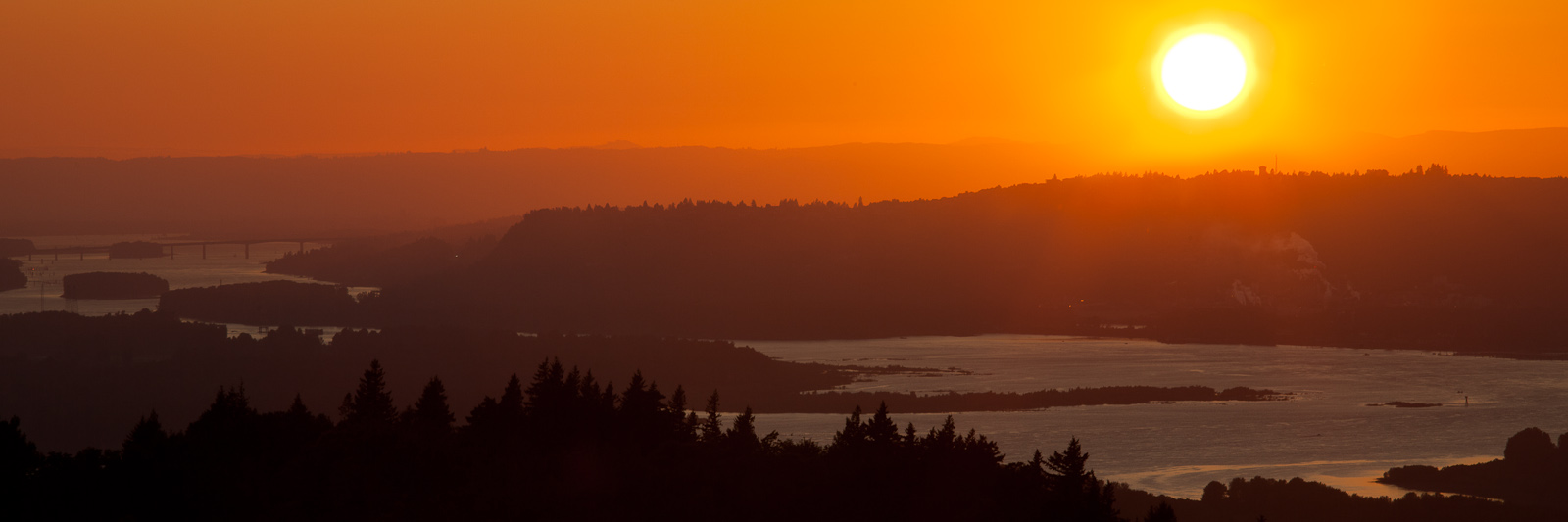
This photo was taken in Corbett, Oregon, from the backyard of some good friends. They live high on a cliff overlooking the mouth of the Columbia River Gorge. This panorama was taken at sunset looking west toward Portland.
I grew up in Corbett, and I always enjoy going back to visit. The town is a kind of jewel, sitting close to Portland, close to Mt. Hood, and surrounded by forest and farmland.
Every time I visit, I try to take some time to explore the area with my camera. I don’t have to wander too far to see first hand why Oregon is hailed for its natural beauty.
Please be sure to click on the image above to see a larger version.