
California ground squirrels poisoned

A California ground squirrel peeks up out of its burrow
A California ground squirrel peeks up out of its burrow. Canon 100-400mm f/4.5-5.6L IS lens with the EOS-40D. ISO 640. Evaluative metering -2/3 stop: 1/400 sec. at f/8

This morning I was alerted to a sad recent development at a local park by Peter J. Metropulos, a fellow participant in a local wild bird discussion email list. Based on a recent article in the Almanac (a local newspaper), last August, the city of Menlo Park contracted with an exterminator to kill off the ground squirrels at Bedwell Bayfront Park, which is situated along the San Francisco Bay. The worry was that a growing squirrel population would eventually dig though the cap that covered the landfill on which the park was built, and drag garbage to the surface. Upon being notified of this issue, the city counsel conducted their own investigation, and determined that the squirrel population needed to be reduced.

Metropulos raised the following concerns in his email. “The tiny bit of undeveloped bay land habitat that remains in San Mateo County is under a constant threat of destruction. One of the precious few bits left is Bayfront Park. This was perhaps our last opportunity to provide a place for Burrowing Owls to re-colonize (they rely on ground squirrel burrows for nesting). Now with the squirrels gone that hope is gone as well.

“The California Ground Squirrel is a native mammal, not an introduced vermin like the roof rat, and it is an important component of our local ecosystem. In addition, having our own local ‘prairie dog’ colony has provided an easily-observable wildlife experience for the general public. People like watching the busy little critters running around. Local residents have been robbed of a part of their natural history.”

Now I’m not arguing that this type of action is never appropriate (although I do know which side of the argument my bias would land me on). But at the very least, before a decision like this is made, we must have careful, thorough scientific study, and input from local citizens. Before mid-level politicians decide to “play God” by poisoning a population of local wildlife, we need to consider the effects. How will this impact the food chain within which the ground squirrels are an integral part? What about all the birds of prey that feed on them? What about the dwindling burrowing owl population that relies on the ground squirrels to excavate their homes?

As a wildlife photographer, I can’t help but have a respect and care for the creatures that grace me with their presence. It saddens me any time I see people meddling in nature, especially when it looks like was done with little thought about the wider implications. I really hope that is not the case here.

I think the worst part of this entire situation is the fact that the public was not notified of the burrow poisoning before it was conducted. I hope that the Menlo Park city counsel releases details of their “own investigation” to the public. I also pray that the probable impacts on other species was taken into account before they concluded that poisoning a native species was the best course of action.

Unfortunately, it appears that this event was not treated with the care that it deserves. The article concludes, “[Deputy City Manager Kent Steffens] said he didn’t know how many burrows were baited with poison, or how many squirrels died as a result. Neither did a representative from [the extermination contractor] Animal Damage Management, who said the technician who carried out the contract was on vacation.”
Breaking the rules

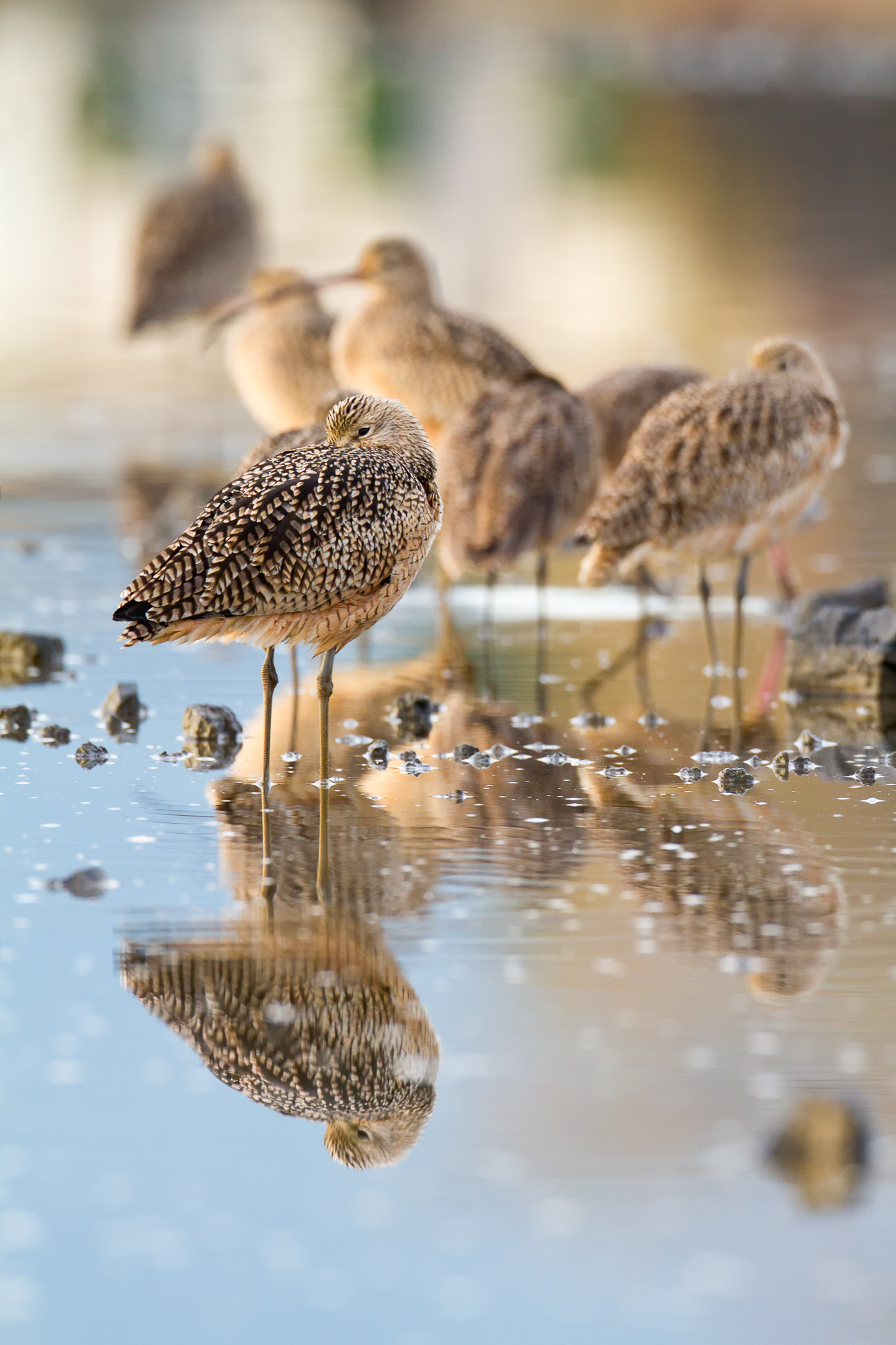
Several long-billed curlews stand together in a shallow wetland pool

Every once in a while a photo comes along that I love, but seems to break many of my own guidelines that I usually follow. Many times when I’m out shooting wildlife or birds, I’ll take a few photos of the surrounding area, or try to include some habitat, to help me remember where I was and what the conditions were like. This is especially important when I’m making bird portraits. If my goal is a simple, clean background, it can be easy to forget what the surrounding area was like when I only see a bird’s head and shoulders in the photo. The photo of the long-billed curlew above was one such “habitat” shot that I took recently.

As I was reviewing my photos, I found that I really liked this one, even though it wasn’t intended as a keeper. I also realized that it breaks some of the rules that I like to follow in my bird photography. I put myself in the role of photo critic, and came up with the following negative aspects of this image.

1. Cluttered background – In most wildlife photography, one goal in creating a successful photo is to simplify the shot as much as possible. Eliminate distracting elements and leave only those that help support the subject. In this photo, the background is busy and the water surface messy.

2. Depth of field issues – The curlews in the background are out of focus. Are they part of the subject of the image? It is not clear from the focus alone. They are too blurry to be successful subjects, but not abstract enough shapes to blend well into the background.

So then, given the above criticisms, why do I like the photo so much?

1. Color – I absolutely love the color in this photograph. I like the pastel blues and tans, and the black in the first curlew’s feather pattern really pops.

2. Wildness – Sometimes the simple portrait with a pure single color background can get old. Even though they can be elegant, sometimes they lack the wild and wooliness of the real natural world. This photo serves up enough chaos to do justice to all the birds eating and preening in a bunch that morning.

3. Leading lines – The photo leads the viewers eye well through the frame and into the distance. Starting naturally at the bird on the left in sharp focus, the eye is attracted to the sleeping bird to the far right of the frame, because of the repeated shape of the first bird. Then the eye draws up and left along the line of birds, finally resting on the bird in the upper left of the photo, which is the farthest distinguishable object from the camera.

It is important to choose your best images in order to edit your collection of photos. Beyond that however, it is important to understand why you chose those photos. Doing so will help you to make better informed decisions about future photos, instead of just going with your gut. Next time you say to yourself, “I really like this one,” or “this one doesn’t work for me,” dig a little deeper and list out what you like or don’t like about a photo. What you come up with when your really think about it might surprise you.

So what do you think? A nice break from the norm, or not your cup of tea? Love it or hate it, I’d love to hear your opinion in the comments below.

Cedar Waxwing (Photo of the week)

A cedar waxwing perches on a tree eating berries
A cedar waxwing perches on a tree eating berries. Canon 100-400mm f/4.5-5.6L IS lens with the EOS-7D. ISO 400. Evaluative metering +1/3: 1/800 sec. at f/7.1.

This weeks photo features the Cedar Waxwing, one of my favorite passerine species. I love the way this bird’s feather colors blend together into soft gradients, giving the appearance of a painting. Waxwings derive their name from bright red feathers near the tips of their wings, which is thought to resemble sealing wax. Cedar Waxwings travel in flocks and almost always perch off the ground, usually in trees, and rarely in bushes or shrubs.

A cedar waxwing perches on a tree in soft diffused light
A cedar waxwing perches on a tree in soft diffused light. Canon 100-400mm f/4.5-5.6L IS lens with the EOS-7D. ISO 400. Evaluative metering +1/3: 1/500 sec. at f/7.1.

The waxwings seen here descended on a row of cherry trees, and proceeded to eat with great gusto for about an hour, moving from tree to tree. All shots were taken hand-held with my 100-400mm zoom lens. This is a great walk-around lens, which I use on hikes if I’m expecting the possibility of seeing wildlife.

A cedar waxwing perches on a small branch of a tree
A cedar waxwing perches on a small branch of a tree. Canon 100-400mm f/4.5-5.6L IS lens with the EOS-7D. ISO 400. Evaluative metering +1/3: 1/500 sec. at f/7.1.

Thinking digitally

A juvenile black-crowned night heron perches among reeds along the edge of a pond
A juvenile black-crowned night heron perches among reeds along the edge of a pond. Canon 800mm f/5.6L IS lens with the EOS-7D. ISO 800. Evaluative metering 0 EV: 1/320 sec. at f/8

I little while ago I found myself in a situation in which I could not have gotten the shot I wanted had I been using film. After being tipped off by a friend, I found this nice looking juvenile black-crowned night heron in some reeds next to a pond. The shoreline was such that in order to get the proper frontal lighting on the heron, with a small angle of inclination between the lens view and the ground, I had to be right up close to him. Luckily, he seemed in no hurry to move, nor did he seem to care about my presence. While this distance was great for making tight head shots like the photo above, there was no way I could “back up” and capture any habitat around the bird.

Then I started thinking digitally. I knew that if I was careful in my photographing, I could take multiple photos and stitch them together later, creating the illusion of a wider angle. An added benefit would be a huge image file, which I could later print at very large sizes if I wanted to.

The process of taking the photos was very similar to the process I use for creating stitched panoramas – set the camera to manual exposure, fix the focus so that it is constant for all images, and fire away. The difference was that instead of moving left to right in a single line, my goal was for an aspect ratio close to a normal 35 mm photograph (2:3). In this case, I created two columns of three photos. I didn’t worry about lining up the overlap perfectly – I just eyeballed it.

Note that this only worked because my subject was completely stationary. If the heron was moving at all, the photos would not have lined up well and the stitched image wouldn’t have been successful. It probably took between five to ten seconds to capture all six shots, which I then stitched in Photoshop, creating the 50 megapixel image below.

A juvenile black-crowned night heron perches among reeds along the edge of a pond
Composed of six separate images (two columns of three shots), this stitched photo is 50 megapixels. Canon 800mm f/5.6L IS lens with the EOS-7D. ISO 800. Evaluative metering 0 EV: 1/250 sec. at f/8

Even though I found myself in a position where I was “too close” (don’t worry, I’m not complaining – its a GREAT problem to have!), I was able to think digitally to solve my problem. By combining multiple shots, I was able to virtually “back up” and capture a wider shot of the heron.