I captured this herring gull last month at Don Edwards National Wildlife Refuge. I had a good combination of nice late-morning lighting, glassy water (creating a mirror-like reflection), and a neat, clean gull.
Gull identification can be quite challenging (gulls and sandpipers give me endless ID trouble!) Certain characteristics to pay attention to include wing tip pattern, eye color, bill markings, and leg color. What really makes gull identification difficult is that fact that you can line up five gulls of the same species, and they can look completely different from one another. Juveniles can have different eye and leg color as their adult counterparts, as well as vastly different feather patterns and coloring. Additionally, breeding season can also change a gull’s appearance. While these same issues exist for many other birds as well, I find them particularly challenging with gulls, as so many gulls look similar.
Happy New Year! Here’s to a healthy and successful 2011. This past year was a great year for me photographically. I was able to get out and shoot more than ever before, and travel to some new places. I’ve created a gallery of my top 30 photo picks for 2010. These are not necessarily my most artistic photos, or more technically perfect from the year, but just ones I liked for one reason or another. Please enjoy the gallery below. For larger photos, be sure to click the icon in the lower right corner to enter full screen mode. If you are using a device that doesn’t support Flash (iPod, iPad, etc), you can view the photos here.
Thank you all for the loyal readership this last year. I hope you enjoyed the photos as much as I enjoyed sharing them!
A palm warbler perches on a tree branch in early morning light. Canon 800mm f/5.6L IS lens with the EOS-7D. ISO 640. Evaluative metering +2/3: 1/2000 sec. at f/7.1
Earlier this month I was happy to get some nice views of a wintering palm warbler, while photographing in the city of Redwood Shores, CA. This is a somewhat uncommon bird for this area, so I was excited when I confirmed the sighting after further research. My view was unobstructed and the lighting perfect – about an hour after sunrise with the low, winter sun directly behind me.
I shot quickly and furiously, trying to capture as many poses as possible before the bird flew off. I ended up with about 45 seconds of time before the little guy decided he’d had enough with the paparazzi. The following photos were taken at the same time, in the same tree. Thank God for 8 frames per second!
A palm warbler perches on a small twig of a tree. Canon 800mm f/5.6L IS lens with the EOS-7D. ISO 640. Evaluative metering +2/3: 1/800 sec. at f/7.1A palm warbler perches on wetland vegetation, showing off its yellow underside. Canon 800mm f/5.6L IS lens with the EOS-7D. ISO 640. Evaluative metering +2/3: 1/1000 sec. at f/7.1
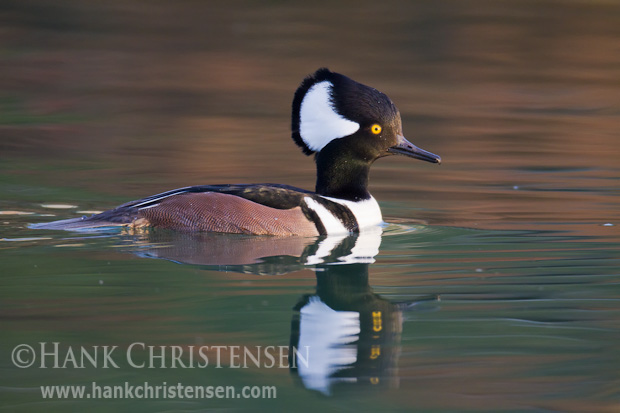
A male hooded merganser extends his crest as he swims through a wetland slough. Canon 800mm f/5.6L IS lens with the EOS-7D. ISO 1250. Evaluative metering +2/3: 1/320 sec. at f/5.6
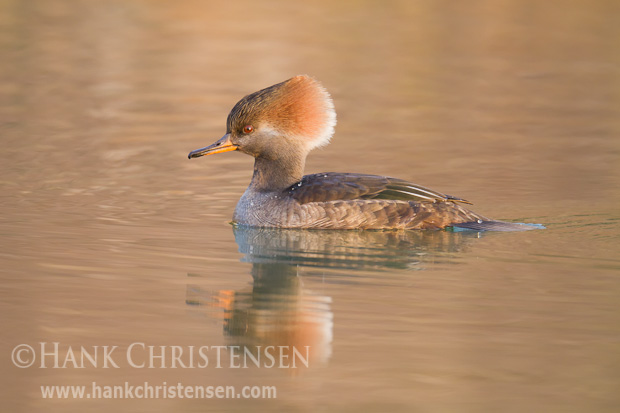
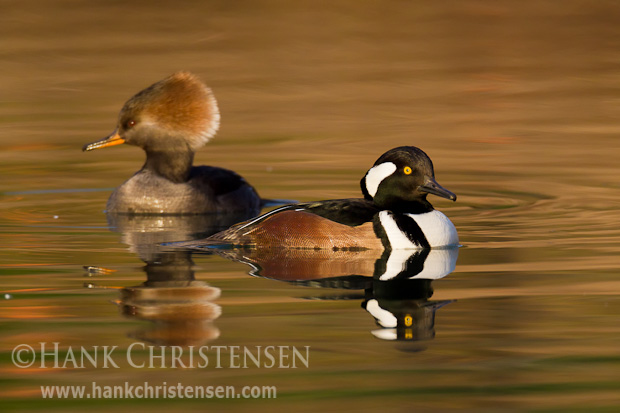
I was lucky enough to find a pair of hooded merganser a few weeks ago at a local birding spot close to my house. While not uncommon to the area this time of year, they are usually seen in very small numbers – usually only in ones and twos. I found this attractive pair in a narrow channel that is usually very shallow, but had recently flooded, providing enough depth for these diving birds.
A female hooded merganser swims through still water, reflected in the early morning sunlight. Canon 800mm f/5.6L IS lens with the EOS-7D. ISO 800. Evaluative metering +2/3: 1/125 sec. at f/5.6
As I approached, I crouched down and worked my way toward a large clump of tall grass along the channel that could provide some screening. I crept up behind the grass and set up, careful to work very slowly so as not to disturb the pair. The last thing I’d want is for them to fly somewhere else – they seemed to be set up in the perfect position for me. The rising sun was behind me, casting the birds in full frontal lighting, and the channel was narrow enough that the entire surface of the water reflected the straw colors of the opposite shore.
After I set up, I knelt behind my tripod in the mud and goose poop (I often wear knee pads when I expect to shoot at water level) and poked my lens through the grass. They seemed right at home with me there, giving me a full half hour with them as they swam back and forth in front of my camera.
A pair of hooded merganser swim together, reflected in the water. Canon 800mm f/5.6L IS lens with the EOS-7D. ISO 1000. Evaluative metering +1/3: 1/800 sec. at f/7.1
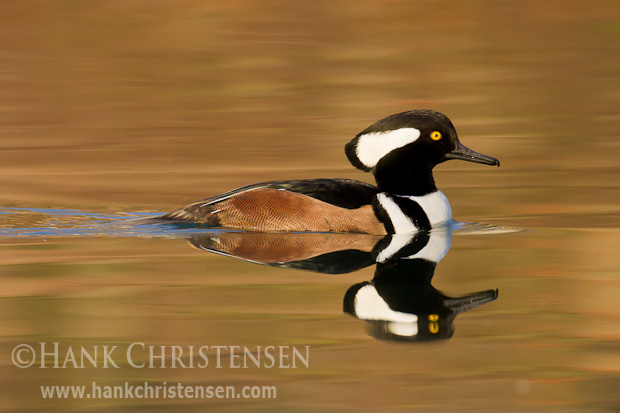
During courtship displays, the male fans his crest open, as seen in the first photo. The male seen here had a flat crest most of the time, only displaying his crest once to ward off a curious cormorant, and once while scratching the back of his head with his foot. The female seemed to display her crest most of the time I was watching them. The photo below shows the male with a flattened crest.
A male hooded merganser swims with a flattened crest. Canon 800mm f/5.6L IS lens with the EOS-7D. ISO 800. Evaluative metering +1/3: 1/320 sec. at f/7.1
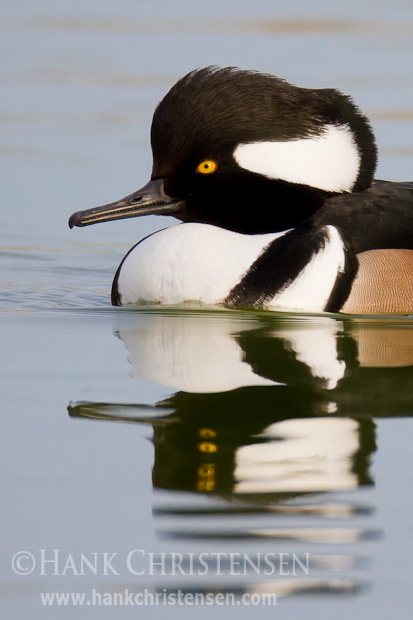
Like other mergansers, the hooded merganser has a long thin bill with serrated edges. This helps to grip fish and crustaceans when the birds dive underwater for them. Because of this trait, mergansers are often called “sawbills”. They are a somewhat secretive bird, nesting in small tree cavities hidden away from would-be predators. Hunting underwater by sight, they can actually change the refractive properties of their eyes in order to enhance their underwater vision.
Like other merganser, the hooded merganser has a long, serrated bill for gripping fish. Canon 800mm f/5.6L IS lens with the EOS-7D. ISO 800. Evaluative metering +1: 1/1000 sec. at f/5.6
After a while, the mergansers decided they were done with this water channel and it was time to head off to more fertile fishing grounds. I was elated to have had that time with them, in such good photo conditions.