
A Counter-intuitive Tip To Tack Sharp Photos With A Long Lens

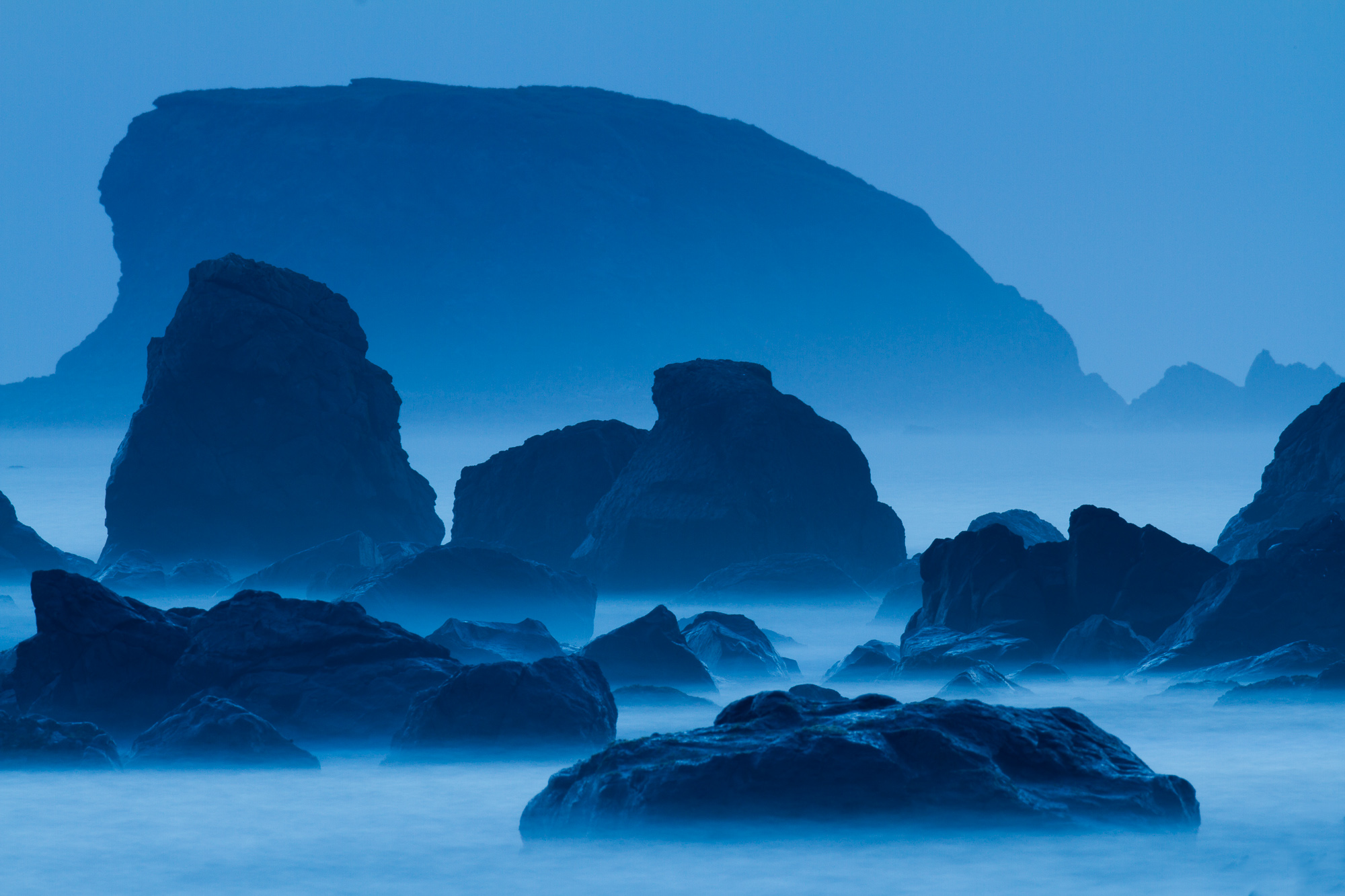
The hues of twilight cast offshore sea stacks in a blue glow as waves wash around them, Crescent City, CA

On my recent trip north up the California coast to photograph redwoods and rhododendrons, I also had an opportunity to shoot sea stacks just offshore in Crescent City, CA. After shooting a bit with my 70-200mm, I really wanted to go for a unique perspective of these rocks and stack them on top of one another. So I grabbed my go-to bird lens, the 800mm f/5.6. Using a Canon 7D with a cropped sensor gave me an equivalent focal length of 1280mm.

I waited until the sun set, giving me photos with the cool blue of dusk, and allowing me to slow my shutter speed to turn the crashing waves into a calming mist. This is the effect I was after – hard, sharp rocks shrouded in a blue fog of moving water. However, as soon as my shutter speed got longer than 1/100th of a second and started creeping toward the 1 and 2 second mark, the results on the back of my LCD were horribly blurry.

In normal shooting conditions with this lens, I never like to let the shutter speed drop below 1/250th of a second, and only if I have a stationary subject do I lock down the gimbal head on my tripod and go for something slower. But usually 1/100th of a second is my slowest usable shutter speed. What to do in this situation? Even by bumping the ISO very high I couldn’t achieve a fast enough shutter speed in these darkening conditions, and doing so would also counteract the effect of the moving water.

The solution seemed counter-intuitive at first. I found that by greatly lengthening my exposures, I was able to achieve much sharper results! The initial blurriness I was seeing was caused by the shutter vibration, amplified by the extremely long focal length (and yes, I was using mirror lockup). When I increased the exposure time, the percentage of time that the mirror shake impacted the overall exposure time was reduced, thus creating a sharper image. Using this principal, I found that by exposing for 30 seconds, I was able to achieve the sharpest results.

A couple things to keep in mind. First, this technique will only work if there is no wind. Even a slight breeze will blow a huge lens like that back and forth, ruining any chance of a long exposure. Second, make sure to check sharpness by zooming in to your resulting photo on the camera’s LCD. Never trust sharpness from a photo displayed 3 inches across – everything looks sharp when it is that small!

So next time you’re out with a giant lens trying to do landscape work (really not a very common combo!), remember to experiment with the slower shutter speeds. You might just find some sharpness in there.

California’s Coastal Redwoods

Rhododendrons grow amongst the redwoods along the California coast. Fog regularly permeates the forest, giving these giants the perfect conditions in which to grow.

A couple of weeks ago I made a trip north to shoot old growth redwoods during the spring rhododendron bloom. It was my first time to the area and was quite an experience. First of all, I found the landscape quite challenging. Once I entered a redwood forest, it was a sensory overload, with subjects to shoot everywhere. The forest was so busy with life that it became difficult to distill each shot down to an individual subject. I could shoot everything from a super wide angle with trees converging into the fog, to macro detail shots of leaves, moss and flowers.

Ferns grow at the base of a large redwood tree, Prairie Creek Redwoods State Park

I visited several old growth forests in the vicinity of Redwoods National Park. However, I never visited the park itself, as the oldest forest is preserved in several state parks in the area. These California state parks contain the first trees to be saved from the lumber mills, with the national park encompassing whatever land was left unprotected decades later.

Rhododendron grows throughout a redwood forest shrouded in fog, Del Norte Redwoods State Park

This time of year is very popular for photographers because of the massive rhododendron bloom throughout these forests. The best way to capture the flowering bushes against the giant redwood trunks is to wait for thick fog to permeate the forest, which luckily happens quite often this time of year.

Fog does two things – first, it evens out the lighting in the forest by diffusing sunlight. This prevents the harsh contrast sometimes seen in thick forests when thousands of small light beams spotlight the vegetation. Cameras can’t capture this kind of contrast, and the fog cuts it out completely. Secondly, fog fills in behind the closest trees and greatly simplifies the scene. Instead of seeing a dense forest and all its detail behind the closest redwoods and rhododendrons, you instead see a misty fog. The viewer’s eye can stay focused on the main subject matter.

Intertwining leaves of false lily-of-the-valley form an abstract pattern, Jedediah Smith Redwoods State Park

In addition to capturing my main target, the forest provided opportunities for macro shots as well. Walking along the trails, I always kept an eye out for interesting patterns formed naturally. I found the large green leaves of false lily-of-the-valley intertwined and zoomed in to pick out a pattern among the leaves.

Naturally, there were also other interesting subjects, such as this fungus growing on a decaying tree branch.

A fungus grows from the branch of a decaying redwood, Del Norte Redwoods State Park

The last morning I was in town, I was greeted by a light steady rain. Normally this kind of weather would see me rising, checking the window, and then jumping back into bed. However the rain also came with more fog, which actually created ideal conditions for more forest photography. Not necessarily the best conditions for me, but with my camera well protected with its own rain gear, the resulting photos came out just fine.

Rhododendrons grow amongst the redwoods along the California coast.  Fog regularly permeates the forest, giving these giants the perfect conditions in which to grow.
Rhododendrons grow amongst the redwoods along the California coast. Fog regularly permeates the forest, giving these giants the perfect conditions in which to grow.

The forest offered more than just lush green vegetation and enormous trees. Some of the older trees had large gashes and burns which lent to more graphical than subjective photographs. Here the negative space formed by the dark burn marks frames and offsets the light window to a distant tree.

Dark burns cut a graphic pattern through the base of giant redwood trees, Del Norte Redwoods State Park

Once the fog cleared, there were moments of magical, ethereal sunlight filtering through the canopy. I loved finding backlit ferns juxtaposed against a much darker wall of redwood. The photo below contains a bonus element of a double swoop of sorrel framing the bottom of the photo.

Sorrel, fern and redwood trees all contribute to the many shades of green of a redwood forest, Prairie Creek Redwoods State Park

It was a brief, challenging weekend. I’m not sure if I quite hit my stride in the redwood forest, which is usually an indicator that another visit is in order in the near future. There were difficult shooting conditions with the rain, and the sheer complexity of the forest had me scratching my head more than once. It is times like those that I have to take my hands away from the camera and just sit with the surroundings, listening. More often than not, it will tell me where to point my lens next.

Rhododendrons grow amongst the redwoods along the California coast.  Fog regularly permeates the forest, giving these giants the perfect conditions in which to grow.
Rhododendrons grow amongst the redwoods along the California coast. Fog regularly permeates the forest, giving these giants the perfect conditions in which to grow.

California’s Newest National Park – Pinnacles

Legislation to make Pinnacles National Monument a national park passed the United States Senate on December 30, 2012

Recently I made my way down to the newly minted Pinnacles National Park, California’s ninth. Legislation to make Pinnacles National Monument a national park passed the United States Senate on December 30, 2012. Located just southeast of Hollister, it is an easy day trip from the San Francisco Bay Area.

A California Condor perches on a branch in front of a rock wall, Pinnacles National Park

This area is known for being a possible location to spot the rare and endangered California Condor. At present, there are only 226 total California Condors in the wild. The species was nearly decimated in the 60s and 70s with the introduction of DDT into the environment. In fact, in 1987, there were only 22 condors left in the world, all of them in captivity. I was amazingly lucky to see one perched close to a trail, offering point blank views for several minutes.

A California Condor perches on a branch in front of a rock wall, Pinnacles National Park

Unfortunately, I was in the middle of a 5 mile hike with some serious elevation, which meant carrying my big lens wasn’t appropriate. I had a full frame camera, with a 70-200mm lens attached. Luckily, I was helped by both the close proximity of the bird, and its sheer size. They have a wingspan of up to 10 feet, giving them the largest wingspan of any North American bird. Some of the larger specimens have weighed in at 31 pounds.

Pinnacles National Park features many rock spires dotting the landscape. The Pinnacles are part of the Neenach Volcano which erupted 23 million years ago near present-day Lancaster, California. The movement of the Pacific Plate along the San Andreas Fault split a section of rock off from the main body of the volcano and moved it 195 miles to the northwest.

As far as national parks go, Pinnacles is very small. However, it contains some important and interesting geological history. The Pinnacles are part of the Neenach Volcano which erupted 23 million years ago near present-day Lancaster, California. The movement of the Pacific Plate along the San Andreas Fault split a section of rock off from the main body of the volcano and moved it 195 miles to the northwest.

Light steams down through the ceiling at the entrance to Bear Gulch Cave, Pinnacles National Park

The park is home to several talus caves, which are home to at least 13 different species of bat. Trails are built through the caves and can be explored by flashlight.

It would probably take two full days to explore the highlights of this park (and by explore, I mean including several lengthy hikes to hit some of the peaks). Spring seems like a great time of year – try to catch the wildflowers in bloom. Summer would likely be too hot, easily reaching over 100 degrees. It will be interesting to see if visitation increases due to its new “promoted” status from a monument to a park.

Recent Publication – Textbook Cover

A photo of mine taken in Lassen National Park was used for the cover of a recent text book about child development

Hot on the heels of my recent Outdoor Photographer cover comes a new textbook featuring a photo I took a couple of years ago in Lassen National Park. The textbook is geared toward educators interested in child development.

This shot features a trail built into the side of a cinder cone, located in the northeast corner of the park. The hike to the top is very cool, offering views of Mt. Lassen in the distance, and even a second trail descending into the crater of the volcanic peak.

Copyright 2017 Hank Christensen