
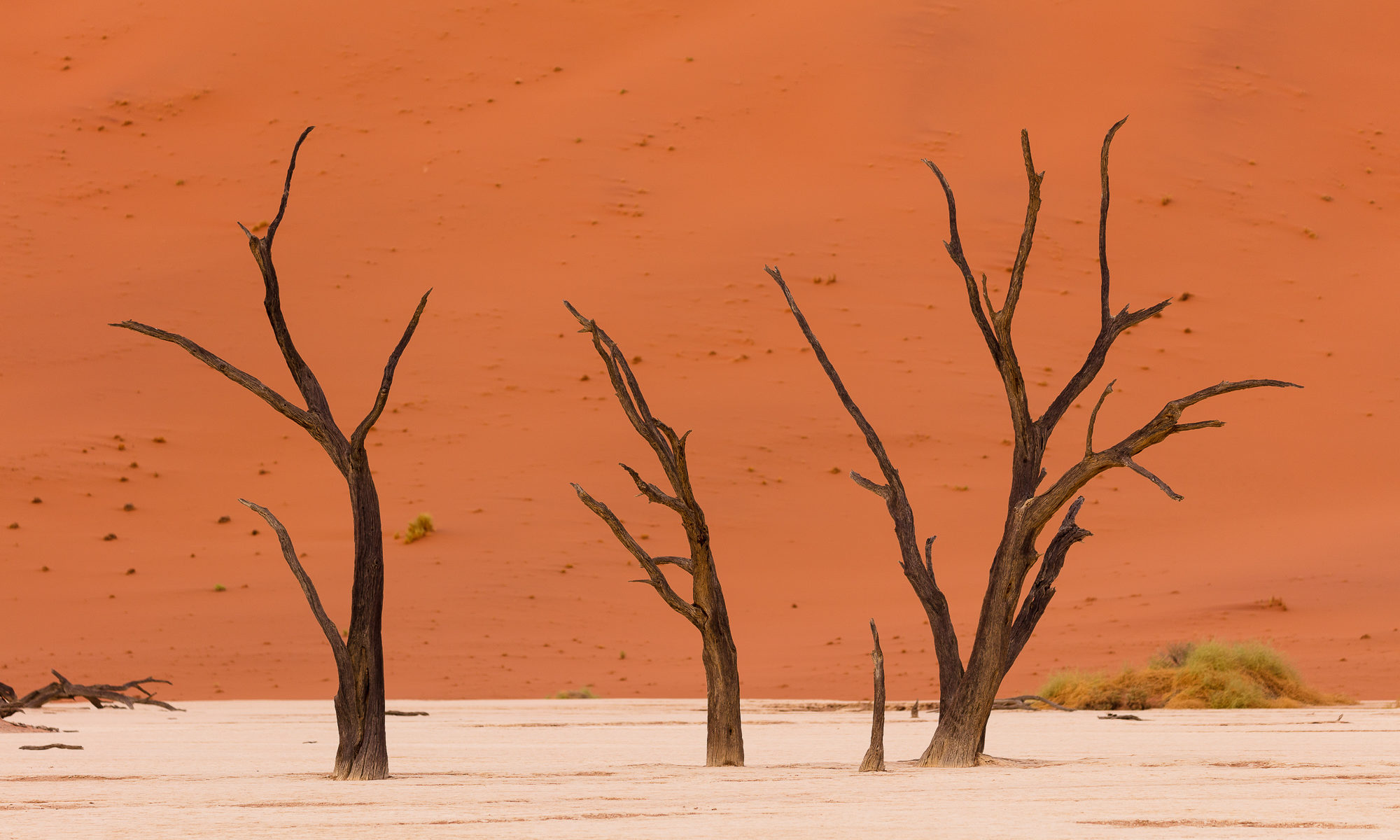
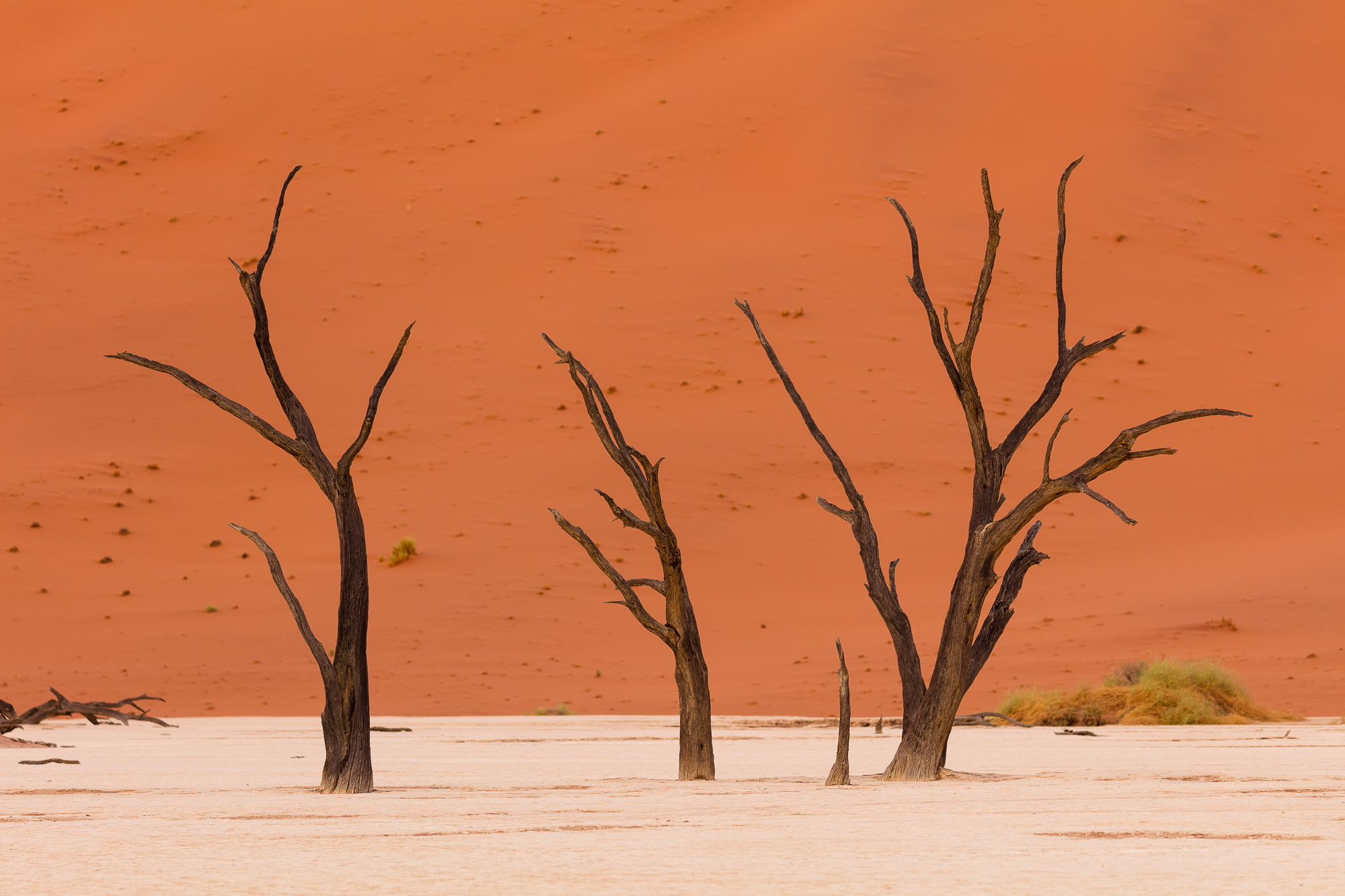
Deadvlei – A Study In Graphic Forms

The clay pan of Deadvlei contains numerous camel thorn trees that have been dead for at least 600 years.

Welcome to Deadvlei, one of those mystical places on earth that simply takes your breath away. There are a few places in the world that have spoken to me this way – whether it’s 5,000 year old Bristlecone Pines clinging to life on a windswept mountain slope, or morning sea fog rolling through a quiet stand of old growth California coastal redwoods (why do these special places always seem to involve trees?). Deadvlei is certainly one of those places.

Deadvlei is a dry and dusty river bed, located in the heart of Namib-Naukluft National Park, Namibia. Deadvlei translates to “dead marsh”, taking the Afrikaans word vlei, meaning a seasonal pond or marsh. This area once lined the banks of the Tsauchab river, flooding at times of abundant rainfall. Around 600 to 700 years ago, a great drought hit the region, drying up the river. Blowing sand encroached upon the flood plain, blocking the river’s path and forming the massive dunes that cover the land today. The camel thorn trees that grew in this marsh died, but due to the extremely dry climate, none of the wood decomposed, leaving skeletal husks still standing for hundreds of years. Centuries spent in the hot African sun have scorched the remains into blackened ghosts.
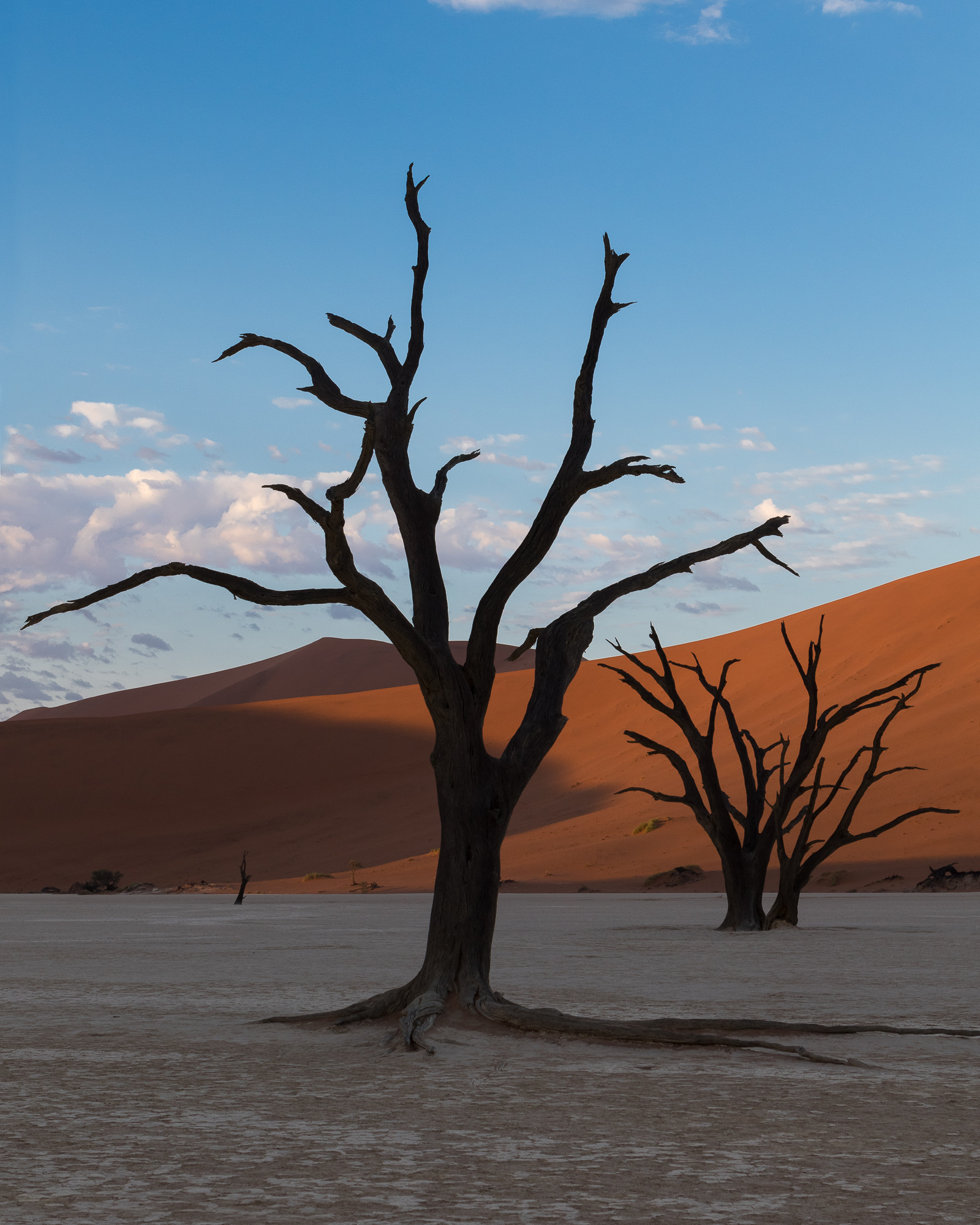
600 years ago, a drought dried up the Tsauchab river, 1000 foot dunes encroached on the dried up marsh, and the river was blocked.

In order to do an on-sight scout and be ready for the light, I arrived before dawn. This involved rising about 4 AM, hopping in a hired safari vehicle (with giant tires) and taking the 45 minute ride among the largest dunes in the world. The asphalt road soon turned to dirt, which turned to sand. Low tire pressure, 4-wheel drive, and high clearance are all musts in this area – no sedans allowed.

From the drop off, it was a 15 minute hike into the dunes before I topped a rise and saw Deadvlei down below me, surrounded on three sides by immense walls of blood red sand. The tallest point is south east of the clay pan, nicknamed Big Daddy. Standing over 1,000 feet tall, it towers above everything else in the area.

I did a quick scan from my vantage point before descending to a stand of trees. I set up a composition, and waited for the light.
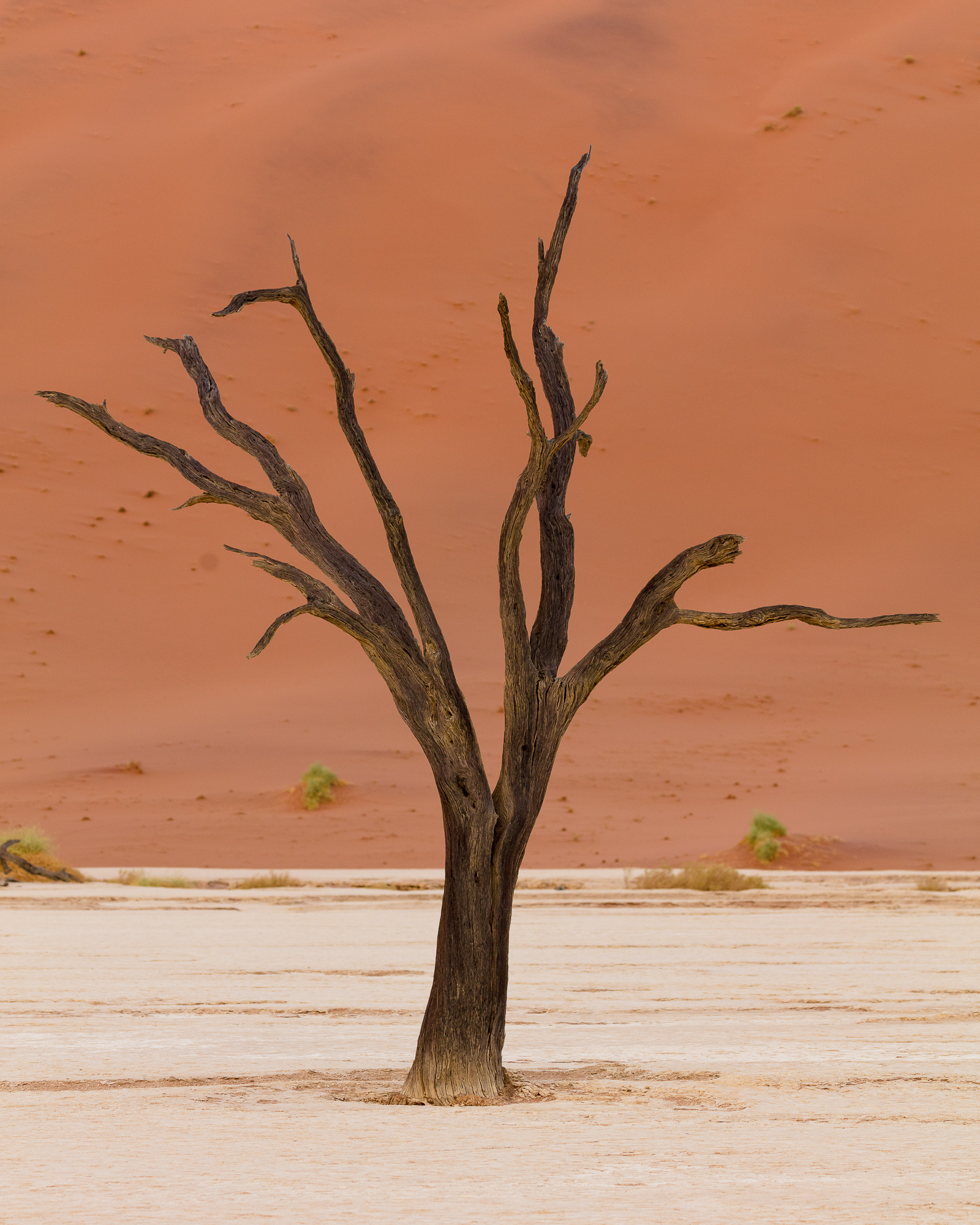
The wood of the dead trees does not decompose because the area is so dry.

Based on my trip research, I knew much of my shooting at this location would be a study of form and separation. Before I set up for any particular shot, I spent a lot of time looking for the right composition. I needed to avoid unnecessary converging lines, and try to separately my subjects from each other. I would walk around clusters of trees, trying to discern how I would render three dimensions onto a flat, two-dimensional plane.

I imagined the trees in silhouette, reduced to graphical elements of lines and shapes. I moved forward and backward, up and down, trying to find the angles that would convey the subjects in a compositionally elegant manner.
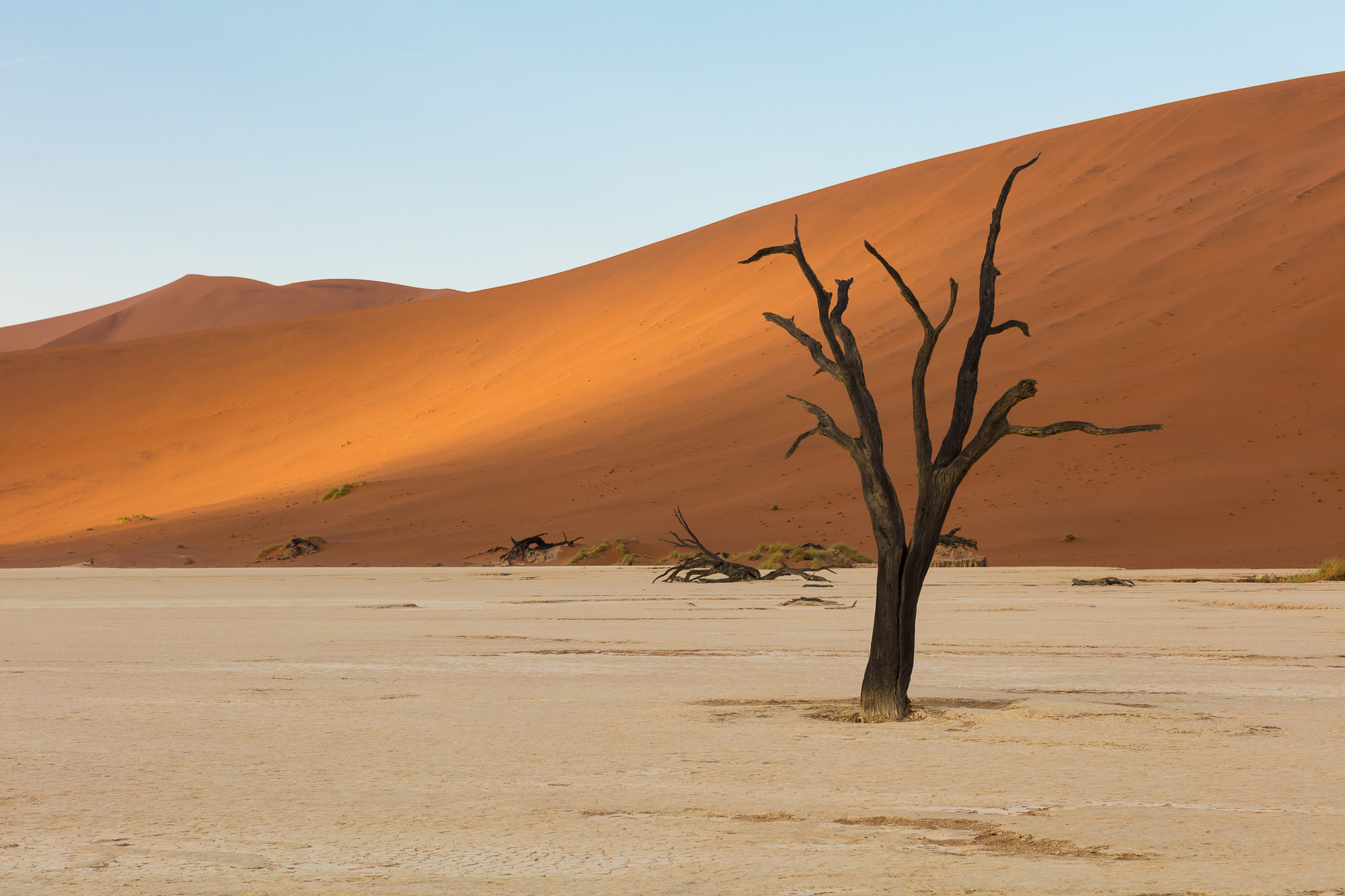
Sun spotlights the side of a dune wall behind a desiccated tree.

The sun moved higher in the sky, spotlighting parts of the landscape through lazy clouds. I looked for new patterns that the light played out across the desert surface.
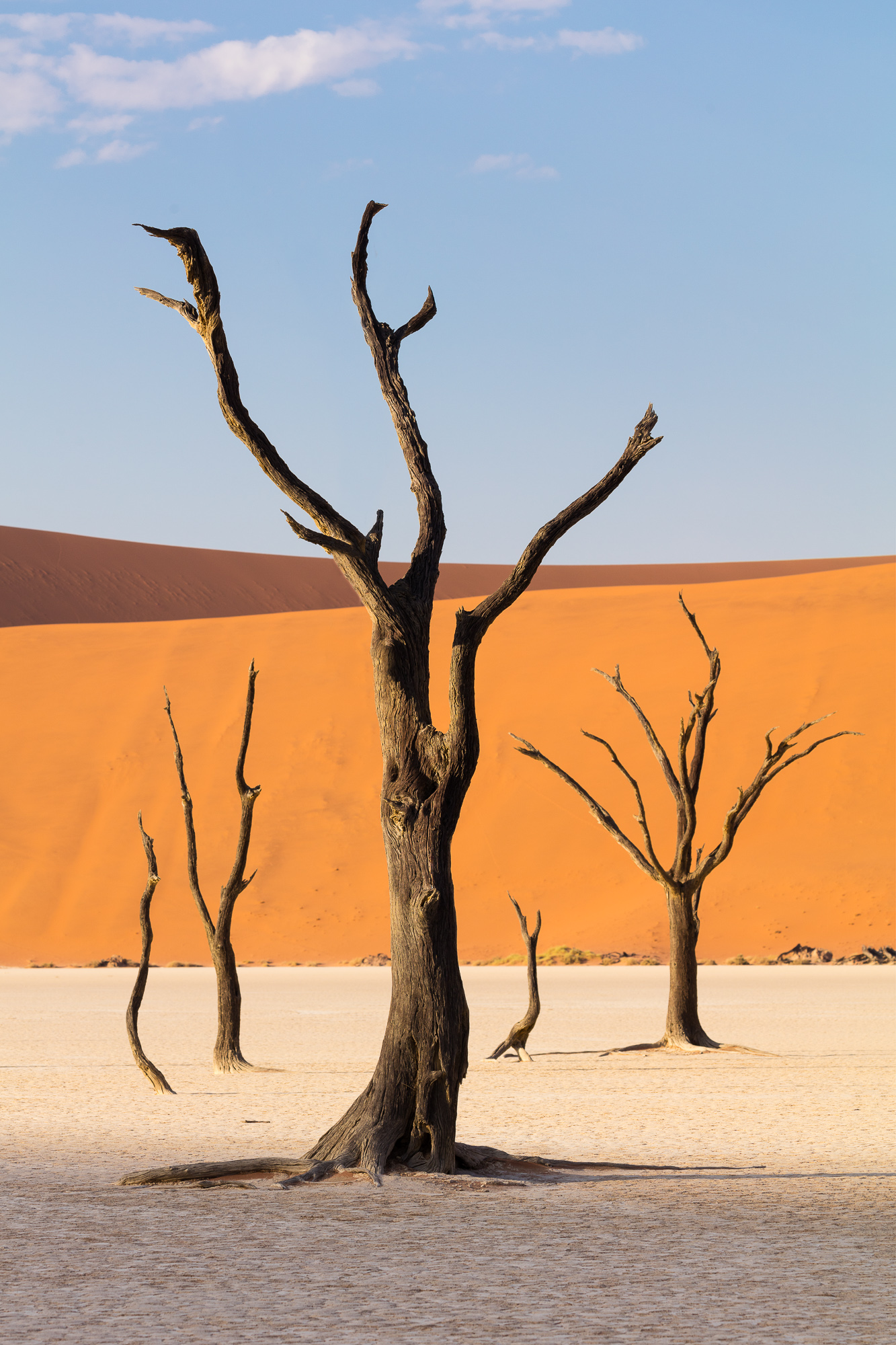
Tree husks reach out of the clay pan toward the morning sky.

As the desiccated trees moved from shadow to light, their dark forms contrasted against the bright ground and red sand, emphasizing the graphical nature of the scene.
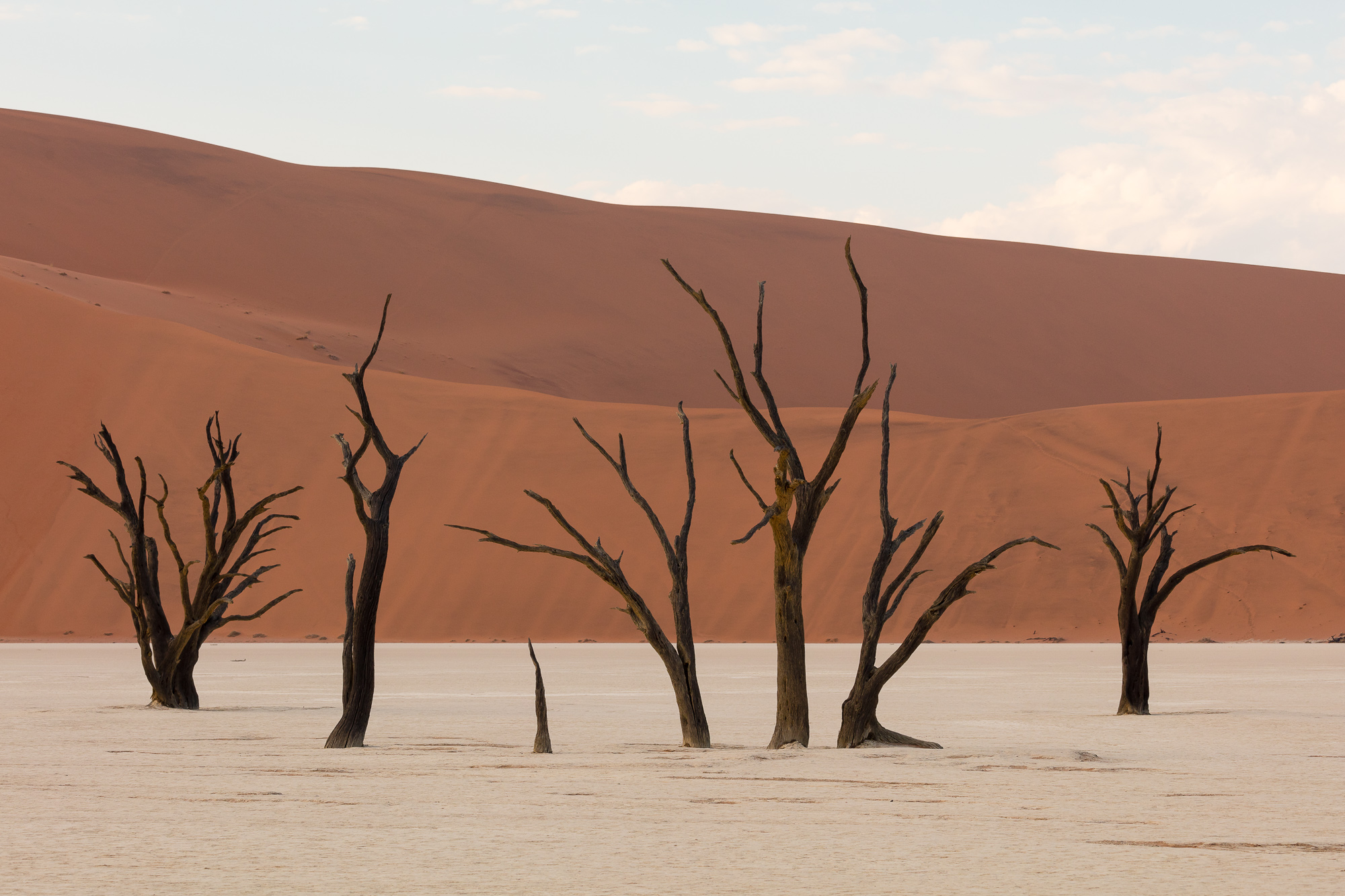
Pulling a three-dimensional stand of trees into a flat plane can be challenging.

This is a place I’ve wanted to visit for a long time. As I was standing in that dusty, dry, ancient river bed, I could hardly believe I was there. I was half a world away from home, and my surroundings could not have been more alien. I truly relish these experiences. Being able to capture an area photographically and share it with others is rewarding, but there is nothing that could replace being there in person.

The Etosha Pan

A camel-thorn acacia grows next to the Etosha Pan, Etosha National Park, Namibia.

The Etosha Pan is a large dry lake bed in Namibia, which due to heavy mineral deposits forms a dry salt pan. The name “Etosha” comes from an Ndonga word meaning “great white place”. While the pan rarely sees water, it is surrounded by savanna and sparse forest, teeming with wildlife. The pan is 75 miles long and just shy of 3,000 square miles. Here you can see the white expanse of the pan stretching into infinity.

A blue wildebeest wanders out alone onto the Etosha Pan, Etosha National Park, Namibia.

Occasionally the wildlife that lives at the edges of the lake bed wander out onto it to gather surface minerals, making up a portion of their diet. A blue wildebeest is dwarfed by the vastness of the pan.

The lake was fed by a large river about 16,000 years ago when glacial melt caused the formation of many such rivers. At some point tectonic plate movement changed the course of the river, and the pan dried up to its current state. The only time it sees a few centimeters of water is due to heavy rains, but this is a seldom occurrence.

Herds of plains zebra and springbok visit a waterhole for a morning drink, Etosha National Park, Namibia.

The area surrounding the pan is dotted with waterholes which support a wide variety of wildlife. This area is protected within the boundaries of Etosha National Park, which completely surrounds the pan. Although I only spent one full day here, that glimpse of wildlife photographic possibilities will surely draw me back.

Sunset Over Damaraland

One of my favorite locations I visited in Namibia was the Damaraland region. I was staying at the Mowani Mountain Resort – a collection of beautifully architected bungalows settled in among giant boulders. Each structure was connected by a series of footpaths, and situated so that each room felt completely isolated. I felt as though I had the entire landscape to myself.

The Damaraland region of Namibia is very dry, and features an occasional white-barked tree growing from the rocks.

The surrounding desert was composed of hard sandy soil and large red rocks. It was occasionally accented by gleaming white-barked trees that popped out of the rubicund scene.

The setting sun turns the boulder strewn landscape surrounding the Mowani Mountain Camp a burnt red, Twyfelfontein, Namibia.

The low sun lit up the rocks all around me, accentuating the ruddy hue.

Godrays stretch out from the sun setting over the African desert region of Damaraland, Twyfelfontein, Namibia.

Luckily there was an interesting cloud bank to the west, blocking the sun and allowing its light to radiate into strong beams. The only element missing was a herd of desert-adapted elephants roaming the desert floor.

Godrays stretch out from the sun setting over the African desert region of Damaraland, Twyfelfontein, Namibia.

I had two camera bodies with me for the shoot, one mounted to a tripod with a medium zoom (24-70mm) and the other with a telephoto zoom (100-400mm) which I was hand holding. This way I could capture the larger scene with the tripod, and still shoot the sun’s transition through the western clouds as a dominant subject with the telephoto. The photo above was taken at 170mm, emphasizing the sun’s rays breaking through the clouds.

Twilight decends upon the landscape of Damaraland, Twyfelfontein, Namibia.

After the sun had set, the landscape radiated a deep blue, beckoning me to keep firing the shutter. This is a crop of a much wider panorama. Sometimes these photographs that appear more muted lend themselves to large wall hangings. Some day I may do just that.

As usual for a sunset landscape session, the action was over too quickly. Soon it was time to pack up the gear, have a quick sleep and prepare for an early safari the next morning.

Okaukuejo Waterhole: Wildlife Diversity

My last blog post detailed my experience with five endangered black rhino at the Okaukuejo Waterhole in Ethosa National Park, Namibia. But that’s certainly not all I saw during those long quiet hours in the dead of night.

The sun sets over the Okaukuejo Waterhole, Etosha National Park, Namibia

I arrived at the waterhole just as the sun was setting behind the horizon. Night is the best time to see wildlife here, and to facilitate wildlife viewing, this camp has set up a flood light by which to see the nocturnal visitors. Quite a few people gathered at the waterhole to watch the sunset, but soon they were off to dinner and bed. Over the next hour, the crowds thinned out and only the die-hards remained for a long night’s wait.

Zebra come at night to drink from the Okaukuejo Waterhole. Night is a good time for prey animals to visit waterholes as they have a better chance of escaping predators.

One of the more common visitors were the zebra. One night a small herd came at dusk, but it was those few that crept up to the waterhole in the middle of the night that were more fun to watch. The absolute silence was only disrupted by the soft crunching of rocks under their feet, as they lined the edge of the water to drink. The stillness of the water cast a perfect reflection. However there was no chance to relax, as any little sound had the zebra darting their gaze to the darkness, trying to see beyond the wall of black.

A giraffe stands next to a tree at the Okaukuejo Waterhole. Its body is reflected in the still waters, Etosha National Park, Namibia.
A giraffe stands next to the Okaukuejo Waterhole. Its body is reflected in the still waters, Etosha National Park, Namibia.

Zebra gave way to giraffe, which traveling in ones and twos. In order to capture photos of these animals at night, I had my 400mm lens locked down on the tripod, my mirror locked up, and my shutter speed just slow enough to gather the required light. Keep the shutter too slow, and the animal was more likely to move during the exposure. It was a careful balance of predicting animal behavior, and making sure all my camera functions were set correctly.

Giraffe visit the Okaukuejo Waterhole at night, drinking from its still water, Etosha National Park, Namibia.

One of my favorite sights was the comical way in which giraffe drank water. They had to contort their bodies and spread their front legs in order to bring their heads low enough to the ground to drink.

A springbok visits the Okaukuejo Waterhole at night, its form reflected in the still water, Etosha National Park, Namibia.

In addition to the larger mammals, I saw a couple of antelope species. The ever present springbok made an appearance.

A species endemic to Namibia, several black-faced impala visit the Okaukuejo Waterhole at night, Etosha National Park, Namibia.

As did the endemic black-faced impala.

I did see an elephant in the early hours of morning. However luck was not on my side, and none of my photos turned out. There was too much movement from this giant beast to capture under low lights.

I would certainly recommend this type of experience to wildlife lovers. It was incredibly intimate to watch these animals interacting under the cover of darkness, with nobody else around. It was a wildlife cathedral I was lucky enough to attend!

Copyright 2017 Hank Christensen