
Grand Tetons National Park – The Mountains

The Tetons glow red as they are front lit by the sun at dawn, Grand Teton National Park

For my second post from my recent trip to Grand Teton National Park, I’ll focus on what I had considered the main attraction before the trip – the mountains. What was not expected however was being greeted by thick smoke from several nearby forest fires. On my first day in the park, the mountains were obscured by a dull gray haze that was so thick, you could barely make out the outline of the peaks.

Storm clouds drift high above the Tetons, Grand Teton National Park

Luckily however, some wet weather and (better yet) wind came through the valley, and helped clear things up a bit. In fact, I was excited to see the wet weather move in not just to help in clearing out the smoke, but because storms (and the clouds they bring) really help create drama. One of the worst things a landscape photographer can see in the forecast is clear blue skies.

I managed to visit all of the famous views of the Tetons while I was there. Though I usually shy away from such places, any self-respecting photographer should have these shots in his portfolio. After all, there is a reason they have become famous views!

The Tetons are reflected in the Snake River at Schwabacher's Landing, Grand Teton National Park
The Tetons are reflected in the Snake River at Schwabacher’s Landing, Grand Teton National Park

Even with the wind and weather moving through, we had several very foggy mornings. It was nice to see the smoke dissipating (fog generally looks “cleaner” than smoke), but at times the thick fog obscured both the view and the sun rising behind us. However, as the old saying goes, work with what ya got, and on one morning, I was able to use the fog to my advantage, adding a layer of separation to an otherwise straight forward sunrise shot.

A fog bank moves in front of the Grand Tetons as the rising sun illuminates the sheer peaks, Grand Teton National Park

Probably the most iconic spot in the park is Oxbow Bend, where the Snake River pools into a large area, allowing for still water and insane reflections. I was there on two mornings, and both times I didn’t even stop the car. The first attempt saw that familiar smoky haze, and in the second we were greeted by dense fog. And yet both times there were close to 100 photographers lined up waiting for sunrise. To this day I still don’t know what they expected to shoot in that weather, but I guess you have to respect their commitment? Meanwhile I was off to better spots for that weather.

Eventually I did get to photograph Oxbow Bend, this time around 10 in the morning. Usually I’m done for the morning by this time, but the fog was just starting the clear out. Luckily the trees along the shoreline were blazing with yellow, which juxtaposed the late morning blue of the mountains beyond. Some day I’ll have to make it back here for sunrise – I’ll be sure to sharpen my elbows first.

The fall colors of Aspen contrast the blue hues of the Tetons, Grand Teton National Park

As amazing as the Tetons were to see in person, I began to realize by the mid point in my trip that the real stars of the show (beyond the numerous wildlife) were the fall colors and the trees that wore them. But that will have to remain for another post….

Teaching A Middle Aged Dog New Tricks For Old Photos

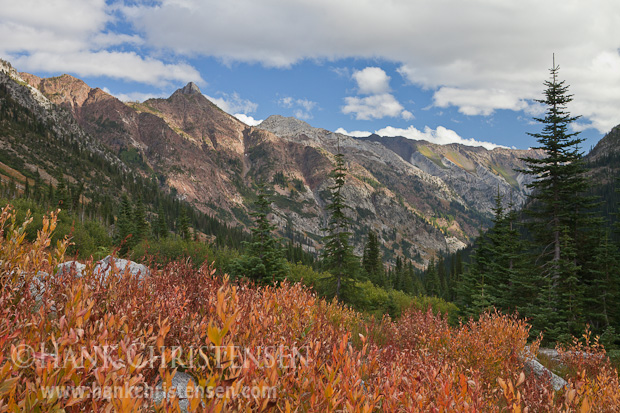
Painted cliffs descend to a mixture of fir and pine along East Eagle Creek, Eagle Cap Wilderness, Oregon

For me, learning happens in spurts. Call it a growth spurt of the mind. Over the last few weeks I have been spending many hours learning advanced Photoshop techniques to help me process my photos. This gives me better tools to recreate exactly what I saw, and the mood I felt when I took the photograph.

Now, I’m no slouch when it comes to Photoshop, but that application is so deep and allows for so much creativity, there is always more to learn. Once you’ve become expert in all the individual tools Photoshop has to offer, combining them to work for you becomes a life-long practice.

Needing to try out some of the new techniques I was exploring (detailed selections, channel masking, blending modes, etc), I decided to reprocess the photo above, which I took two years ago in Eagle Cap Wilderness. I always loved the photo, but never felt that I achieved that sense of awe that I experienced hiking down East Eagle Creek canyon. My latest reworking of the photo is above – here is the result of my original processing two years ago:

Painted cliffs descend to a mixture of fir and pine along East Eagle Creek, Eagle Cap Wilderness, Oregon

One of the things that I love about digital is that as time goes on, the experience I gain not only impacts my photographs going forward, but can have a positive impact on old photos as well. It can also be seen as a curse – that feeling that you’re never really finished working on a photograph. But I’d rather see my work (even old work) improve over time, and I’m more than willing to put in the time to make that happen.

Sunrise Over The Salt Pan

The rising sun creeps toward the eastern horizon as the dried flats of Salt Creek sit in shadow, Death Valley National Park

On the final morning of the recent Death Valley Dykinga workshop, we headed to the Salt Creek area in the heart of the park. This year it was dry as a bone, the water evaporating off the salt to form geometric shapes in the salt crust. This morning we only had clouds to the east, so I knew my first opportunity would be sunlit clouds in that direction, as the sun was still well behind the eastern mountains. Walking west from the road, I moved out into the salt pan far enough so that when I looked back to the east, the road was indistinguishable from the mountains. I knew that with my selected exposure, any cars (and other photographers!) would disappear into shadowed insignificance.

With the sun fast approaching, I hunted for the perfect foreground. This can be tricky to see with the naked eye – I can find my compositions better by looking through my viewfinder with the camera off-tripod. Once I see the composition I like, I set up the tripod in that spot. Then it is a matter of fine tuning up or down, left or right until the edges of the frame are just right. For the shot above, I decided not to go too wide because I wanted to fill the top of the frame with the meager clouds.

Instead of using a graduated ND filter, I took two shots – one exposed for the foreground and one for the sky. I knew I’d have more blending latitude on the computer later. I know many photographers who frown on this practice. They preach “getting it right” in the field. I consider that a noble pursuit, but I see my method as more future-proof. As my blending technique improves over time, I can always go back to my originals and recreate a better blend.

Sunlight moves down the mountains to the west of Salt Creek, now a dried salt flat, Death Valley National Park

As soon as I was finished with my first shot, I looked west and started pre-visualizing my second desired shot for the morning. This is when I really started getting excited. When the sun rose behind me, it would first strike the top of the western mountains and then start moving down, painting them red and orange (due to the mountains reflecting only the longer wavelengths of light as it traveled through the atmosphere). The whole time, the salt pan would still be in shadow, the pure white salt reflecting cool blue tones. One of my favorite things to do with photography is find places in nature that combine hot and cold tones together. Here was a great opportunity!

There was only one problem. Directly in front of me was a huge patch of dark mud, disrupting the disappearing patterns of the salt pan. I needed to move to the south of the mud field so I had uninterrupted salt pans fading to the base of the mountains. With little time to spare, I mounted my camera on my chest harness, picked up my tripod and ran to the south as fast as I could. As I got farther from the mud field, the ridges of the salt pan grew more shallow, which added a delicate feeling to the salt.

I found my composition, went ultra wide to accentuate the enormity of the salt pan, and waited. The sun had risen behind me and was already touching the highest peaks to the west. As the sun moved down the mountains, I took several safety shots, but I knew that I wanted as much of those mountains in red as possible. Soon the clouds to the east began brushing the mountain tops with light shadow patterns, and I knew this was the moment. Click.

I spent the rest of the morning experimenting with different lenses and techniques, unconcerned about getting anything else of substance that morning. I was pretty happy with my haul.

Zabriskie Point Sunrise

Clouds explode with light over the multi-colored rock at Zabriskie Point, Death Valley National Park

During my recent visit to Death Valley National Park, one morning was spent at Zabriskie Point, a popular roadside overlook filled with tourists. Usually, I try to avoid these places, but it was my first visit to the park, and as much as I hate to admit it, these roadside tourist zoos were put there for a good reason. They offer amazing views! So, it was time to buck up and stand elbow to elbow with every other photographer in the park that morning.

The sky turns pink at first light at Zabriskie Point, Death Valley National Park

No one there that morning was disappointed. As the sun rose behind us, the sky to the west exploded with light. Unearthly pink hues skipped across the bottom of the clouds, topping the canyon of ribboned stone below with a surreal canopy. A hundred clicks echoed off the walls of the valley before us.

Dawn light permeates the clouds at Zabriskie Point, Death Valley National Park

It was on. I felt myself move into the space between consciousness and dreaming, where my creative mind took control and the technical operations of my camera faded from thought. Landscape, portrait, panorama, zoom in, pull out. My fingers flew over the controls as my mind prepared the next shot. In an instant, it was over and all around me came a collective sigh of relief. The race to capture first light was over – time to have a brief pause before the sun started peaking over the eastern hills.

Muted light plays across the ridges of rock at Zabriskie Point, Death Valley National Park

Soon people were packing up to leave. I took this opportunity to capture some of the details of the rippled rock below. It was still in shade, but with so much light bouncing off the bright walls of the canyon, all the shadows were full and rich in detail.

Before long I was packing up as well. The streams of outgoing photographers were replaced with point-and-shoot tourists, fresh after a morning breakfast. I knew that seeking originality from Zabriskie Point was likely a lost cause, but it was hard not to be inspired by such a light show. I left with a huge smile on my face, thankful for the unending gift of nature.

Copyright 2017 Hank Christensen