Mesquite Dunes, Death Valley National Park

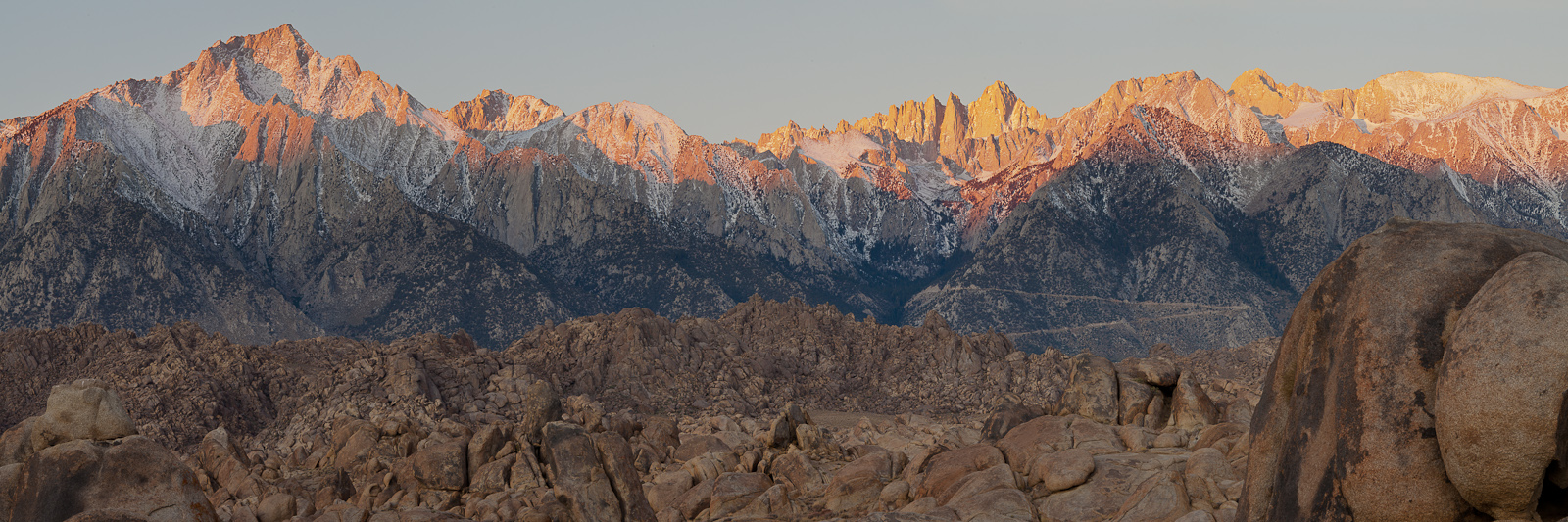
Mountains rise beyond the sand dunes of Mesquite Flat, Death Valley National Park
The Mesquite Dunes stretch across the valley just north of Stovepipe Wells, Death Valley National Park

I just spent a week in Death Valley National Park attending a workshop with landscape photographer Jack Dykinga. It was an amazing week catching up with old friends, doing a ton of field work, and trying to soak in Jack’s incredible talent whenever possible. One of my favorite places to shoot was the sand dunes of Mesquite Flat, just north of Stovepipe Wells.

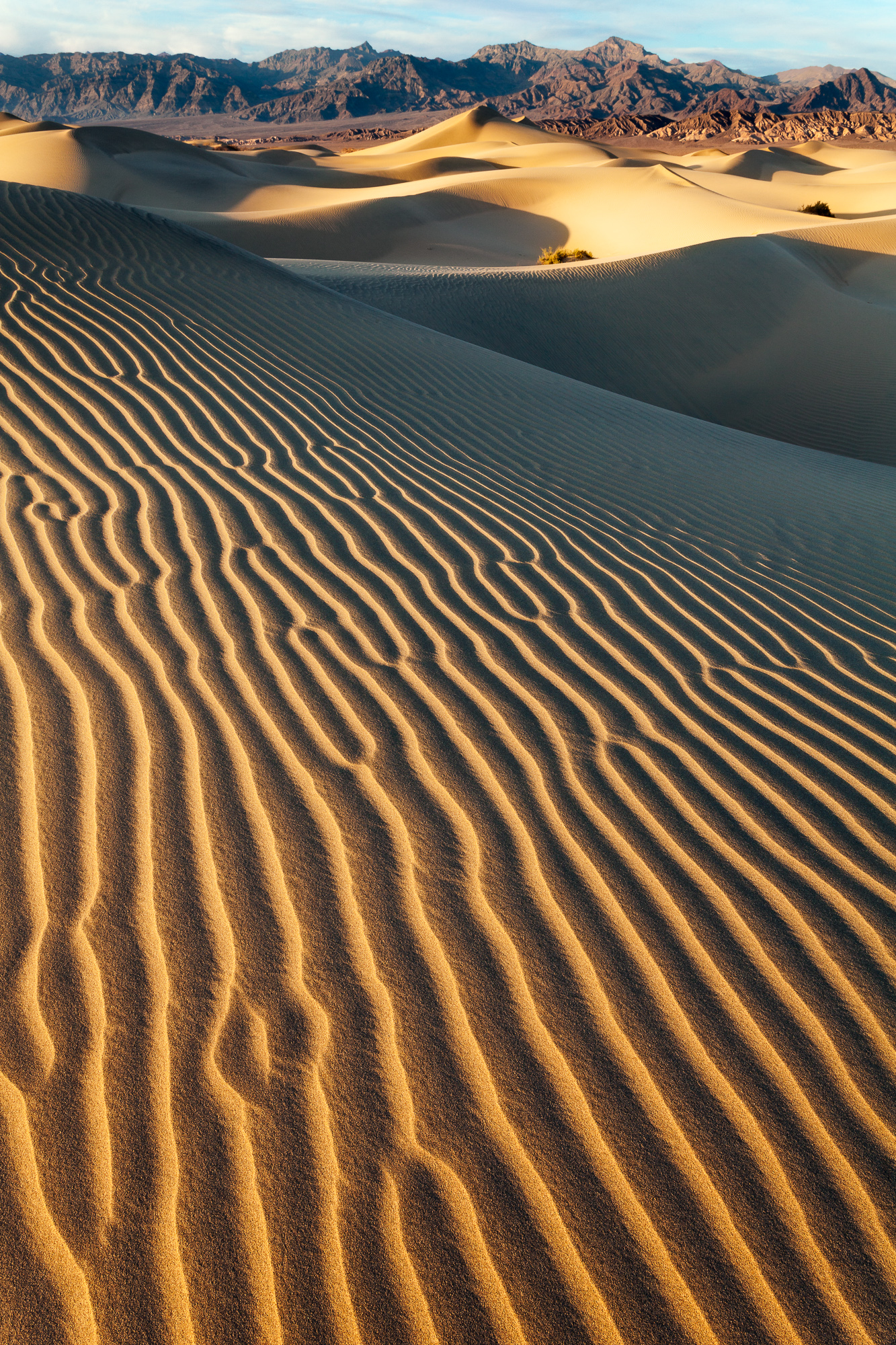
Wind and weather carve the Mesquite Dunes into endless shapes and textures, Death Valley National Park

The dunes provided an amazing array of shapes and pattern with which to craft photographs. It was a place that really clicked for me, and it was a joy to shoot. An hour or two before sunset, the sun was still high enough to provide strong shadows and side lighting.

Death Valley's Mesquite Dunes are a study of form and lines
Death Valley’s Mesquite Dunes are a study of form and lines

At this time of the day, I really wanted to capture strong contrast which let the eye see the huge variety of patterns in the sand.

Visitors to Stovepipe Wells are treated to a view of wind carved sand dunes across Mesquite Flat, Death Valley National Park

As we got closer to sunset, the dunes and mountains to the east began to reflect that sweet magic hour light. Using a longer lens to stack the dunes against the mountains helps to give the viewer a sense of place.

Mountains rise beyond the sand dunes of Mesquite Flat, Death Valley National Park

My favorite time of day to shoot however, was after the sun had set. The light across the dunes evened out, filling in the shadows and giving the dune contours a milky softness.

As the sun sets, the soft light give the sand dunes a buttery feel, Death Valley National Park

Black and white photos still worked well in this light. Instead of cranking up the contrast to show those sharp lines, the key here was to keep it soft and lower contrast. I tried to find compositions that allowed the eye to move easily up into the frame, flowing through the dunes.

Soft light across the dunes adds a milky texture to the wind carved lines, Death Valley National Park

As the valley settled into shadow, the sand was cast in a cool blue light.

In the moments after sunset, the light softens to accentuate the subtle curves of the sand dunes, Death Valley National Park

As I had never spent much time photographing sand dunes before, I was thrilled with the experience. It is definitely a subject that offers endless variety and continual learning. These are my favorite kinds of photographic subjects – challenging and varied, forcing me to adapt and grow.

If you are serious about your photography and want to learn from one of the masters, I highly recommend putting Jack on your short list of workshop instructors.

Eastern Sierra, The Panoramas

On my recent trip to the Owens Valley, I tried to look for good panorama opportunities. These situations arise when there is an expansive vista that lends well to an image that is three to six times wider than it is high. As with any photograph, one thing to keep in mind is to make sure the entire contents of the frame supports the photograph. There should be no large empty areas, unless those areas purposefully support the image with negative space.

These images can be created with any regular digital camera. The images are stitched together in post processing to create large, wide angle views. All of the photos presented here are in the 40 to 100 megapixel range, which means they can be printed very large (at least 30×90 inches). For better appreciation for the detail captured in these photos, please be sure to click on the image to see a larger view.

The sun lights stormy clouds as sets behind the eastern Sierra range, north of Bishop
The sun lights stormy clouds as sets behind the eastern Sierra range, north of Bishop. Canon 70-200mm f/4L lens with the EOS-5D MkII. ISO 640. Evaluative metering 0 EV: 1/400 sec. at f/8. Composed of 7 stitched photos, handheld.
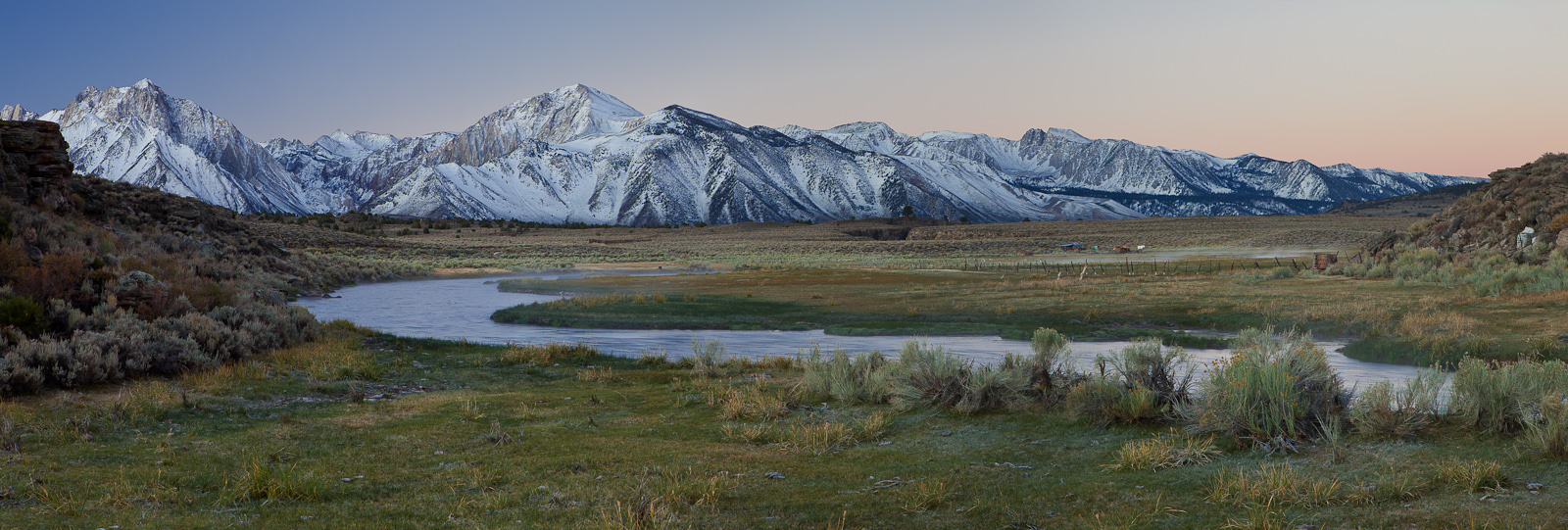
The sun rises over Hot Creek, as the Sierra Nevada looms in the distance
The sun rises over Hot Creek, as the Sierra Nevada looms in the distance. Canon 24-70mm f/2.8L lens with the EOS-5D MkII. ISO 100. Evaluative metering 0 EV: 3.2 sec. at f/16. Composed of 4 stitched photos.
The wall of the eastern Sierra rises over ten thousand feet above the Alabama Hills at dawn
The wall of the eastern Sierra rises over ten thousand feet above the Alabama Hills at dawn. Canon 70-200mm f/4L lens with the EOS-5D MkII. ISO 200. Evaluative metering 0 EV: 1/4 sec. at f/16. Composed of 7 vertical stitched photos.
An ancient bristlecone pine crouches on a snowy slope, greeting morning's first rays of light, Ancient Bristlecone Pine Forest
An ancient bristlecone pine crouches on a snowy slope, greeting morning's first rays of light, Ancient Bristlecone Pine Forest. Canon 70-200mm f/4L lens with the EOS-5D MkII. ISO 200. Evaluative metering 0 EV: 1/6 sec. at f/7.1. Composed of 7 stitched photos.

The Grove Of The Patriarchs

The setting sun casts a red glow in an ancient bristlecone pine, Ancient Bristlecone Pine Forest
The setting sun casts a red glow in an ancient bristlecone pine, Ancient Bristlecone Pine Forest. Canon 24-70mm f/2.8L lens with the EOS-5D MkII. ISO 100. Evaluative metering 0 EV: 1/8 sec. at f/14.

On my trip to the Owens Valley last month, I spent a night up in the Ancient Bristlecone Pine Forest with some friends. This forest runs across the ridge of the White Mountains in Inyo National Forest. It is an inhospitable environment, with a barren landscape, freezing weather, and frequent gale-force winds blasting across exposed rock. It is also one of my favorite places on earth.

This was the first time that I was in that area for both sunset and the following sunrise. A few small clouds moved in at sunset (above), providing some texture to the sky.

At sunrise, I had unobstructed views of the sun rising over the eastern horizon, across the Nevada desert. Similar to the intense alpenglow of the eastern Sierra peaks, at this elevation the trees turn an unworldly red glow at dawn. From a distance, these bare, twisted branches can transform into the wild licking flames of a campfire.

A twisted bristlecone pine glows orange in the intense rising sun, Ancient Bristlecone Pine Forest
A twisted bristlecone pine glows orange in the intense rising sun, Ancient Bristlecone Pine Forest. Canon 17-40mm f/4L lens with the EOS-5D MkII. ISO 200. Evaluative metering 2/3 EV: 2 sec. at f/16.

The early tree-glow gave way to direct sun on the bark. This was prime time to capture the morning light, and the race was on to photograph as much as possible before it faded. Of course, working along a steep slope at 11,500 in deep snow is not easy! Soon I was panting for breath and my heart was racing out of my chest. In these types of environments, it is better to pick a spot with several morning light opportunities and stay there.

A twisted bristlecone pine reflects the warm glow of the rising sun, Ancient Bristlecone Pine Forest
A twisted bristlecone pine reflects the warm glow of the rising sun, Ancient Bristlecone Pine Forest. Canon 24-70mm f/2.8L lens with the EOS-5D MkII. ISO 200. Evaluative metering 1/3 EV: 1/10 sec. at f/16.
A bristlecone stump clings to the side of a snowy slope, where it has sat for thousands of years
A bristlecone stump clings to the side of a snowy slope, where it has sat for thousands of years. Canon 17-40mm f/4L lens with the EOS-5D MkII. ISO 200. Evaluative metering 2/3 EV: 1/5 sec. at f/16.

An hour later, the sun had risen above the horizon, and the trees went back to their natural brown-tan color.

A gnarled bristlecone pine grows out of a rocky slope high in the White Mountains
A gnarled bristlecone pine grows out of a rocky slope high in the White Mountains. Canon 24-70mm f/2.8L lens with the EOS-5D MkII. ISO 100. Evaluative metering 1/3 EV: 1/60 sec. at f/16.

Photographing these trees in the right way is not an easy task. I learned this the hard way when I first visited the forest. Having seen many amazing photographs from Galen Rowell and David Meunch taken in this area, I was expecting a lot. But I came away with less than desirable photographs, and a deeper appreciation for the difficulty in photographing these trees well. The key is to take it slow and spend some time with the trees. Not to get too metaphysical, but it helps to sit with a tree, and listen. Each time I go back, I feel as though I understand the trees a little better, and my photos improve just a little more. Some day, I may just do them justice.

Alabama Hills

Dawn begins to light Mt. Langley and the wild rock formations of the Alabama Hills
Dawn begins to light Mt. Langley and the wild rock formations of the Alabama Hills. Canon 70-200mm f/4L lens with the EOS-5D MkII. ISO 200. Evaluative metering 0 EV: 1.6 sec. at f/16.

A popular stop on any eastern Sierra tour is the Alabama Hills outside of Lone Pine. I’ve been here before, but every time I come back I see new things to focus on and photograph. Dawn is the most versatile time to shoot the area, as your photographs are enhanced by the intense alpenglow that adorns the 14,000 foot peaks to the west.

The two dominating mountain subjects in this area are Mt. Langley (above) and the Mt. Whitney massif (below). I was lucky to shoot the area after an early season snow storm, so I had some snow to contrast the red rock of the mountain tops. The Alabama Hills are covered with interesting boulder shapes, which provides endless photographic possibilities.

The peak of Mt. Whitney glows red in the early morning light
The peak of Mt. Whitney glows red in the early morning light. Canon 70-200mm f/4L lens with the EOS-5D MkII. ISO 200. Evaluative metering 0 EV: 1/4 sec. at f/16.

Using an entire arsenal of lens lengths is key to this area. Wide angles work well framing mountains inside of arches. Medium lengths can use rock formations as foregrounds, while not diminishing the relative size of the massive mountains in the background (as seen in the first photo). Perhaps my favorite in this area however, are the long lenses. Point them anywhere and you’ll see interesting rock detail or a study of the cracks and crags that define a mountain face.

Moments after the sun rises over the Nevada desert, the peak of Mt. Whitney glows a bright orange
Moments after the sun rises over the Nevada desert, the peak of Mt. Whitney glows a bright orange. Canon 100-400mm f/5.6L lens with the EOS-7D. ISO 400. Evaluative metering +1/3 EV: 1/500 sec. at f/5.6.
Snow, rock, shadow and light combine to illustrate the steep slopes of Mt. Langley at dawn
Snow, rock, shadow and light combine to illustrate the steep slopes of Mt. Langley at dawn. Canon 100-400mm f/5.6L lens with the EOS-7D. ISO 400. Evaluative metering +1/3 EV: 1/640 sec. at f/5.6.

I kept shooting until the red glow of the mountains faded to its natural gray, and the long shadows of dawn began to shrink. I looked to the shady spots so that I didn’t have to work against the harsh shadows of mid morning. My eye was drawn to the variety of cactus growing in this high desert. In order to separate the cactus from their busy surroundings, I attached my 70-200mm lens and got down on my stomach. I worked with apertures that gave me just enough depth of field for the cactus, but threw the background out of focus.

Cholla cactus thrives in the high desert of the Alabama Hills
Cholla cactus thrives in the high desert of the Alabama Hills. Canon 70-200mm f/4L lens with the EOS-5D MkII. ISO 100. Evaluative metering 0 EV: 1/250 sec. at f/4.
A modest beavertail cactus grows in the Alabama Hills
A modest beavertail cactus grows in the Alabama Hills. Canon 70-200mm f/4L lens with the EOS-5D MkII. ISO 100. Evaluative metering +1 1/3 EV: 1/10 sec. at f/8.

After another hour, it was time to pack up for the morning and head out. If I had several days here, I would use this part of the day to explore and scout potential spots for future sunsets and sunrises. Unfortunately this day, I had other places to visit.

Copyright 2017 Hank Christensen