Recently I uncovered a couple of unprocessed photographs in my collection that I took in Death Valley National Park several years ago. These were sitting in my “reject” pile, but upon a second look, I thought each photo had its own merit. When I looked at these two images a little more closely, I began to feel a very different mood with each.
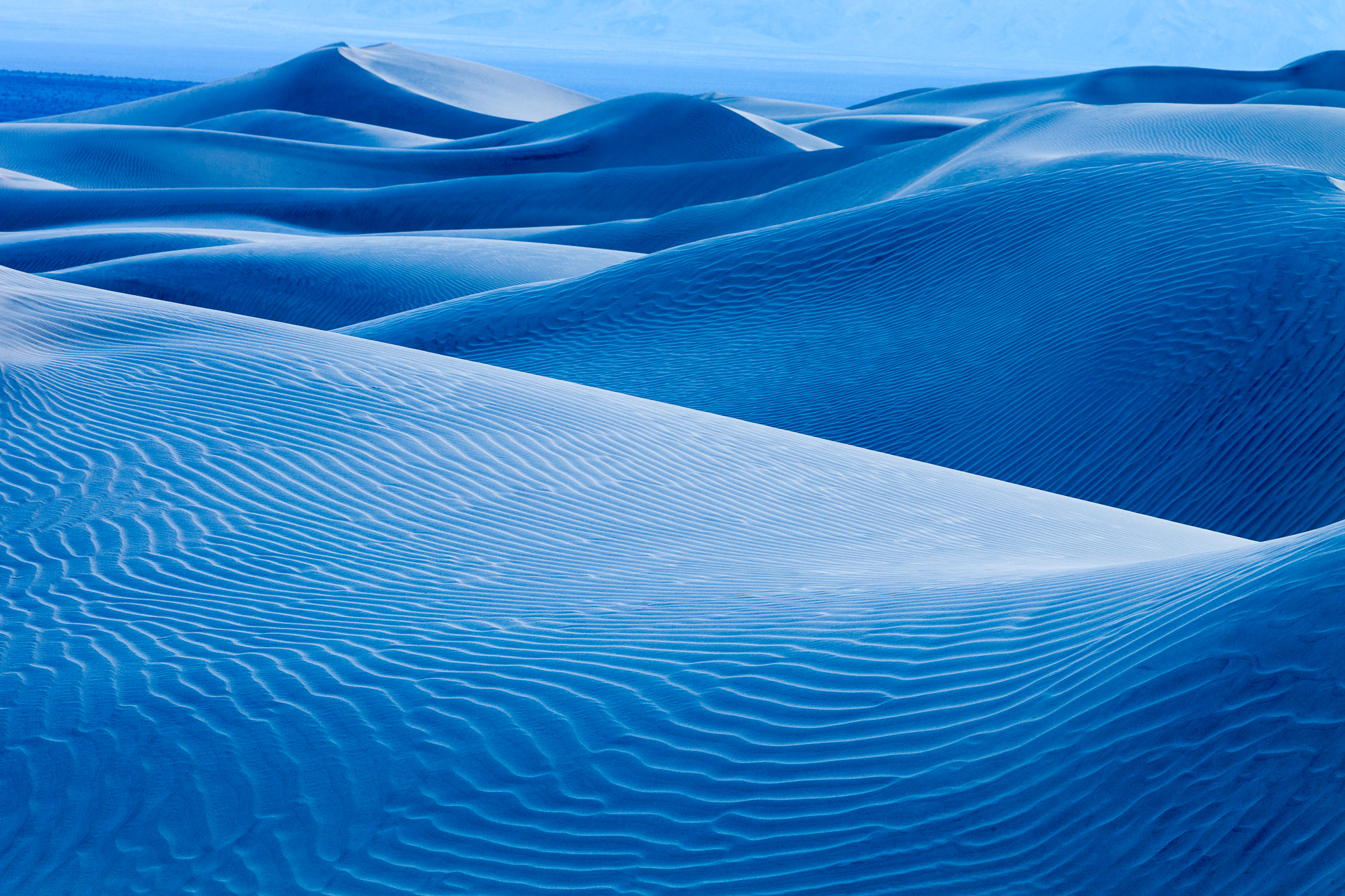
Blue shadows of twilight dance over the dunes of Death Valley National Park
What struck me with the first photo were the vibrant blue hues that emerged after sunset. Shot in deep twilight, the evening sky was reflected off the light tan sand, creating an amazing blue glow throughout the dune field. In order to accentuate this glow, I increased the contrast of the image overall, and increased the clarity. High contrast helped show off the intricate texture of the foreground dune, showing sharpness in each ripple of sand. Contrast was increased two ways: the first was to set the white and black point of the image. While I didn’t use the extreme ends of the histogram, I got pretty close.
The second was to add a contrast s-curve to the image. All adjustments were done in Adobe Lightroom. I kept the white balance pretty close to what the camera chose, increasing it slightly. This gave me a white balance of just over 6000 Kelvins – I was amazed at how blue it still was even after using such a warm color temperature.
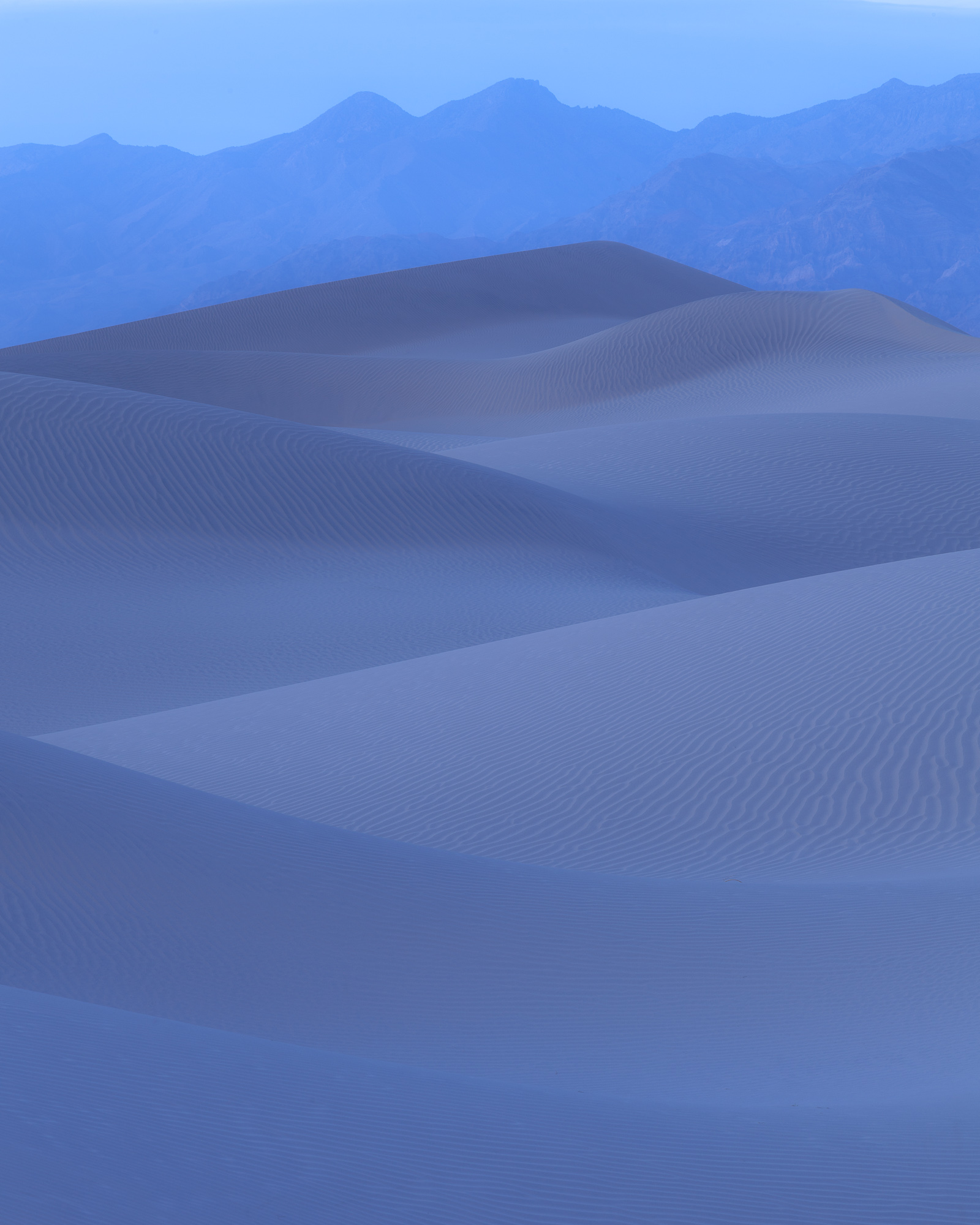
In the blue shades of twilight, smooth dunes stretch to distant mountains, Death Valley National Park
The second image I selected gave me a sense of calm and quietness. In order to accentuate this mood, I kept the contrast very low. I left the white and black points where they were originally, and actually decreased the clarity, giving the dunes a soft, buttery appearance. Because this was more of a graphic image, the low clarity and contrast helped to de-focus attention on the sand texture, and instead allow the dune pattern to abstract, driving the eye up toward the distant mountains.
When making processing decisions, I find it vital to fully understand the message I am trying to convey with each photograph. These moods convey two extremes, even though the images were captured within 20 minutes of each other.
Two weeks ago I was challenged by friend and photographer Jerry Dodrill to post 5 black and white photographs on social media over 5 consecutive days. As I am not known for shooting much black and white, I dug back into my archives to see what I had. From that selection, I chose five photos from a variety of subject matter (landscape, wildlife, and architecture) that spoke to me more as fine art than editorial photos. Here is my selection collected together, along with a short synopsis of each.
Day One
Dawn breaks over Banner Peak and Thousand Island Lake, Ansel Adams Wilderness
I shot this last year on my attempt at the John Muir Trail. Thousand Island Lake is a beautiful location in the heart of the Ansel Adams Wilderness. This was a dark, moody, stormy morning, and during a brief pause in the torrential downpour, I braved the elements and scrambled out of my tent to capture Banner Peak with the lake below. In order to convey my feelings at the time I shot it, it seemed like a perfect candidate for a B&W conversion.
Day Two
Death Valley’s Mesquite Dunes are a study of form and lines
This shot is of the Mesquite Dunes outside of Stovepipe Wells in Death Valley National Park. I shot this fairly wide (21mm) as I was standing on the foreground dune. Those who have photographed a lot of sand know that you can’t just back up to reshoot – you’ll end up with a photo full of footprints! Black and white allowed me to add contrast into the sand ripples along the crest of the dune.
Day Three
Four american white pelicans line up, all of them fishing at the same time. There was a nice symmetry to this image, which was calling very strongly to be rendered as a black and white fine art photograph.
With this photo, I’m switching focus to birds (hey, birds can make great B&W too!) I was shooting a group of American White Pelicans and was waiting for that perfect, synergistic moment. Finally they all ducked down for fish at the same time (the white pelicans tend to be much lazier when eating as compared to the California Browns who are constantly dive bombing their food). I caught the moment and new it would make a nice pano crop – a conversion to a high-key black and white was icing on the cake.
Day Four
Church and cemetery, Great Smoky Mountains National Park
This image is a little different from my usual fare. Quite a few years ago, a friend and I were hiking through the woods of Great Smokey Mountain National Park. It was a still, crisp November day, and we were utterly alone with the trees. Throughout the day, we had been getting a very creepy vibe. Unlike the wilderness of the west, these forests are littered with remnants of past civilizations – small mountain villages linked to other settlements only via walking paths. It almost felt like the ghosts of the past were watching our progress through their woods. Suddenly our trail opened up into a clearing with an old church, complete with cemetery and 100+ year old headstones. When I took this photograph, I knew I wanted to try to convey that feeling that we’d been getting all day. A black and white, high contrast conversion was in order.
Day Five
Soft light across the dunes adds a milky texture to the wind carved lines, Death Valley National Park
My final shot is another B&W dune photo from Death Valley. This time I kept the contrast and the clarity low, to emphasize the soft buttery texture of twilight. What first attracted me to this spot was the three tall dunes in the background. I think they reminded me of pyramids off in the distance. I set about looking for a foreground. When I found layer upon layer of sand “waves” stacked up in front of the dunes, I knew I had my shot. I fell in love with the way the light moved across the sand like it was a living thing. In order to remove all other distractions from the photo, I subtracted all color and let the interplay between the shadows and highlights define the photograph.
Those of us who have spent a good deal of time in nature have probably witnessed a few moments of pure magic when weather, light and other natural forces converge to create unforgettable events. I have had several such experiences, some of which I’ve been fortunate enough to have had a camera ready to capture them. When I see it in person, I’m often awe struck at the magnificence before me. But many times when I get home and process the resulting photos, I realize that I’m going to have some explaining to do. Sometimes the colors and lighting are so striking and unusual, that the resulting photo looks completely fake. This is especially true in this modern world of extreme photo manipulation capabilities.
But what to do in such circumstances? I certainly don’t want to de-saturate and alter the unusual colors so that the scene looks more “natural”. That is like saying these lighting events never occurred and what I witnessed should have looked like any other day. Instead I process the image so that the result matches my memory and add some written descriptions to allow the viewer to understand what they are seeing. So without further ado, here are three “crazy” lighting events and the resulting photos.
Dramatic light bursts from behind the Tetons at sunset. Thick smoke and haze from nearby forest fires create God beams as the sun drops behind the horizon, Grand Teton National Park
We’ll start with one of the most unbelievable sunsets I have ever seen. I was with some friends on a photo trip in Grand Tetons National Park a couple of years ago to photograph wildlife and fall colors against the spectacular backdrop of this mountain range. Smoke from nearby wildfires somewhat hampered our efforts early in the trip, but it also lent a special atmospheric quality to the otherwise clear skies.
The sun set behind the notch in the mountains, and we waited. Finally, it peeked out underneath the clouds on the horizon, cutting through the lingering smoke and turning the sky into an unbelievable magenta. In post processing, I kept finding myself wanting to desaturate or change the sky color, but finally I just left it as is. That is how I saw the scene, so I have to trust the colors.
Mt Wilson and the Wilson Mesa glow a light magenta under a cloud that catches the morning light.
The next example is from a recent fall color photography trip (notice a pattern here?) that I took to Colorado. Standing just below Last Dollar Road and looking out over the Wilson Mesa, I waited for what the sunrise would bring. The morning did not disappoint, and the clouds over Mt. Wilson lit up a beautiful orange. What was strange about the scene though, was that the entire landscape was cast in a similar orange, as if the color from the clouds on the horizon was emanating out in all directions.
What I realized later was that directly above me was a similar cloud catching similar light. It acted as a giant diffuser, coloring the grass, trees, and mountains in that same orange tint. Again I found myself tempted to remove the color cast, but again, that glow was real, and that is exactly how the scene looked that morning.
Clouds explode with light over the multi-colored rock at Zabriskie Point, Death Valley National Park
This sunrise was really spectacular. Given that I was shooting at a popular roadside pullout, the sky really saved the shot here and made it unique (which is why I emphasized it so much in this photo). The bright pink/magenta color continued to get more and more intense as the sun rose behind me. This was one of those moments when the heart starts beating faster and I can feel the blood pumping. I knew I had just seconds to capture the shots I wanted while this phenomenon remained. In all, within 30 seconds it was gone.
As I look back on these shots I see wild colors and unreal looking landscapes. I’m not sure if I’ll ever print any of these, because they look processed beyond reality. But looking at these photos also reminds me of some amazing moments that I’ve witnessed first hand. I wouldn’t trade them for anything.
When arriving at a new location to photograph, it is easy to get over-excited, and like a moth to a flame, focus all attention directly on the obvious composition. This is easy to do when shooting a grand vista, and more than once I’ve gotten so caught up in this one shot, that only later do I realize that I’ve missed many other great photos that could have been captured there.
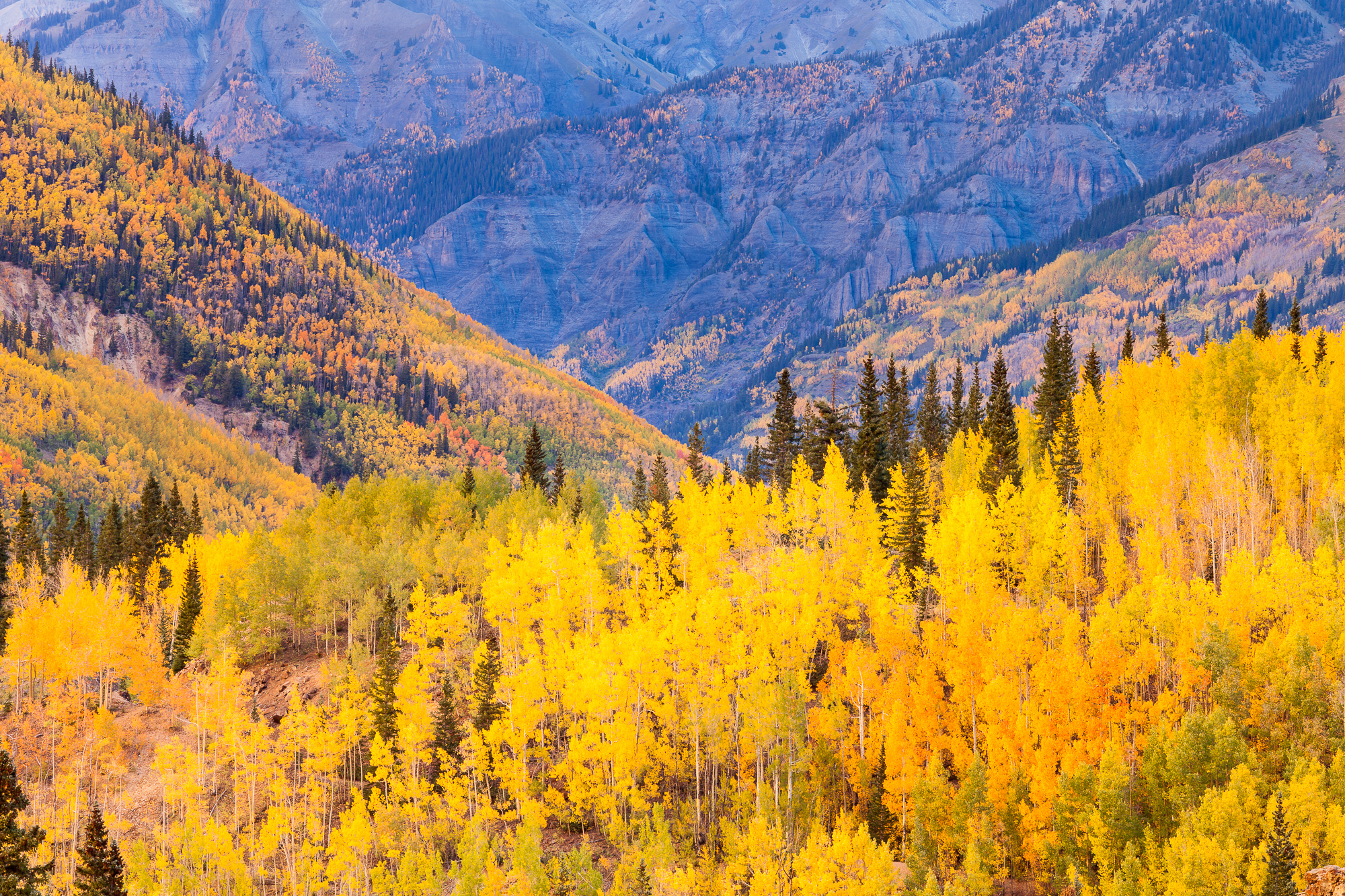
On a recent trip to Colorado, I kept this top of mind as I shot a valley filled with beautiful aspen. I made sure to look for many different photos to be made within the scene. This is a good example of thinking of different ways to capture a scene, because I didn’t even move the tripod – here are six different shots taken from the same spot.
Light beams cut through afternoon storm clouds over Abrams Mountain, Ouray, Colorado
I started with the “obvious” grand vista shot. Situated on a bluff overlooking this valley, I shot down the valley at the mountain capping it off. Of course, waiting for just the right moment is also important, and here I captured a ray of light that broke through the clouds for a moment, illuminating the peak.
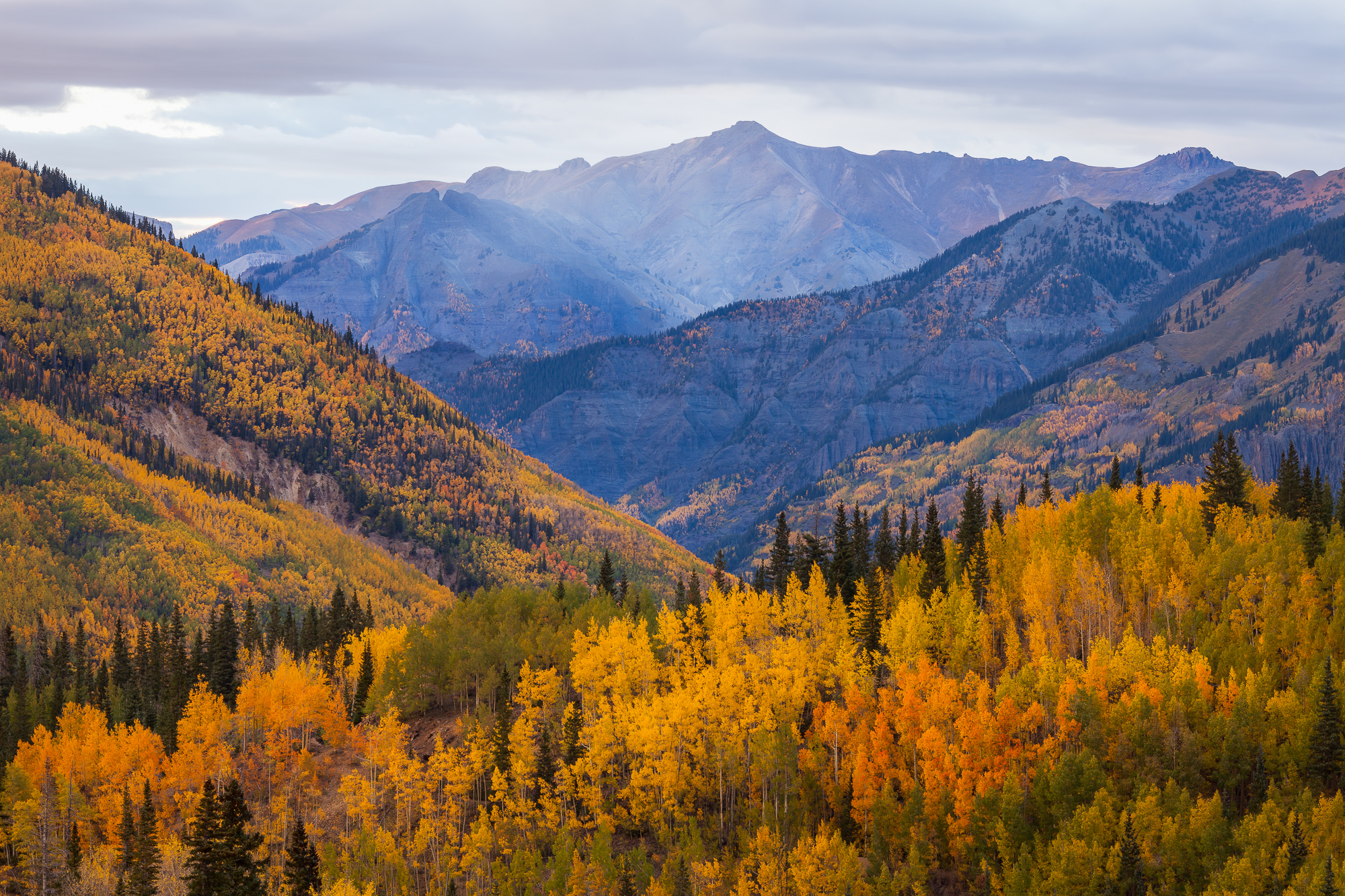
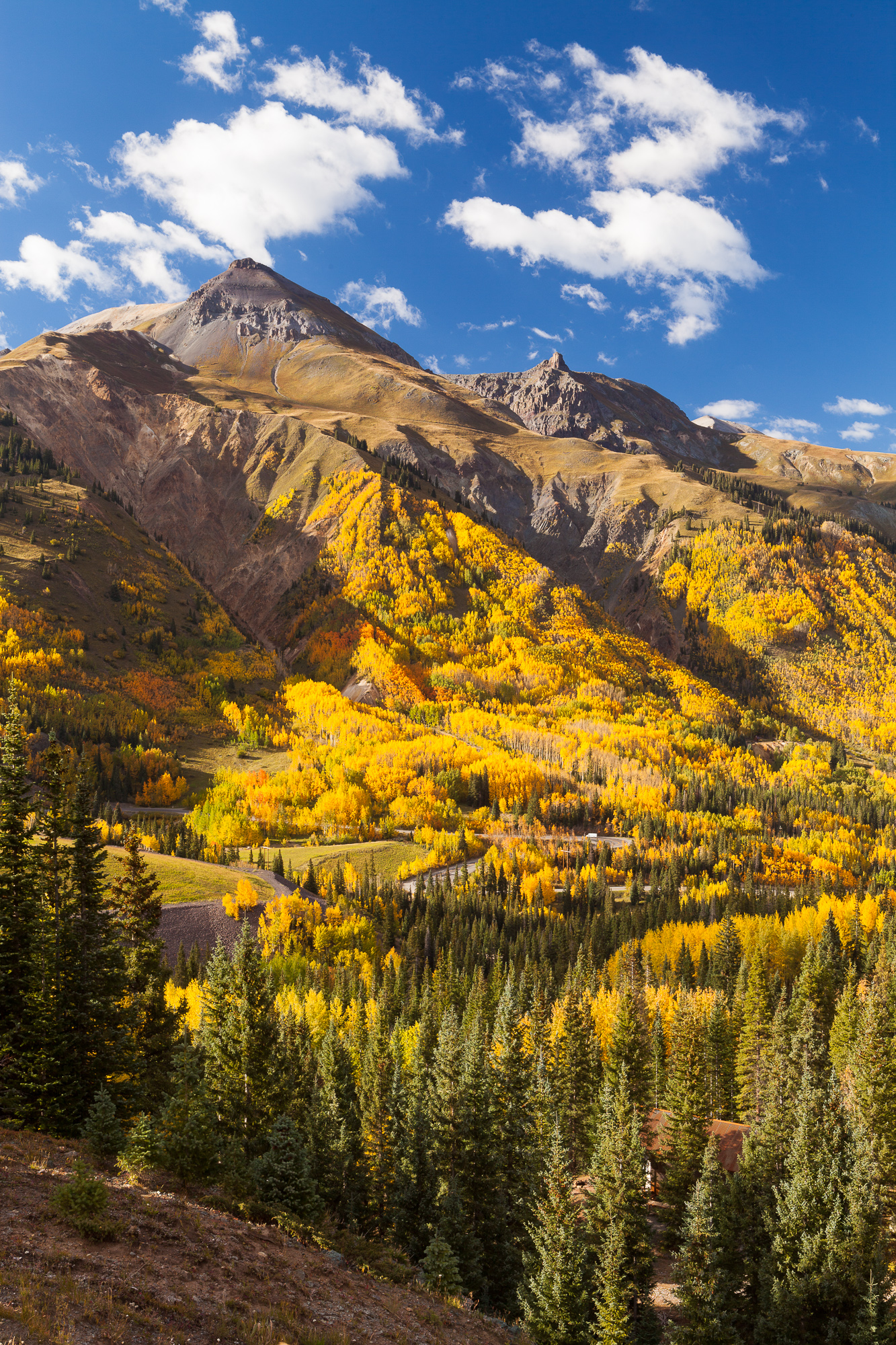
Abrams mountain rises above lower slopes filled with bright fall colors, Ouray Colorado
My next shot was essentially the same shot, but in a vertical orientation. When the landscape allows for it, I always try to capture both vertical and horizontal shots, offering variety for my stock collection.
Fall colors explode on the slopes of Hayden Mountain, Ouray, Colorado
Turning to my left, I shot another vertical, this time of Hayden Mountain. The groves of aspen climbing up its lower slopes were ablaze in fall color glory.
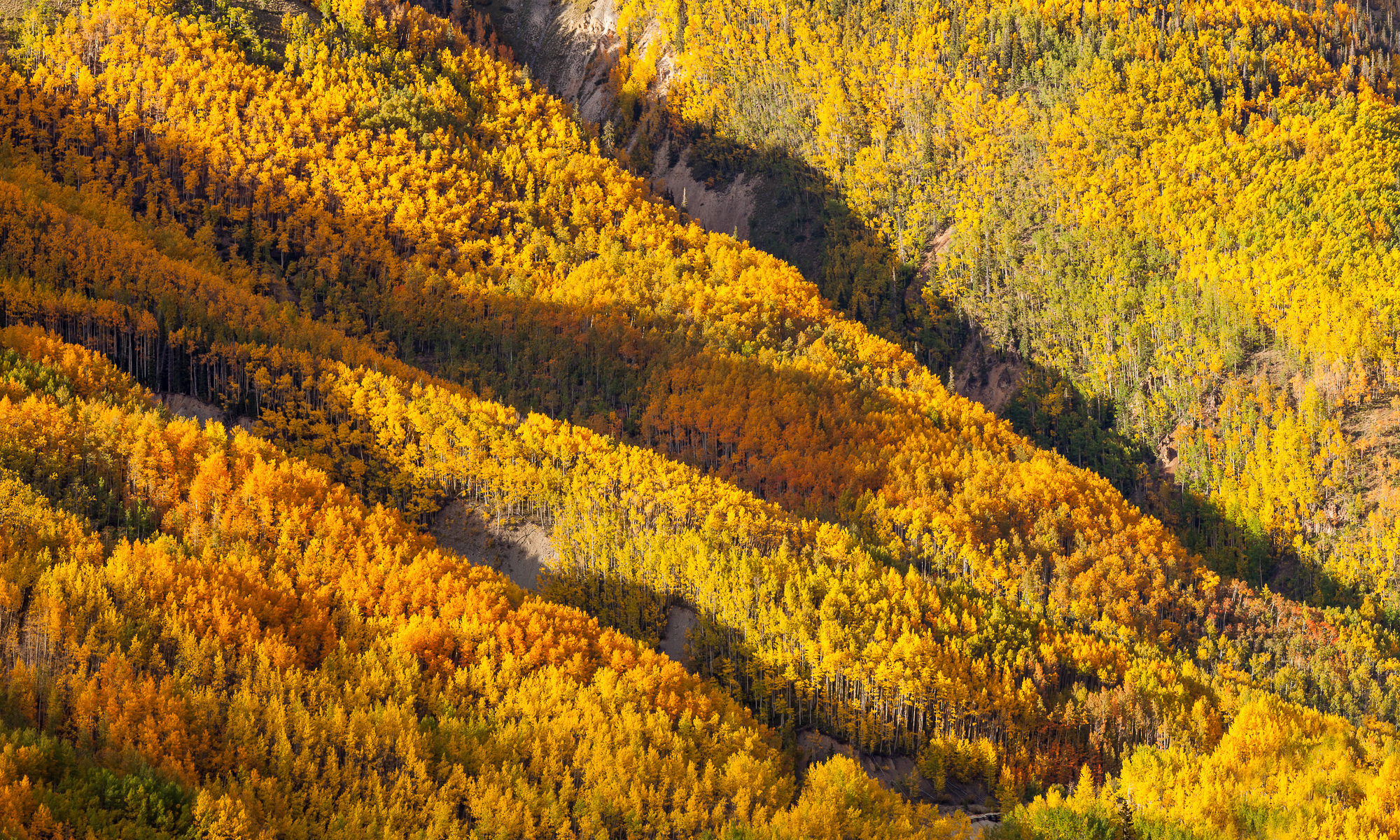
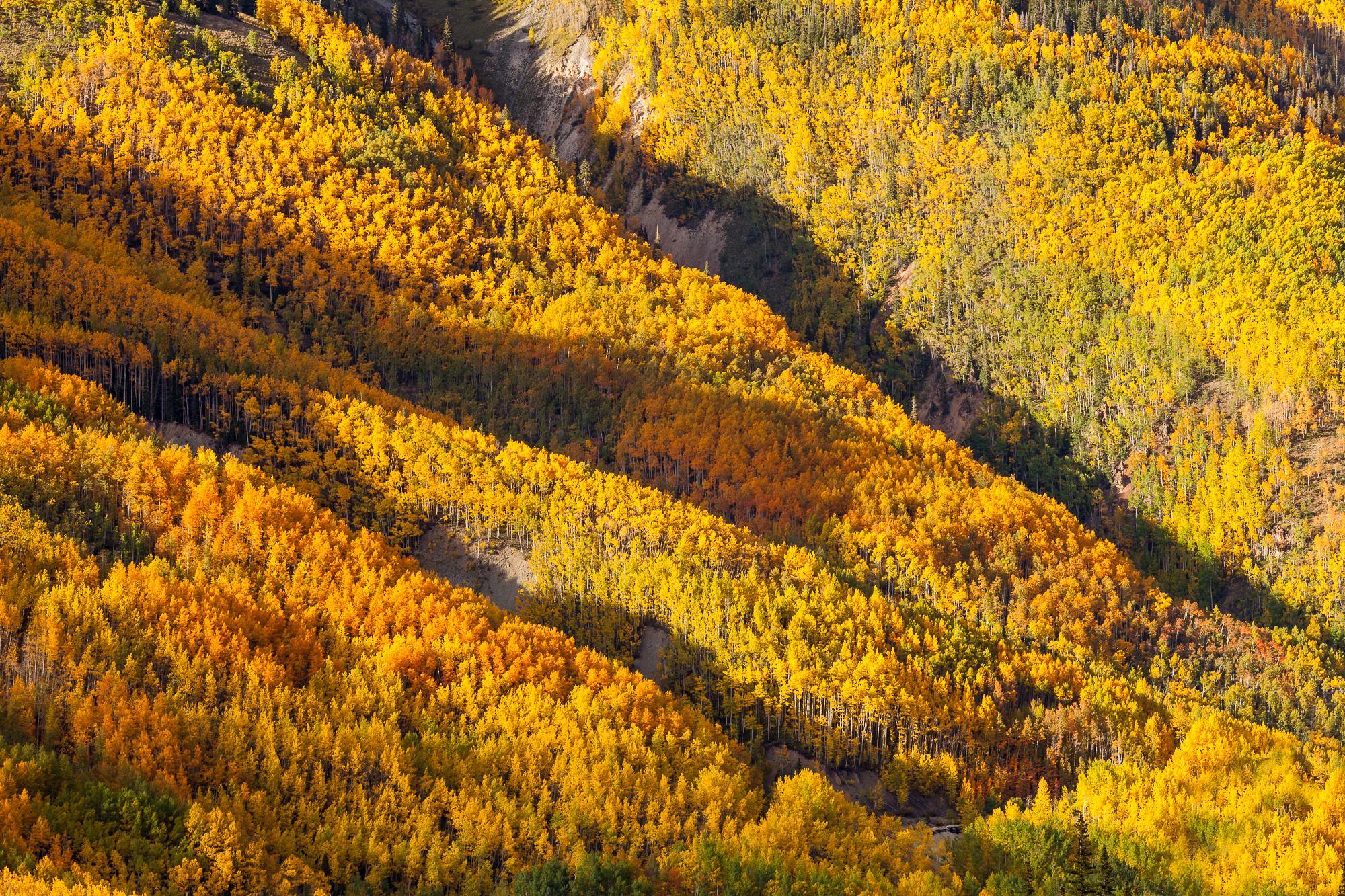
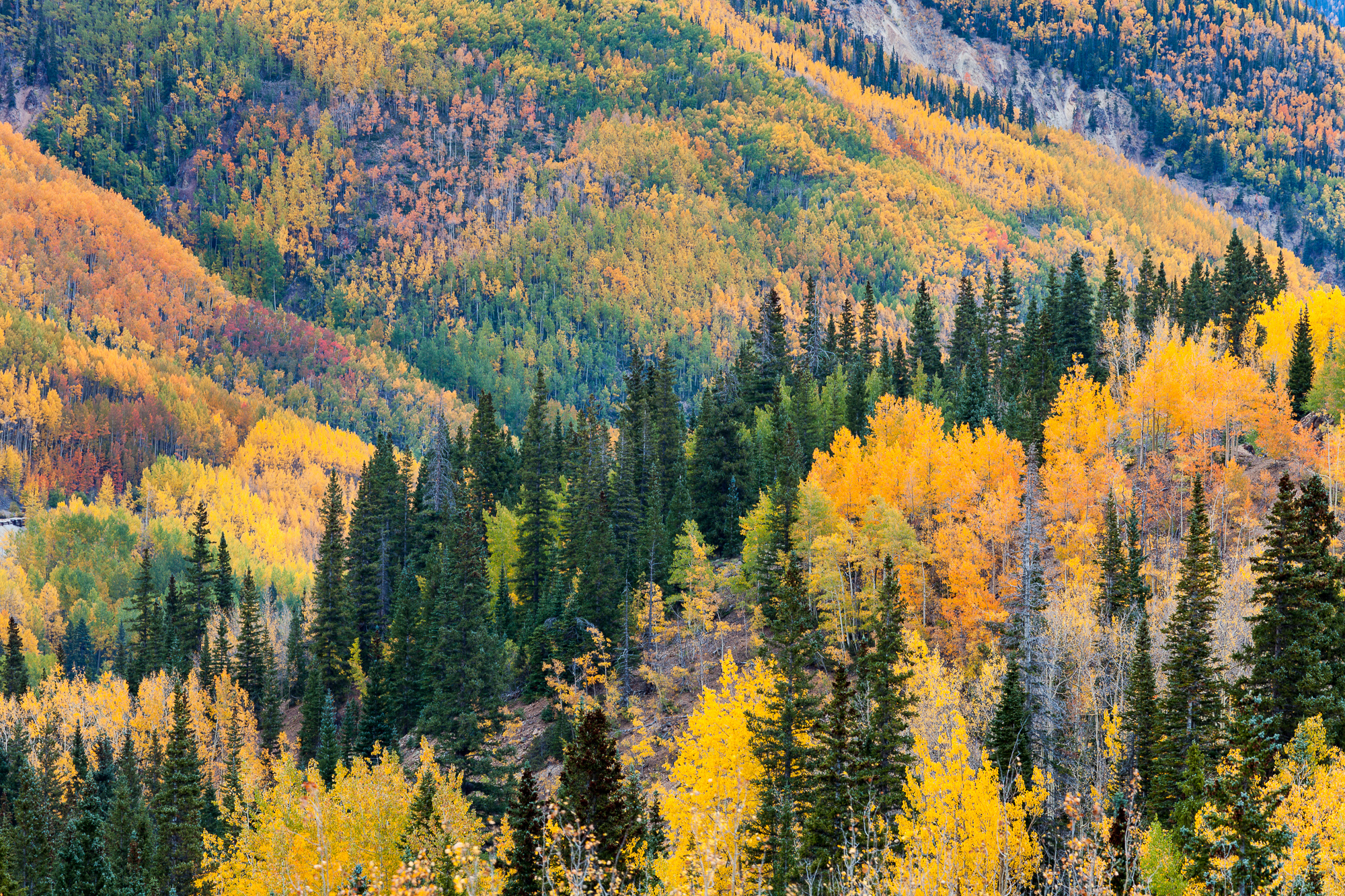
Mountain slopes exhibit a kaleidoscope of color in the fall, Ouray, Colorado
Telephoto lenses are great for carving out smaller sections of a landscape. If the landscape holds enough detail interest, there are likely many different photographs to make from a single scene. Here the collection of colors was changing from spot to spot, providing strong abstract photos, each unique from one another.
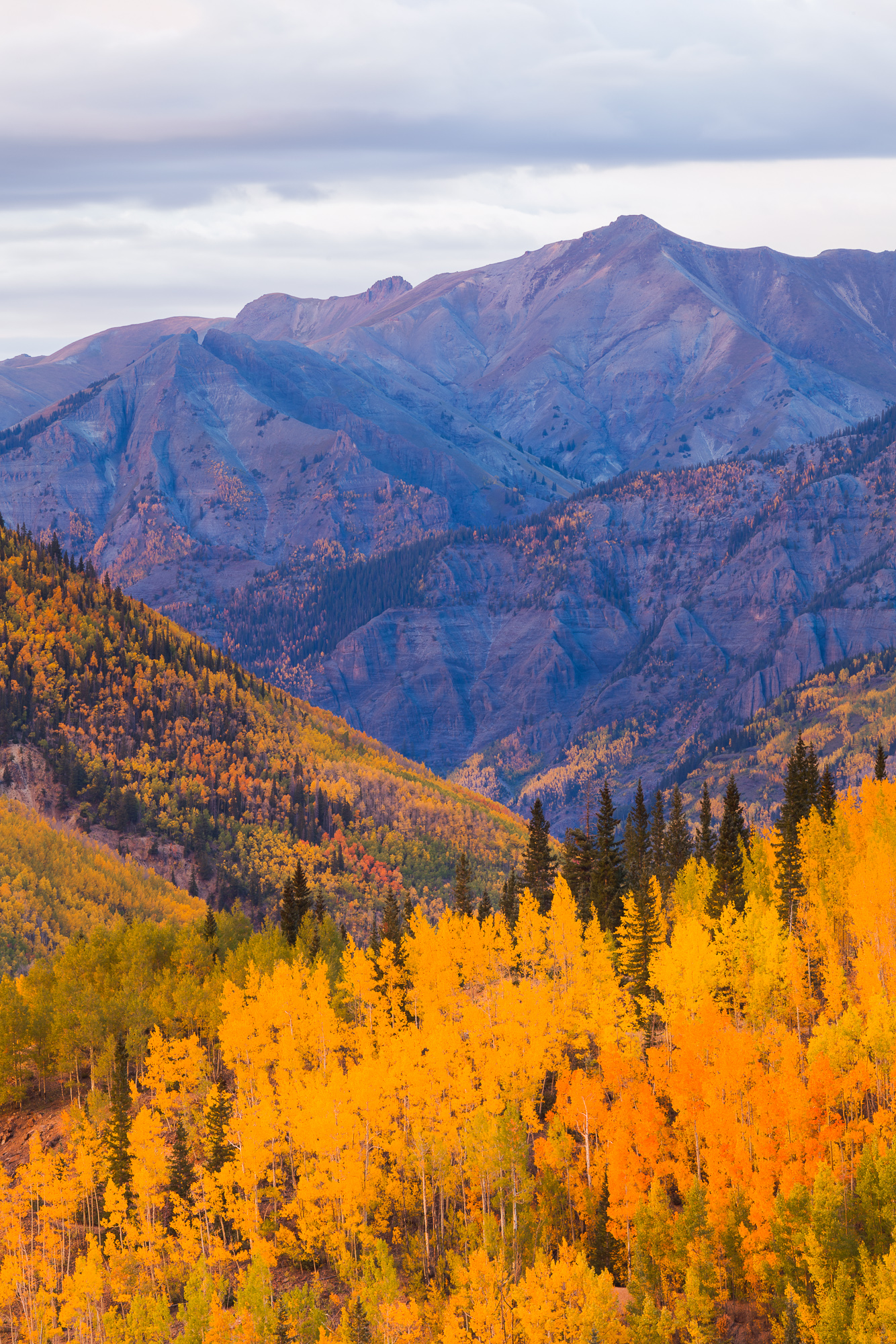
Abrams Mountain caps the end of a valley filled will fall color, Ouray Colorado
Finally, I made a shot similar to my first, but this time leaving out the sky and mountain top. Using the telephoto I created a photo that was more about the variety of color (the warm colors of the forest contrasting with the cool blues of the base of the mountain) than it was about a mountain scenic.
I tried a variety of other shots from this spot (panoramas, cloudscapes, etc), some more successful than others. But by the time I left, I felt I covered the area pretty thoroughly photographically.