
Palo Alto Baylands

While I usually don’t make location specific posts about birding, I did want to call out Palo Alto Baylands as one of the San Francisco Bay Area’s great birding spots. Located in Palo Alto right along the bay, it provides the birder with a variety of species, from water birds to song birds to raptors – there is always something interesting to see here. It even holds one of the best viewing areas for the elusive (and endangered) clapper rail. Here are a few photos of what I found there on a recent morning.

A song sparrow perches on wild fennel in the morning sun

Song sparrows are one of three most common sparrow (along with white and golden-crowned) species seen at Baylands. The ubiquity of the house sparrow in the suburbs gives way to the song sparrow this close to the water. With common birds such as this, I try to create photos that go beyond just showing the bird, but also show some behavior or interesting background. In this photo, I liked the way the sparrow is tilting downward (he was eating from the wild fennel) – it creates more of an action pose.

A white-tail kite perches on a large branch

Baylands has the occasional visit from a bird of prey. Kites are seen anywhere from the water up into the foothills, hunting large, open spaces. Other birds of prey I’ve seen include fly-overs by osprey, red-tailed and red-shouldered hawks, and norther harriers.

A female yellow warbler pauses briefly on wild fennel in the morning sun

The smaller passerines get me excited because they are much harder to photograph than water birds or sparrows. The are small, fast, and rarely stay in one place for more than a few seconds. The most common warbler here is the yellow-rumped, but orange-crowned and yellow warblers are not uncommon. There are many many others, from chestnut-backed chickadees to bushtits – all of them equally hard to photograph. I loved the tonality of this image – the yellow on yellow really works here, blending the bird into her background.

A domestic goose swims through still water reflecting fall color foliage

Palo Alto Baylands also has a man-made pond that attracts a wide variety of migrating ducks throughout the year. There are also quite a few year-round residents, including this domestic goose. Most of the resident ducks here are cross breeds of domestic ducks and mallards. But this pond is also a great opportunity to see migrants up close, including ruddy ducks, greater and lesser scaup, northern shovelers, american wigeons, and a variety of teals.

An american avocet stands in shallow water, catching the first rays of morning sun

Finally there are the water birds. Habitat here includes plenty of tidal wetlands, so these species abound. All the usual suspects can be seen here, and there are good viewing angles in morning and evening. In this photo, the earliest morning light is lighting the feathers of this american avocet. In spring, there is a popular nesting area for avocets and black-necked stilts. Photographers line up to capture cute photos of hatchlings venturing for the first time out into the mud flats.

For birders there is always lots to see at Palo Alto Baylands. If you live near or are visiting the San Francisco Bay Area, be sure to put this on your list of bird spots to visit.
2014 Round-up – Top 40 Photos Of The Year

After a bit of thought, I have compiled my top 40 picks from the last 12 months. I selected from a variety of outings and types of photography, ranging from landscape, to wildlife, to pet photography. Unfortunately, 2014 was not the year I caught up on my backlog of photos waiting to be processed, so this list was not selected from all of my 2014 photographs (you’ll have to wait till next year’s round-up for those!)

This year included a fantastic fall color photo trip to the San Juan mountains in Colorado, as well as visits to the Sierra Nevada and of course many bird photographs, including some previously unpublished.

Please enjoy the gallery below. For best viewing (especially if viewing on a mobile device), please click on the following photo:

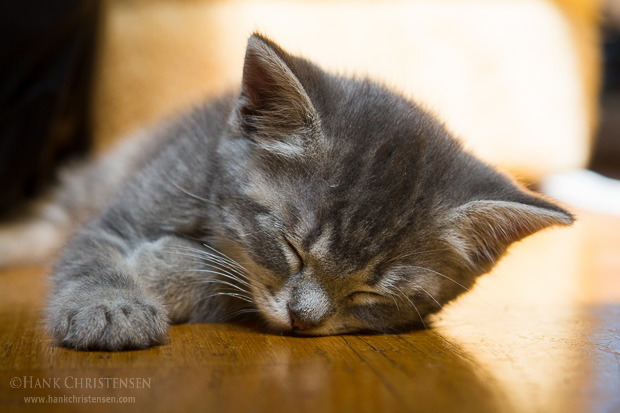
Gem lies on the floor, fast asleep

Or, just enjoy the gallery here on the page. To view larger photos in the embedded gallery below, click here to enter full screen mode.


If you are interested in compilations from previous years, please see the 2010, 2011, 2012, and 2013 lists.

7D Mk II High ISO Performance

Last week I went out in the evening to run my new 7D Mk II through its paces with bird photography (most likely my primary use for this camera). Since my mind was in test mode, I decided to stay out after sunset (much later than normal for bird photography) to see how the camera performed in low light situations. I left the camera in auto-ISO mode to let it decide how high it needed to go. About a half hour after sunset, I was packing it in and heading back to the car, when I saw this blacktail jackrabbit eating from a patch of grass.

A blacktail jackrabbit ventures out into the grass just after sunset, Redwood Shores, CA.

I was a bit skeptical that anything would turn out given how dark it was. Not even sure if the auto focus would be able to work well in the darkness, I splayed out my tripod legs and got very low to the ground. Auto-focus seemed to be tracking well, so I started firing off bursts of shots, not really paying attention to the ISO. I knew it was high, but I wanted to see how high the ISO could go and still produce a usable image. This was highly dependent on the noise produced at high ISOs, and the amount of reasonable noise reduction I could perform in post processing.

The image above was shot at ISO 25,600! While I realized this produced far too much noise for a large print, it seems to be perfectly usable for web-sized images. You can also see here that the auto-focus was extremely accurate, even in low light.

So how does this translate into changes in the way I photograph? Nothing, really – a shot with this much noise is more of a curiosity than any hard data with which to change my workflow. However, let’s look at another example at a more reasonable ISO.

A hermit thrush pauses briefly on a branch in the last night of the day, Redwood Shores, CA.

I photographed this hermit thrush a little earlier in the evening than the jackrabbit. It was around sunset, but the sun had already set over the coastal mountains, so the light was certainly waning. Because of the extra light, the camera chose a more “reasonable” ISO of 5000 for this shot. But still, ISO 5000 is very high!

With my previous camera, ISO 1600 was really pushing the boundary of acceptability, with only about 50% of those images being able to hold up to the noise level. After running noise reduction on this image however, it became clear that images shot as high as 5000 ISO would be usable for many circumstances. This probably still wouldn’t hold up for a 16 x 20 inch wall print, but would most likely do fine for editorial use.

Finally, in order to show how smooth the images really are at ISO 800, I’ve included a shot of an anna’s hummingbird, followed by the 100% crop of its head.

An anna's hummingbird perches on a thin branch, surveying the landscape, Redwood Shores, CA.
An anna’s hummingbird perches on a thin branch, surveying the landscape, Redwood Shores, CA.
A 100% crop of an anna's hummingbird. At ISO 800, the Canon 7D Mk II performs with amazingly low noise.
A 100% crop of an anna’s hummingbird. At ISO 800, the Canon 7D Mk II performs with amazingly low noise.

With previous cameras, I’ve always used ISO 400 as my standard starting point, moving up and down the range as light would allow. But with the 7D Mk II, I will likely start shooting at ISO 800 most of the time. I’ve run a slight amount of NR on the hummingbird shot, but the noise is so low that I’d rather have an extra stop of light to play with and get faster shutter speeds than feel the need to drop down to a lower ISO.

Bird Photography With The Canon 7D Mk II

A great blue heron stalks fish in still shallow water, Belmont, CA.

I spent about an hour this morning doing some bird photography with my new 7D Mk II. My primary use for this camera will be birds and wildlife, and I found and photographed some of the usual suspects around my home. This is not meant to be a formal review by any means, but I wanted to share some of my first impressions.

A black-crowned night heron perches above water in pre-dawn light, Belmont, CA.

Aesthetics

Before we get to performance, I have to address how the camera felt out in the field. It was a real joy! The build quality is solid and the camera was extremely responsive and accurate. Ergonomically, the buttons are laid out well, and I can tell a lot of thought went into designing the UI. The number of settings on this camera can be daunting, but almost everything can be customized to suite your exact photography needs.

A golden-crowned sparrow perches atop an ornamental bush, Belmont, CA.

Auto-focus

Obviously auto-focus capabilities are one of the headliner features for this camera. Canon’s new auto-focus debuted on their flagship pro body, and have been filtering down to less expensive cameras in the last couple of years. I haven’t tried out the myriad AF algorithms available (I’ll do further testing with these using birds in flight), but I can say that auto-focus was fast and accurate. Almost everything I captured was tack sharp. I’ll be setting up the camera with different AF settings depending on whether I’m photographing stationary animals or birds in flight.

A blacktail jackrabbit pauses in the morning light to watch for predators, Belmont, CA.

Noise Performance

As the sun was rising, I shot mostly at ISO 1600, gradually dropping down to ISO 400 as the day got brighter. At ISO 1600, there is still some noise visible in the shadows, but it was easily corrected in post processing. I found very clean shadows at ISO 800 and below. With my previous camera (7D), my starting ISO was usually 400 and I’d go up from there if the situation demanded it. Based on the performance of the Mk II, I will probably do most bird photography at ISO 800, giving me a full stop of extra light to play with in most circumstances.

A great blue heron is reflected in still water in early morning light, Belmont, CA.

Frame Rate

Shooting at 10 frames per second felt awesome. Even though I’m used to 8 fps with the older 7D, the incremental speed boost was noticeable. While I didn’t have any action situations that called for this speed this morning, having that capability was reassuring. With the large buffer, I never hit any card write delays, even though I was shooting with a slow card.

A black-crowned night heron stands on a buoy, watching for fish, Belmont, CA.

Silent Shooting

At one point, I crept close to a black-crowned night heron and began to fire off 10 fps bursts (mostly just for fun). The chatter of the shutter was loud enough to get his attention, and he stared at me, looking a bit anxious. I then remembered that the camera features a silent shutter mode (it applies extra dampening to the shutter mechanism so that it is very quiet). I set the camera to silent burst mode. This reduces the fps from 10 down to what felt like 3 or 4 fps, but it was nearly silent! I continued shooting photos of the now comfortable bird. This feature will actually be very helpful for getting close to some of the more sensitive wildlife – a nice little bonus.

A greater yellowlegs is reflected in shallow still water, Belmont, CA.

Overall Image Quality

So far, the results are fantastic. One caveat is that at the time of this writing, Adobe does not yet support the camera’s RAW files, so I had to use Canon’s software to convert to tiff before processing them in Lightroom. I’m sure I’ll get better results once I can process the RAWs directly with Lightroom, as Canon’s processor seems very poor. But the images are sharp, and the tones are pleasing. Auto white balance seems accurate. If anything, it seems that the Mk II overexposes a little more than the 7D, but I’ll get a feel for where the exposure compensation needs to be for various lighting conditions as I use the camera more.

Of course, the camera also has some goofy crowd-pleasers like multiple exposure and in-camera HDR. While I wont be using these for any serious work, they can be fun to muck around with if you’re bored.

A black-necked stilt fishes in shallow water, Belmont, CA.

Overall, this is a fantastic camera, and I had a very enjoyable first time out with it!

Copyright 2017 Hank Christensen