I am a little late this year, but finally, here are my favorite images from the previous 12 months. This year I only had one major photography focused trip to the northern California coast, capturing the delicate rhododendrons amongst the fog of the coastal redwoods. I also had a truncated attempt at the John Muir Trail (got completely rained out after only three days) and a wonderful trip to Kauai to celebrate ten years with my beautiful wife.
Photos from all of these trips plus a wide variety of birds made my top 40 list this year. Please enjoy the gallery below. For best viewing (especially if viewing on a mobile device), please click on the following photo:
Click the photo above to see the top picks from 2013!
Or, just enjoy the gallery here on the page. To view larger photos in the embedded gallery below, be sure to click the icon in the lower right corner to enter full screen mode.
Over the years, I have read many negative reviews and comments about the Canon EF 100-400mm zoom lens, ranging from softness in the resolution capability to a useless “toy” lens. Many of those I have asked follow up questions to about their views reveal themselves to have never used the lens themselves (they have just “heard” bad things). Others seem to spend more time deriding the lens than going out and improving their photography skills.
A male northern cardinal stands under the shade of a bush. Although most commonly seen throughout the eastern US and Mexico, this species was introduced many years ago to the Hawaiian islands.
This lens was in fact my first “bird” lens, and I used it extensively until I could prove to myself that I was passionate about wildlife photography enough to justify spending more on a more specialized lens. I have found the lens to be sharp and reliable. While it doesn’t provide the extreme sharpness or reach of my 800mm, it is smaller, lighter, and I typically hand hold it, giving me ultimate mobility. It was for these reasons that I opted to take it on my recent trip to Hawaii, in lieu of my bigger lens.
A cattle egret is reflected in a pool of water as it searches for food amongst the grass. This one is in full breeding plumage, with long reddish-orange feathers on the top of the head, back and breast. Also, the skin behind the eye has turned a brilliant purple.
Rather than a traditional zoom, this lens utilizes a push/pull style of zoom, which will take some getting used to. Once you master this style of zoom, however, you’ll be making sharp photographs in no time. For bird photography, I usually just lock out the barrel in the “long” position, giving me the 400mm reach.
If you are just starting out in bird or wildlife photography and don’t want to make a huge investment, this is a great lens with which to get your feet wet. Starting out with a lens like this will force you to improve your non-camera skills, such as stalking and waiting. The limited reach will force you to get closer to your subjects, often requiring patience and creativity to get the desired shot.
The Scaly-breasted Munia or Spotted Munia is known in the pet trade as Nutmeg Mannikin or Spice Finch. Its name is based on the distinct scale-like feather markings on the breast and belly.
On this latest trip, I found that by watching the birds more to understand their patterns, I was able to predict their directionality, and situate myself in a position they would move toward. Then it was just a matter of staying low, being patient, and remaining as still as possible as they came to me. Other times, I would find a tree or bush with lots of activity, move toward it and wait. Even if I scared off the birds on my approach, by remaining still and quiet, many times they eventually returned, sometimes very close to me.
Take a look through these photos and my recent Hawaii posts to judge for yourself. The fact that it is still a regular part of my arsenal shows that I certainly don’t consider it a toy, but a valuable tool that has its place in my toolbox.
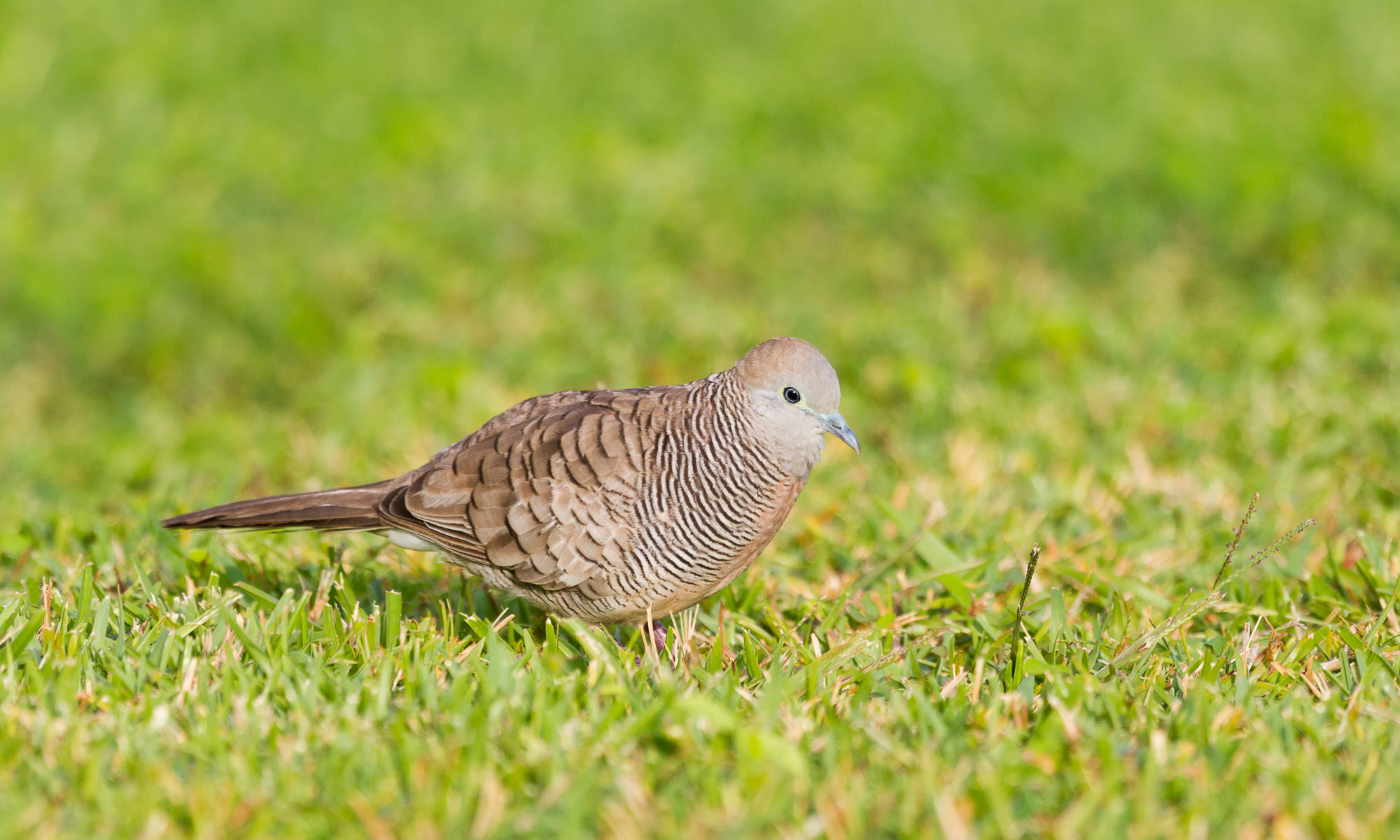
The Hawaiian dove population is dominated by two species, the zebra dove and spotted dove. Parts of Hawaii also contain the Mourning Dove, but its population is small by comparison. Zebra doves are the smaller species, with a distinct barred pattern around its neck and shoulders.
Unlike other doves who forage in large groups, zebra doves tend to eat alone or in pairs. They can commonly be found eating short grass or grass seed.
Spotted doves are larger and feature a spotted pattern around the back of the neck. They can be seen in larger flocks and in populated areas have become accustomed to the presence of humans.
Zebra doves were introduced to Hawaii in the 1920s, and spotted doves were likely introduced around the same time. Both quickly spread to all islands and in some areas are the most populous bird seen.
On my recent trip to Kauai, I got plenty of opportunities to photograph both species in different environments. While both seemed to be more skittish than the Nene, I found that if I was still enough and remained low to the ground these birds would eventually approach reasonably close to me.
Everywhere I go for bird photography, I see starlings. Sometimes alone, sometimes in huge flocks, these birds are very common throughout much of the world. Here in the US, they are known as European Starlings (as they are native to Eurasia), elsewhere as Common Starlings, and in Europe, simply Starlings.
Because of their ubiquity, they are generally regarded as pests or just ignored by the general population. However, closer inspection reveals a beautiful feather display and a strange and sometimes unbelievable vocalization. Adults have an iridescent black feather coloring, and in winter, it becomes speckled with white flecks. At the right angles of light, the black feathers reflect a glossy green or purple.
A European starling perches on a branch of a white-barked tree
They can be excellent mimics, repeating various bird songs and sounds from the environment. Each bird has its own repertoire with more proficient birds having a range of up to 35 variable song types and as many as 14 types of clicks.
Here is a sample vocalization from a common starling:
Taken individually, they can be a quite striking bird. But real amazement comes from their behavior in a flock, or murmuration. Changing speed and direction based on their closest neighbors, they fly as one shape-shifting organism, with the ability to perform a beautiful aerial ballet. A YouTube video gained popularity a few years ago showing off this behavior.
The next time you see one of these birds perched in your neighborhood, take a moment and admire them for the interesting species that they are.