Mandarin Duck (Photo of the week)

A mandarin duck swims through smooth, still water
A mandarin duck swims through smooth, still water. Canon 800mm f/5.6L IS lens with the EOS-7D. ISO 640. Evaluative metering +1/3: 1/320 sec. at f/8

I photographed this Mandarin duck today at a city park in San Jose. This is a very strange location for this species, as it is most often found in Asia. After speaking to some of the locals who visit the park often, I learned that this drake has been seen on and off at the lake over the last three years.

The Mandarin duck once flourished across eastern Asia, but today there are only about 1000 pairs throughout all of China, and about 1000 pairs in Russia. Japan is thought to have about 5000 pairs. They have also appeared in various locations in Europe, numbering about 1000 pairs in total. Because this species is not native to Europe, it is surmised that this population grew from escaped captive birds and flourished as a feral population. They have been breeding in the wild ever since. But where did this guy come from?

A head and shoulders portrait of a mandarin duck is captured as it swims through still water
A head and shoulders portrait of a mandarin duck is captured as it swims through still water. Canon 800mm f/5.6L IS lens with the EOS-7D. ISO 640. Evaluative metering +1/3: 1/320 sec. at f/8

It turns out that something similar to what happened in Europe may have also happened in Sonoma, California, only on a much smaller scale. Sonoma is a couple hours drive north from San Jose, and has about 100 feral Mandarin ducks. I’m just guessing here, but this bird may be associated with that population. And apparently he enjoys coming to this lake!

A mandarin duck looks up after taking a sip of water
A mandarin duck looks up after taking a sip of water. Canon 800mm f/5.6L IS lens with the EOS-7D. ISO 640. Evaluative metering +1/3: 1/320 sec. at f/8

It was fairly overcast today, which has its advantages and disadvantages for bird photography. One of the downsides is that the sky is much darker, which means that shutter speeds must be slower than on a sunny day. However, benefits include a lack of harsh shadows from the sun (meaning I could photograph this bird from any angle, instead of with the sun directly behind me), and more saturated colors due to reduced glare. I was very happy to be able to photograph this species in decent conditions. The biggest bonus of course was that I only had to drive half an hour instead of flying to Asia or Europe!

Pied-billed Grebe (Photo of the week)

A pied-billed grebe swims through still water
A pied-billed grebe swims through still water. Canon 800mm f/5.6L IS lens with the EOS-7D. ISO 800. Evaluative metering +2/3: 1/1000 sec. at f/5.6

My photo pick this week is of a pied-billed grebe that I found swimming alone in a narrow channel in a neighborhood near my house. The afternoon light reflected off of the rocks in front of me, which acted as a diffuser, giving me night even light across the scene. Houses along the opposite shore cast the water in a reddish hue.

As always, I tried to get as close to eye level with the bird as possible. However, it was difficult to do so in this spot, requiring me to pick my way over sharp rocks to get close to the water. True eye level was impossible here, as the channel was only about fifteen feet wide, and the immediate shore was too steep to set up my tripod. I made the best of the given situation, unfolding two of the legs so that they were close to flat, with the third tripod leg longer and pointing downhill, almost touching the water. Then I sat down underneath and behind the camera – giving me a comfortable position from which to shoot, while still allowing good hand support for my lens. It also lowered my profile and allowed me to be absolutely still, which will usually allow the target bird to approach closer instead of swimming away (which they often do!)

A pied-billed grebe swims through still water calling out with its beak open
A pied-billed grebe swims through still water calling out with its beak open. Canon 800mm f/5.6L IS lens with the EOS-7D. ISO 640. Evaluative metering +2/3: 1/250 sec. at f/8

By remaining perfectly still, I was able to photograph this grebe for a while as it swam back and forth in front of me. The narrow channel kept the wind off the water, creating great reflections.

When I’m out specifically photographing birds, I look for two things – either an uncommon species that I haven’t photographed before, or a great shooting situation with good light and the right aesthetics to create a good photograph. I’ve photographed pied-billed grebes before, but this was a situation I couldn’t pass up because of the nice light, great reflections, and close proximity to the bird.

Barrow’s Goldeneye (Photo of the week)

A male Barrow's goldeneye swims through golden water
A male Barrow's goldeneye swims through golden water. Canon 800mm f/5.6L IS lens with the EOS-7D. ISO 400. Evaluative metering +2/3: 1/1250 sec. at f/7.1

This week’s photo features a Barrow’s goldeneye. The Barrow’s is similar to the common goldeneye, but, as its counterpart’s name suggests, is less “common”. In fact, only a few are seen in the San Francisco Bay Area each winter, whereas the common goldeneye can number in the thousands (with dozens visible at one time).

While both male species look similar, the Barrow’s goldeneye has several distinguishing features. The two most prominent are an elongated teardrop shaped white area in front of the eye (the common has a smaller circular white patch) and a row of white squares across the base of the wings (which can be seen across the top of the back in the photo above).

When I found this male, I was lucky enough to find a female with him (which I assume made up a breeding pair).

A female Barrow's Goldeneye swims through a narrow water channel in the low light of a late winter afternoon
A female Barrow's Goldeneye swims through a narrow water channel in the low light of a late winter afternoon. Canon 800mm f/5.6L IS lens with the EOS-7D. ISO 400. Evaluative metering +2/3: 1/800 sec. at f/7.1

Female Barrow’s goldeneye look more similar to the female common goldeneye. The biggest difference is a completely yellow bill (as above), compared with a yellow-tipped black bill on the common. Other than that, they look identical (to my eye).

I saw this pair on several occasions, as they frequented the same spot for a couple of weeks at least. On one occasion, I began to worry for the female, because I saw the male swimming with a would-be harem of twelve female common goldeneyes. There were no male commons in sight. These two species have been known to crossbreed, but I’m not sure exactly what was going on in this situation. Perhaps it was because he was the only male of either species around, or perhaps it was just because he is much cooler looking with his bold white square pattern. The next time I saw them however, his lady was back at her top spot, and the other females has moved on to more common mates.

Breaking the rules

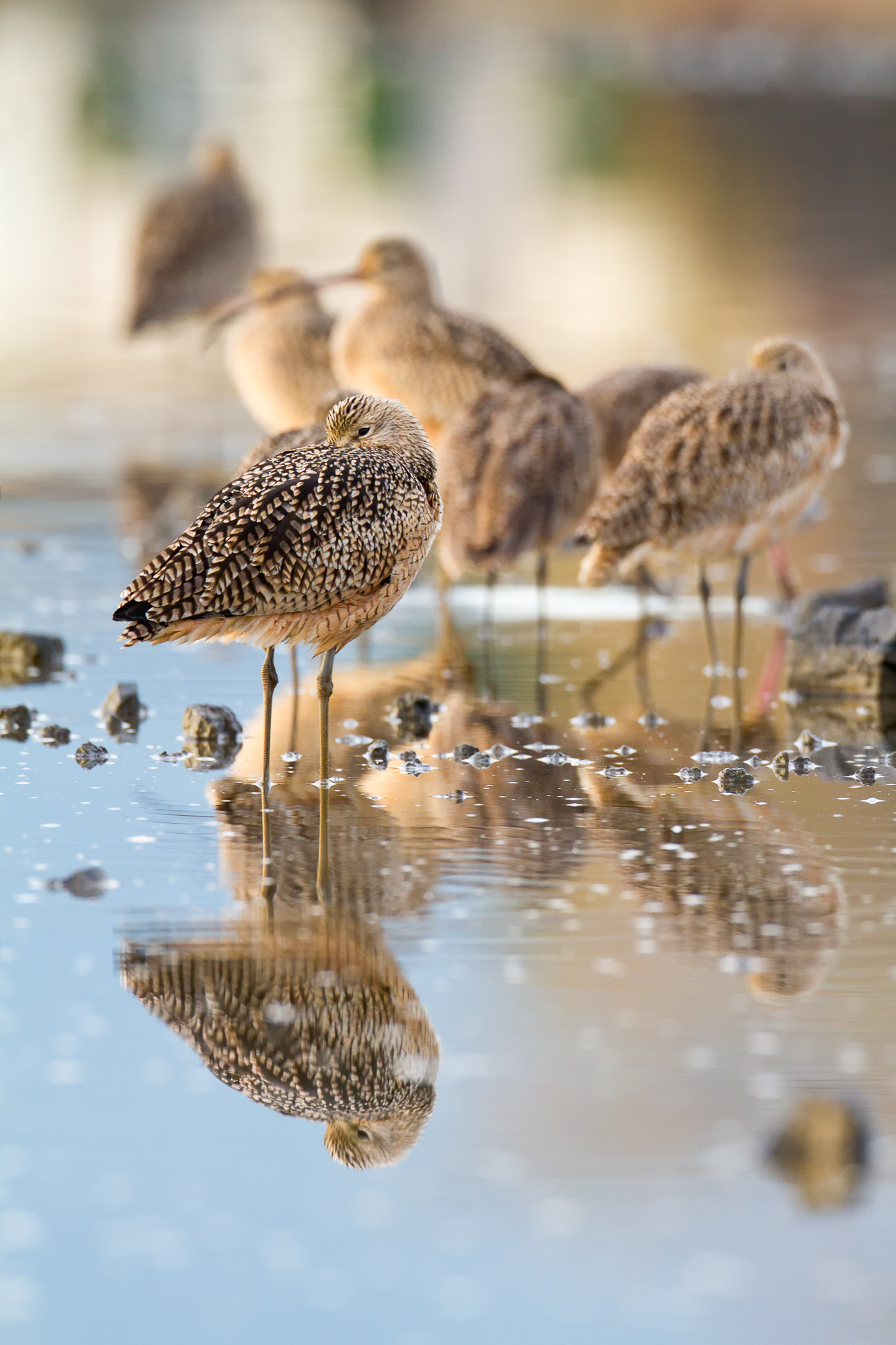
Several long-billed curlews stand together in a shallow wetland pool

Every once in a while a photo comes along that I love, but seems to break many of my own guidelines that I usually follow. Many times when I’m out shooting wildlife or birds, I’ll take a few photos of the surrounding area, or try to include some habitat, to help me remember where I was and what the conditions were like. This is especially important when I’m making bird portraits. If my goal is a simple, clean background, it can be easy to forget what the surrounding area was like when I only see a bird’s head and shoulders in the photo. The photo of the long-billed curlew above was one such “habitat” shot that I took recently.

As I was reviewing my photos, I found that I really liked this one, even though it wasn’t intended as a keeper. I also realized that it breaks some of the rules that I like to follow in my bird photography. I put myself in the role of photo critic, and came up with the following negative aspects of this image.

1. Cluttered background – In most wildlife photography, one goal in creating a successful photo is to simplify the shot as much as possible. Eliminate distracting elements and leave only those that help support the subject. In this photo, the background is busy and the water surface messy.

2. Depth of field issues – The curlews in the background are out of focus. Are they part of the subject of the image? It is not clear from the focus alone. They are too blurry to be successful subjects, but not abstract enough shapes to blend well into the background.

So then, given the above criticisms, why do I like the photo so much?

1. Color – I absolutely love the color in this photograph. I like the pastel blues and tans, and the black in the first curlew’s feather pattern really pops.

2. Wildness – Sometimes the simple portrait with a pure single color background can get old. Even though they can be elegant, sometimes they lack the wild and wooliness of the real natural world. This photo serves up enough chaos to do justice to all the birds eating and preening in a bunch that morning.

3. Leading lines – The photo leads the viewers eye well through the frame and into the distance. Starting naturally at the bird on the left in sharp focus, the eye is attracted to the sleeping bird to the far right of the frame, because of the repeated shape of the first bird. Then the eye draws up and left along the line of birds, finally resting on the bird in the upper left of the photo, which is the farthest distinguishable object from the camera.

It is important to choose your best images in order to edit your collection of photos. Beyond that however, it is important to understand why you chose those photos. Doing so will help you to make better informed decisions about future photos, instead of just going with your gut. Next time you say to yourself, “I really like this one,” or “this one doesn’t work for me,” dig a little deeper and list out what you like or don’t like about a photo. What you come up with when your really think about it might surprise you.

So what do you think? A nice break from the norm, or not your cup of tea? Love it or hate it, I’d love to hear your opinion in the comments below.

Copyright 2017 Hank Christensen