
The Search for Sky Rock

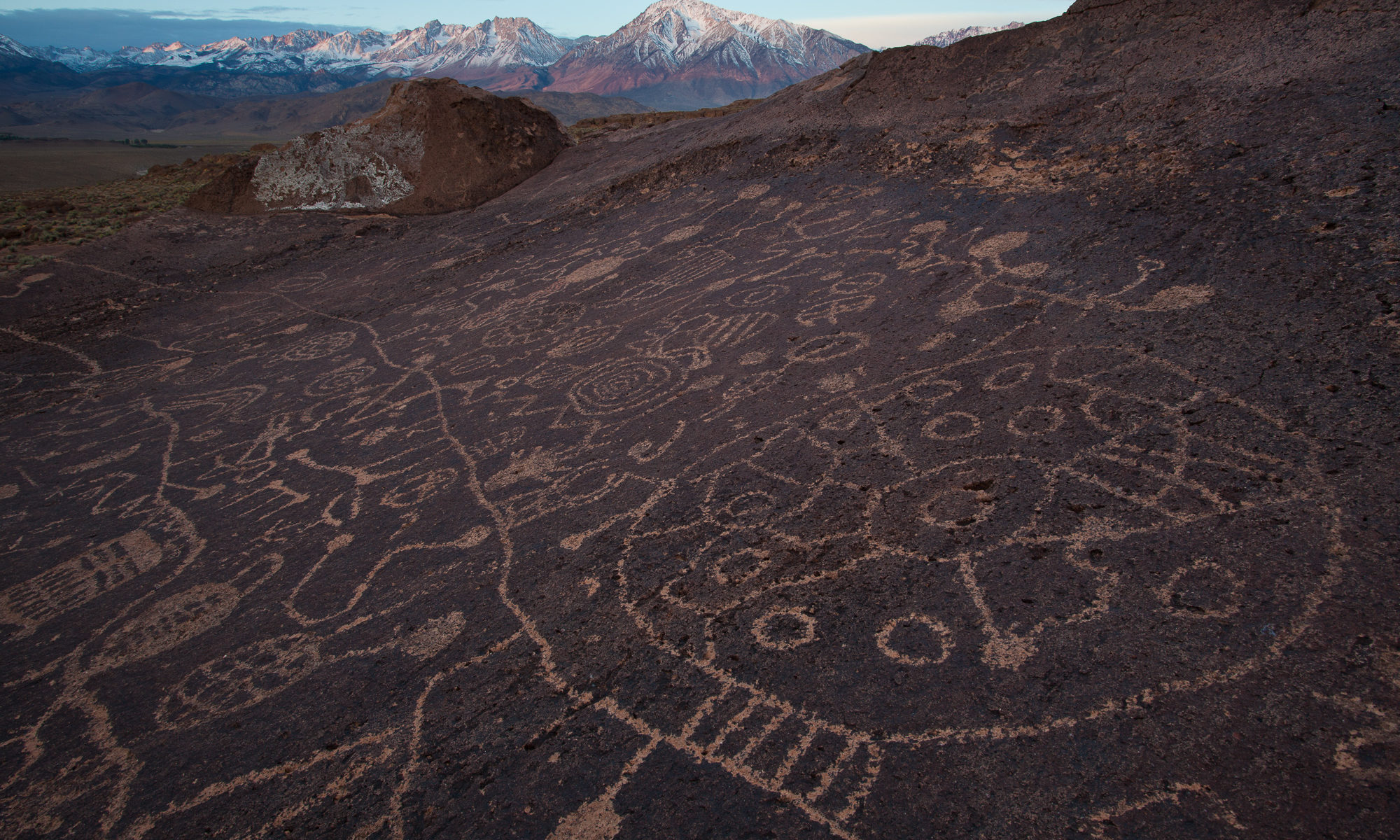
Created long ago by Native Americans, the Sky Rock Petroglyph's location is kept fairly private. It is only shared through word of mouth so that it can be kept safe.

The blazing sun beat down on us as we scanned the horizon looking for more rock piles, heaved up eons ago from the ancient volcanic surface on which we stood.

“Hey Dan, wanna try over there?” I asked, pointing to a long stretch of ten to thirty foot wide boulders. Dan nodded and we trudged across the high desert plateau to search another area.

I was with my photographer friend Dan Canfield, and we had decided on our first night in town that we would try to find a secret Native American petroglyph, in recent years dubbed “Sky Rock”. Not found on any map, this ancient rock drawing is kept secret from the general public. Those in “the know” don’t divulge its location so that fewer people will visit, and its condition will be kept as pristine as natural forces allow. After some hunting, we narrowed down the location to its general vicinity, but even then, the ancient carving eluded us.

It was midday, and our second attempt at searching. Our first attempt was during sunset the evening before, and we quickly ran out of time trying to find it before dark. This time we were armed with a little more research, and many more hours of daylight. Finally, after much scrambling, a few skinned knees, and crawling into some dark and nasty places, we found it! We were giddy with excitement.
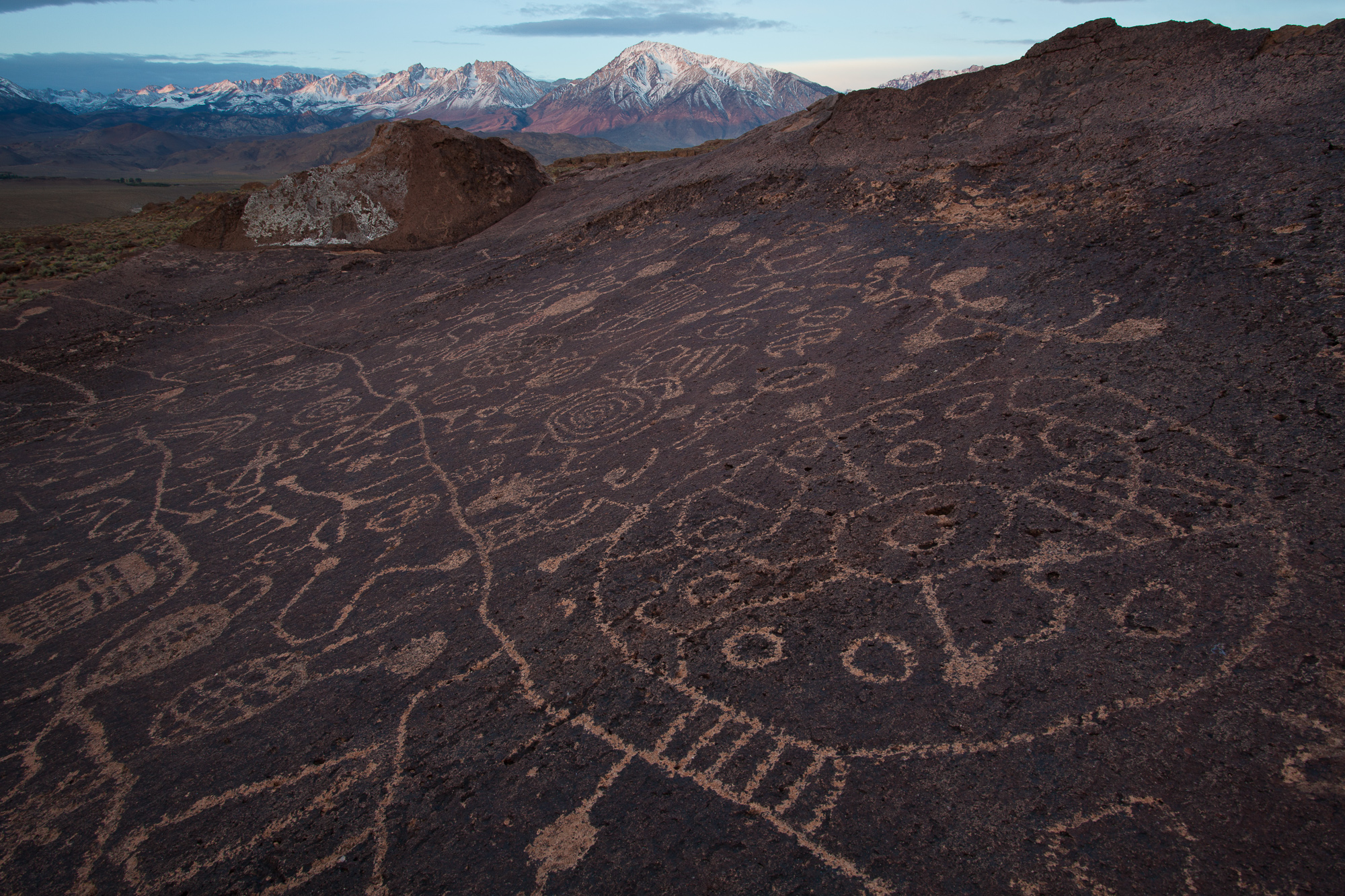
Created long ago by Native Americans, the Sky Rock Petroglyph's location is kept fairly private.  It is only shared through word of mouth so that it can be kept safe.
Created long ago by Native Americans, the Sky Rock Petroglyph’s location is kept fairly private. It is only shared through word of mouth so that it can be kept safe.

Carved into a flat rock, this series of drawings is different than most other petroglyphs because of its horizontal orientation. Most Native American drawings were done on vertical walls. The drawings are carved into the rock about an inch deep, to reveal the lighter colored stone underneath the darker outer coating. We took some photos, sat for a while, and scouted our route so that we could come back in the dark. Midday was great for searching, but as photographers, we wanted only the best light, which would be either sunrise or sunset. Our schedule allowed for a sunrise shoot in a couple of days, so all we could do was cross our fingers and hope for good weather.
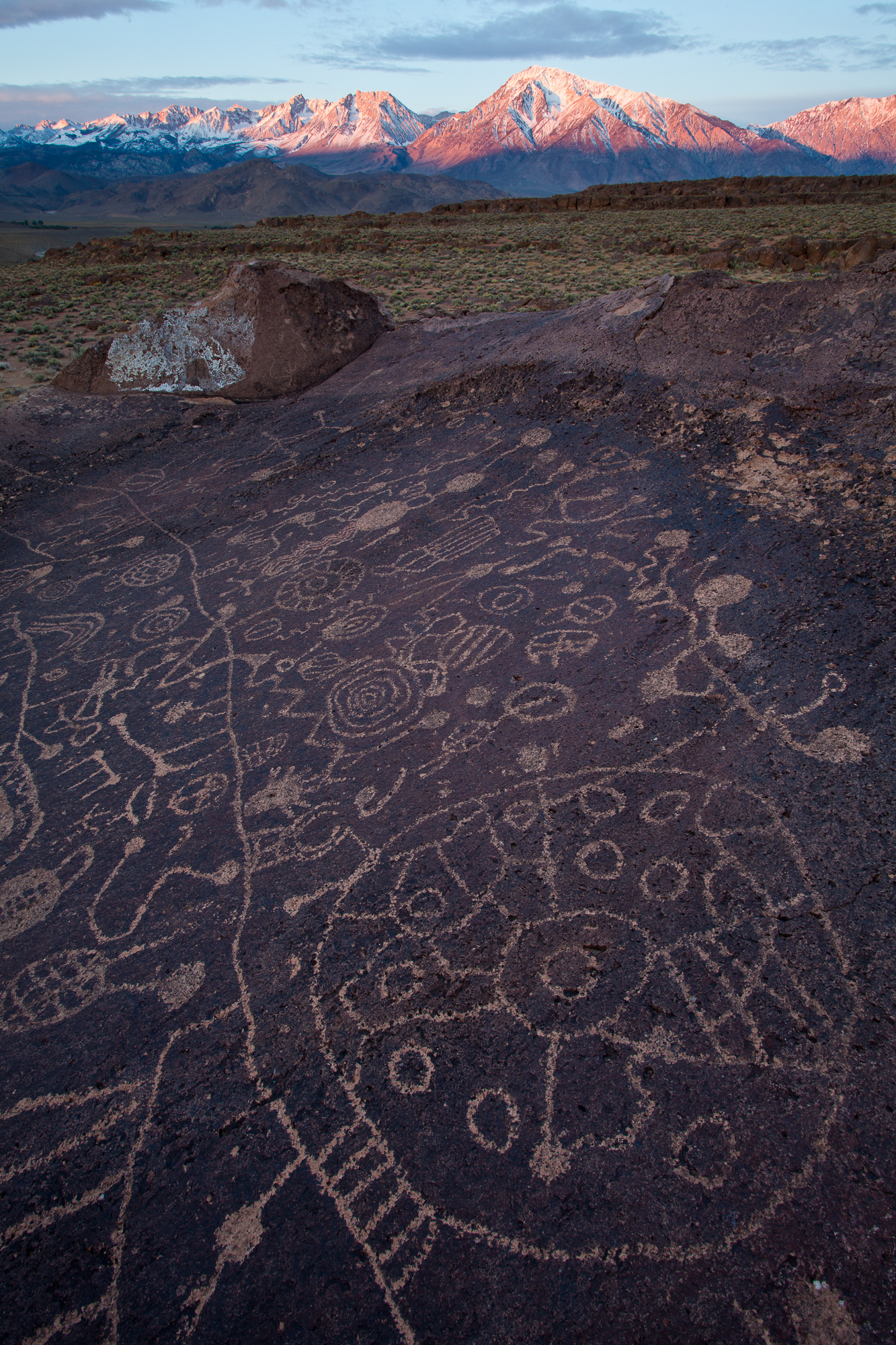
The mountains of the easter Sierra Nevada glow red over the Sky Rock Petroglyph, just outside of Bishop, CA

The history of this carving is not well known. Some have theorized that it was probably created by the ancestors of what are today known as the Owens Valley Paiute, possibly as long as 8,000 years ago.

It was a very special experience spending some time on this rock as the sun lit first the western mountains, and then the valley below us. I devoured the silence of the morning, and felt a special energy around this place. It was an amazing feeling to know that this human creation had sat here for similar sunrises, long lazy days, and powerful storms for millennia.

Possibly the best part of finding Sky Rock was the fact that it was hidden. In the days of instant gratification and unlimited knowledge, it was nice to really have to work for answers.

Ansel Adams Wilderness

A couple of weeks ago my friend Steve and I finally headed into the Sierra high country for a long-overdue back-country excursion. Due to the heavy snow pack this year and busy schedules, this turned out to be our only trip of the summer. To make the most of it, we chose to visit the Ansel Adams Wilderness, arguably one of the most scenic regions of the Sierra.

Banner Peak is reflected in Thousand Island Lake at dawn, Ansel Adams Wilderness
Banner Peak is reflected in Thousand Island Lake at dawn, Ansel Adams Wilderness. Canon 24-70mm f/2.8L lens with the EOS-5D MkII. ISO 100. Evaluative metering -2/3 EV: 1/15 sec. at f/14.

Hiking out of June Lakes and up Rush Creek, we hit less than ideal weather. The climb was a brutal slog (4200 ft of gain), and thunder clouds began to congregate in the western sky. A biting wind whipped us from all sides, making even the flat spots (of which there were few) seem like a chore.

Finally we reached our destination – Thousand Island Lake. Rising above the lake was the impressive Banner Peak, but most of it was obscured by thick clouds. This is a very scenic and popular spot. Sitting next to both the Pacific Crest Trail and the John Muir Trail, it receives an enormous number of visitors each summer. Even though it was after Labor Day, and the weather was no good, there were still quite a few backpackers settling in for the night along the north shore of the lake. I’d hate to see this place on a mid-August weekend!

We set up camp and soon the weather was too cold to even wait for darkness to fall. We were in our tents by 7pm.

The sun rises over Thousand Island Lake and Banner Peak, Ansel Adams Wilderness
The sun rises over Thousand Island Lake and Banner Peak, Ansel Adams Wilderness. Canon 24-70mm f/2.8L lens with the EOS-5D MkII. ISO 100. Evaluative metering -2/3 EV: 1/15 sec. at f/14.

Dawn brought clear weather and introduced me to an entirely new landscape. The wind was gone, and Banner Peak was reflected like a mirror in all its morning glory. I finally got out my camera and began to hunt for shots. The day before I took only four photos the entire day.

After finally warming up, we packed up camp and decided to get away from the crowds. We headed north off trail. We only had one ridge to climb before descending into Davis Lakes. It was our shortest hiking day on record, but given the beautiful scenery we were surrounded by, we couldn’t complain.

Mt. Davis is reflected amongst the boulders in Davis Lake, Ansel Adams Wilderness
Mt. Davis is reflected amongst the boulders in Davis Lake, Ansel Adams Wilderness. Canon 17-40mm f/4L lens with the EOS-5D MkII. ISO 100. Evaluative metering -1 EV: 1/6 sec. at f/16.

We spent a leisurely afternoon by lower Davis Lake, and I scouted the area so that I would be prepared when the evening’s magic hour arrived. I was not disappointed, with views to the south (above) and to the north (below).

Mountains are reflected in the smooth surface of Davis Lake at sunset, Ansel Adams Wilderness
Mountains are reflected in the smooth surface of Davis Lake at sunset, Ansel Adams Wilderness. Canon 17-40mm f/4L lens with the EOS-5D MkII. ISO 100. Evaluative metering 0 EV: .3 sec. at f/16.

After another long night in our tents, I woke long before dawn and watched the world slowly light up around me while I was hunkered behind my lens. It was our last morning out, and it didn’t disappoint. The landscape had a wholly different feel than in the sunset light the night before.

Sun lights the tip of Mt. Davis at dawn, Ansel Adams Wilderness
Sun lights the tip of Mt. Davis at dawn, Ansel Adams Wilderness. Canon 17-40mm f/4L lens with the EOS-5D MkII. ISO 100. Evaluative metering 0 EV: .8 sec. at f/16.

The lake shore had many interesting boulders and grass features to position in the foreground. This helped to keep the shots varied and gave me plenty to work with in terms of composition.

The morning sun touches the peaks surrounding Davis Lake, Ansel Adams Wilderness
The morning sun touches the peaks surrounding Davis Lake, Ansel Adams Wilderness. Canon 17-40mm f/4L lens with the EOS-5D MkII. ISO 100. Evaluative metering -1 EV: 1 sec. at f/16.

Soon the morning’s sweetest light was gone, but I was confident that I had captured at least a little of the beauty around me. It was time to pack up and start the long hike out.

Mt. Davis is reflected in the still morning waters of Davis Lake, Ansel Adams Wilderness
Mt. Davis is reflected in the still morning waters of Davis Lake, Ansel Adams Wilderness. Canon 17-40mm f/4L lens with the EOS-5D MkII. ISO 100. Evaluative metering 1 EV: 1 sec. at f/16.

Despite the problematic weather at the beginning of our trip, I thought it turned out very well. I was glad to have visited this area, and know that I’ll be back to photograph it more in depth.

Eastern Sierra Wrapup

Earlier this month I had the pleasure of attending a short three-day workshop with David Muench, one of this country’s preeminent landscape photographers. Assisting him was Jerry Dodrill, who spend his early professional photography career working for Galen Rowel. It was great to catch up with both of them, and see some of the best that the eastern Sierra has to offer in the spring. It was a busy three days, during which I averaged about four hours of sleep per night. I spent a few days on either end of the workshop to meet up with friends and do a little exploring on my own. Here are a few photographs from the trip.

Barrel cactus is just starting to bloom in the Alabama Hills, Lone Pine, CA
Barrel cactus is just starting to bloom in the Alabama Hills, Lone Pine, CA. Canon 17-40mm f/4L lens with the EOS-5D Mark II. ISO 200. Evaluative metering -1/3 EV: 1/6 sec. at f/22.

The photo above and directly below were taken in early morning in the Alabama Hills, just outside of Lone Pine. It is an area famous not only for the sheer face of the eastern Sierra and the multitude of arches that frame them, but also for the many movies made here. Recent films include Iron Man, Gladiator, and Gone In 60 Seconds. Driving out on the dusty dirt road after sunrise, we saw two women walking along the road. I did a double take as I saw one of them was Penny Marshall. Really weird place to see a Hollywood celebrity!

I love the barrel cactus growing in this area, and wanted to feature one using the backdrop of Mt. Whitney and Mt. Langley.

Various patterns and colors of rock form layers to the face of Mt. Langley, Alabama Hills, CA
Various patterns and colors of rock form layers to the face of Mt. Langley, Alabama Hills, CA. Canon 17-40mm f/4L lens with the EOS-5D Mark II. ISO 200. Evaluative metering 0 EV: 1/4 sec. at f/18.

This photograph is a more straight-forward interpretation, using the layering of rock bands to lead up to Mt. Langley. The area offers infinite patterns of boulders and rocks, many of which can be composed into very strong photographs. This is one of many areas for which David Meunch is famous.

The rising sun lightly dusts the peaks of the Eastern Sierra, Bishop, CA.
The rising sun lightly dusts the peaks of the Eastern Sierra, Bishop, CA. Canon 17-40mm f/4L lens with the EOS-5D Mark II. ISO 200. Evaluative metering 0 EV: 1/13 sec. at f/18.

The mountains to the west of Bishop provide a dramatic backdrop for a variety of foreground locations and environments. The above photo used a small pond in a flooded field to create a reflection of Mt. Humphreys, Basin Mountain, and Mt. Tom (from left to right). The morning was clear with not a cloud in the sky (not a photographer’s best conditions for shooting!) The lack of wind was great for reflections, but the lack of clouds reduced the drama of the morning significantly. This is one of those examples of a great location with imperfect conditions. It is definitely a spot I hope to revisit and capture with more dramatic skies.

Irises come into bloom outside of Bishop, CA
Irises come into bloom outside of Bishop, CA. Canon TS-E24mm f/3.5L II lens with the EOS-5D Mark II. ISO 400. Evaluative metering -1 1/3 EV: 1/20 sec. at f/16.

The flooded field also contained wild irises, which were just starting to come into bloom.

Irises catch first light, Bishop, CA
Irises catch first light, Bishop, CA. Canon 24-70mm f/2.8L lens with the EOS-5D Mark II. ISO 200. Evaluative metering -1 EV: 1/13 sec. at f/18.

Our last evening brought a special sunset treat – a long line of lenticular clouds that formed above the Sierra crest had blown out over the Owen’s Valley. With strong winds out of the west, there was no cloud buildup in that direction, allowing the sun to light up the underside of the lenticulars at sunset. This phenomenon can happen regularly in the area due to the local topography, and has come to be know as the “Sierra wave”.

Lenticular clouds form over Owen's Valley at sunset, Bishop, CA
Lenticular clouds form over Owen's Valley at sunset, Bishop, CA. Canon 17-40mm f/4L lens with the EOS-5D Mark II. ISO 200. Evaluative metering +1 EV: .4 sec. at f/22.

It was a great trip – I got to spend time with friends and meet some new ones. Although nature photography tends to be a “solo sport”, it can be great fun meeting up with like-minded people.

Burrowing Owl

A burrowing owl sits in its burrow surveying the surrounding area
A burrowing owl sits in its burrow surveying the surrounding area. Canon 800mm f/5.6L IS lens with the EOS-7D. ISO 200. Evaluative metering 0 EV: 1/500 sec. at f/8

I took this photo last week of a local burrowing owl, whose burrow I had discovered the week before when out scouting with a couple of local birders. Since the light was poor that day, I returned later to get the bird in the nice warm light of sunrise.

I found the owl sitting upright in the burrow, not crouched low as I’ve seen other owls. He seemed quite comfortable with my presence. He was situated on the edge of a golf course, and I was able to photograph him while standing on a paved road, so I’m guessing that he is quite used to people being in the vicinity. I was careful not to approach too closely however, as the too much human contact with a burrow has been known to displace owls permanently. As much as I liked the lighting and the photos, he never did pop out of his hole, and I wanted to try to get photos of him up out of the ground.

A burrowing owl perches on a tree branch above its burrow at sunrise
A burrowing owl perches on a tree branch above its burrow at sunrise. Canon 800mm f/5.6L IS lens with the EOS-7D. ISO 500. Evaluative metering -2/3: 1/250 sec. at f/5.6

I returned two mornings later, this time a half hour earlier, so I could be there for day break. As I approached, I was excited to see the owl perched on a low branch of a nearby tree. I photographed the owl as the sun rose behind me, lighting the bird like a spotlight, while leaving the background dark. In order to compensate for a much brighter bird than the background, I had to dial down my exposure compensation to -2/3 of a stop, so as not to blow out the highlights of the owl.

In order to keep the ISO as low as possible, I opened up to the lens’ maximum aperture (5.6), knowing that with the owl’s fairly flat features, I could still get its entire face sharp at that depth of field. The shutter speed was just fast enough to photograph without needing to lock down the gimbal head of my tripod. However, because my subject wasn’t moving, I didn’t have to pan the lens with the bird, so I locked it down anyway, eliminating any chance of lens shake.

Soon after the photo above was taken, the sun rose higher in the sky and was casting small shadows into the owl’s large eyes. Sometimes the lighting is perfect for a given situation only for a few moments. While the owl was still in the tree at the time I left that morning, I knew it would only be a matter of time before it returned to its burrow for the day.

Copyright 2017 Hank Christensen